EV rebate Canada 2026: maximize your savings

Canada’s federal Electric Vehicle Affordability Program (EVAP) is defined as a point-of-sale rebate offering up to $5,000 off battery-electric and fuel cell vehicles, and up to $2,500 off plug-in hybrids. The program launched February 16, 2026, backed by $2.275 billion in funding over five years. For Toronto buyers, this ev rebate canada 2026 programme is the single most significant financial incentive available when purchasing or leasing a new electric vehicle. Eligibility hinges on the final transaction value, not the sticker price, which changes how you need to approach every deal at the dealership.
What vehicles qualify for the 2026 EV rebate in Canada?
Eligibility under the EVAP is more specific than most buyers expect. The final transaction value must be $50,000 or less for imported vehicles. That figure includes the base price, options, and dealer fees, but excludes taxes, trade-ins, and certain administrative charges.
Many buyers incorrectly assume MSRP determines rebate eligibility. The shift to final transaction value means a vehicle listed at $48,500 MSRP can easily exceed $50,000 once you add accessories or protection packages. This is one of the most common and costly mistakes Toronto buyers make.
Vehicles made in Canada receive a significant advantage. Canadian-made EVs are exempt from the $50,000 final transaction cap entirely. That means a high-performance domestic model priced above $50,000 can still qualify for the full $5,000 rebate.
The rebate amounts by vehicle type are:
- Battery-electric vehicles (BEVs): up to $5,000
- Fuel cell electric vehicles (FCEVs): up to $5,000
- Plug-in hybrid electric vehicles (PHEVs): up to $2,500
Eligible vehicles must also be light-duty passenger vehicles manufactured in Canada or in a country with a free-trade agreement with Canada. The rebate applies at the point of sale, meaning your dealership deducts it directly from the purchase price. You do not file a separate claim after the fact.
Pro Tip: Ask your dealer to itemize every add-on before signing. Removing a single optional package worth $1,500 could bring your final transaction value below $50,000 and unlock the full $5,000 rebate.

How do provincial and territorial EV incentives interact with the federal rebate?
Provincial incentives in 2026 are fragmented, and buyers cannot count on them as a reliable second layer of savings. Provincial rebate programmes vary widely, with several provinces having paused or ended passenger EV rebates entirely by mid-2026.
The provinces currently offering active rebates stackable on the federal EVAP include:
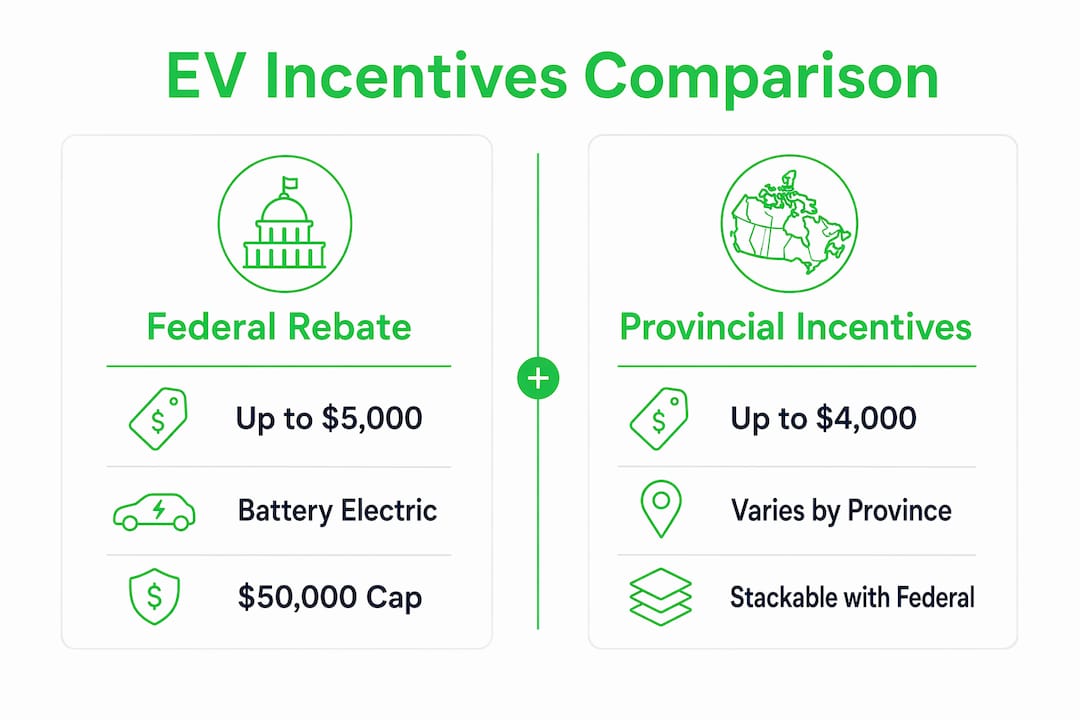
- Manitoba: up to $4,000, stackable with the federal $5,000
- Prince Edward Island: up to $4,000, stackable with the federal $5,000
- Quebec: $2,000 through the Roulez vert programme, ending december 31, 2026
For Toronto buyers in Ontario, the provincial picture is less favourable. Ontario does not currently offer a passenger EV rebate, which means the federal EVAP is your primary source of vehicle purchase savings. British Columbia, New Brunswick, Nova Scotia, Newfoundland, and Yukon have all paused or ended their passenger EV rebate programmes.
The practical implication is significant. Federal EVAP is now the foundation incentive for most Canadians, with provincial programmes increasingly unreliable. Buyers in Manitoba or PEI can combine incentives for up to $9,000 in total savings on a battery-electric vehicle. Ontario buyers should focus entirely on qualifying for the maximum federal rebate.
Pro Tip: Before you finalise your purchase date, check your province’s rebate status directly with the relevant ministry. Programmes can close when funds run out, sometimes with little advance notice.
What are the leasing rules and rebate calculations under EVAP?
Leasing qualifies for the federal rebate, but the amount you receive depends directly on how long your lease runs. Lease rebates are prorated based on lease duration, which surprises many buyers who assume a lease always earns the full incentive.
The rebate schedule for leased battery-electric vehicles is:
- 48 months or more: full $5,000 rebate
- 36 months: $3,750 rebate
- 24 months: $2,500 rebate
- 12 months: $1,250 rebate
Understanding lease term rebate proration is critical to avoid surprises and maximise your subsidy. A 36-month lease feels standard, but it costs you $1,250 compared to a 48-month term. Over the life of the lease, that difference is real money.
Dealerships apply the rebate at the point of signing, reducing your capitalised cost directly. You do not need to apply separately or wait for a cheque. The process is the same whether you are purchasing or leasing.
Pro Tip: If you are comfortable with a longer commitment, a 48-month lease earns you the full rebate and often comes with lower monthly payments. Run the numbers both ways before deciding.
How can Canadian buyers optimise their EV purchase to maximise rebates?
Getting the maximum rebate requires preparation before you walk into a dealership. The rules reward buyers who understand the details and negotiate accordingly.
-
Verify the final transaction value before signing. The final transaction price includes options and dealer fees. Ask for a full itemised breakdown and confirm the total stays at or below $50,000.
-
Ask about manufacturer discounts. Manufacturers like Kia and Toyota have applied strategic discounts to bring otherwise ineligible trims below the $50,000 cap. These discounts are designed specifically to unlock the full federal rebate for buyers.
-
Consider Canadian-made models. Vehicles assembled in Canada face no price cap under EVAP. If you want a premium EV, a Canadian-manufactured model gives you full rebate eligibility regardless of price.
-
Stack provincial incentives where available. If you are in Manitoba or PEI, combining the $4,000 provincial rebate with the $5,000 federal rebate delivers $9,000 in total savings. Ontario buyers should monitor provincial announcements for any new programmes.
-
Confirm fund availability at time of purchase. The EVAP has finite funding. Rebate amounts are scheduled to decrease annually starting in 2027, and the programme could exhaust funds before then. Buying sooner rather than later protects your access to the full incentive.
-
Work with a dealership that knows EVAP rules. Not every sales team is equally familiar with the programme’s eligibility details. A knowledgeable dealer can help you structure the deal correctly from the start.
Pro Tip: Individuals can only receive one federal EVAP incentive over five years. If you are planning a second EV purchase within that window, factor this limit into your household planning.
Key takeaways
The federal EVAP is the primary EV incentive for most Canadians in 2026, and the final transaction value, not MSRP, determines whether you qualify.
| Point | Details |
|---|---|
| Federal rebate amounts | Battery-electric and fuel cell vehicles receive up to $5,000; plug-in hybrids receive up to $2,500. |
| Final transaction value rule | The $50,000 cap includes options and dealer fees, not just the sticker price. |
| Canadian-made exemption | Vehicles assembled in Canada face no price cap and qualify for the full rebate at any price. |
| Lease proration | A 48-month lease earns the full rebate; shorter terms receive proportionally less. |
| Provincial stacking | Manitoba and PEI buyers can combine up to $4,000 provincial with $5,000 federal for $9,000 total. |
Why the EVAP shift matters more than most buyers realise
The move from MSRP to final transaction value is the single biggest change in Canadian EV incentives in years, and most buyers are not ready for it. I have seen deals fall apart at the last minute because a buyer added a paint protection package or a cargo liner and pushed the final price over $50,000. That is a $5,000 mistake for the sake of a $300 accessory.
The manufacturer discount angle is genuinely interesting. Kia and Toyota are not being generous out of goodwill. They are making a calculated decision that a manufacturer discount to unlock the federal rebate produces more sales volume than losing buyers to eligible competitors. That is worth knowing when you negotiate, because it means there is often room to push for a lower final transaction value even on popular models.
Provincial fragmentation is the trend I watch most closely. Ontario buyers have been without a provincial passenger EV rebate for years now. Quebec’s Roulez vert programme ends this december. The federal EVAP is increasingly carrying the full weight of EV incentive policy in Canada. That makes the programme’s finite funding a real risk. Rebates decrease starting in 2027, and if uptake is strong, funds could be exhausted before the scheduled end date.
My advice to any Toronto buyer is straightforward. Get your deal done in 2026, choose a 48-month lease or purchase, and strip out any optional add-ons that push you above the $50,000 threshold. The savings are real and the rules are clear. You just need to know them before you sit down at the desk.
— Hafiz
Ready to complete your EV setup after the rebate?
Claiming your federal rebate is step one. Getting a reliable Level 2 charger installed at home is what makes EV ownership practical every day. Evchargerinstallationtoronto provides ESA-licensed charger installations across the Greater Toronto Area, with transparent pricing starting from $1,800 and same-week booking available.
Use the free installation cost calculator to estimate your home setup costs before you finalise your EV budget. Evchargerinstallationtoronto also handles all permits and inspections at no extra charge, and the team can walk you through Ontario EV charger rebates that apply to your installation. With a 4.9 customer rating and installations completed within a few hours, the process is straightforward from start to finish.
FAQ
What is the maximum EV rebate available in Canada in 2026?
The federal EVAP offers up to $5,000 for battery-electric and fuel cell vehicles, and up to $2,500 for plug-in hybrids, applied directly at the point of sale by your dealership.
Does the $50,000 price cap apply to all electric vehicles?
The $50,000 final transaction value cap applies to imported vehicles. Vehicles manufactured in Canada are exempt from this cap and qualify for the full rebate regardless of price.
Can you stack a provincial rebate on top of the federal EV rebate?
Yes, in provinces where active rebates exist. Manitoba and Prince Edward Island each offer up to $4,000 stackable with the federal $5,000, for a combined total of up to $9,000.
How does leasing affect the federal EV rebate amount?
Lease rebates are prorated by term. A lease of 48 months or more earns the full rebate, while a 36-month lease earns $3,750 and a 24-month lease earns $2,500.
How do you apply for the federal EV rebate in Canada?
No separate application is required. Your dealership applies the rebate automatically at the point of sale, reducing the purchase or lease price directly.
Recommended
- EV Charger and Energy Rebates Ontario 2026 | EV Install Pro Toronto | EV Install Pro Toronto
- EV Charger Rebates York Region 2026 | Markham, Vaughan, Richmond Hill | EV Install Pro Toronto
- EV Charger Installation Cost in Toronto 2025: Complete Pricing Guide | EV Install Pro Toronto
- EV Charger Installation Cost Toronto 2026 | Full Breakdown + Rebates | EV Install Pro Toronto
Get Your Free Installation Quote
Free assessment · ESA permit included · Same-week availability across the GTA