GFCI breaker vs outlet: what homeowners should choose

For most homeowners, a GFCI outlet is the better starting point. It resets right at the wall, makes fault location obvious, and costs less per device. Choose a GFCI breaker when you need whole-circuit protection, have hardwired appliances with no accessible receptacle face, or are running a long branch circuit with multiple outlets that all need coverage.
- Prefer a GFCI outlet when protecting a bathroom, kitchen counter, or single outdoor location where the person using the space should also be the one resetting it.
- Prefer a GFCI breaker when protecting an entire circuit from the panel, covering hardwired equipment, or when tenant access to individual outlets is limited.
Both options deliver the same Class A personnel protection and can satisfy the Ontario Electrical Safety Code when correctly installed. The choice is about convenience and coverage, not about which one is safer.
Table of Contents
- How does a GFCI actually sense a fault?
- GFCI breaker vs outlet: side-by-side comparison
- Where do Canadian and Ontario rules require GFCI protection?
- What to expect when installing a GFCI outlet or breaker
- How to test your GFCI and when to replace it
- Which option fits your situation?
- GFCI protection for home EV chargers: notes from an Ontario installer
- Key takeaways
- What licensed electricians actually recommend
- Evchargerinstallationtoronto: licensed GFCI and EV charger installation in Toronto
- Useful sources and further reading
How does a GFCI actually sense a fault?
A GFCI monitors the current flowing out on the hot wire and compares it to the current returning on the neutral. Any imbalance means current is leaking somewhere it should not, possibly through a person. Class A devices trip at low leakage current levels and do so rapidly, well before a shock becomes dangerous.
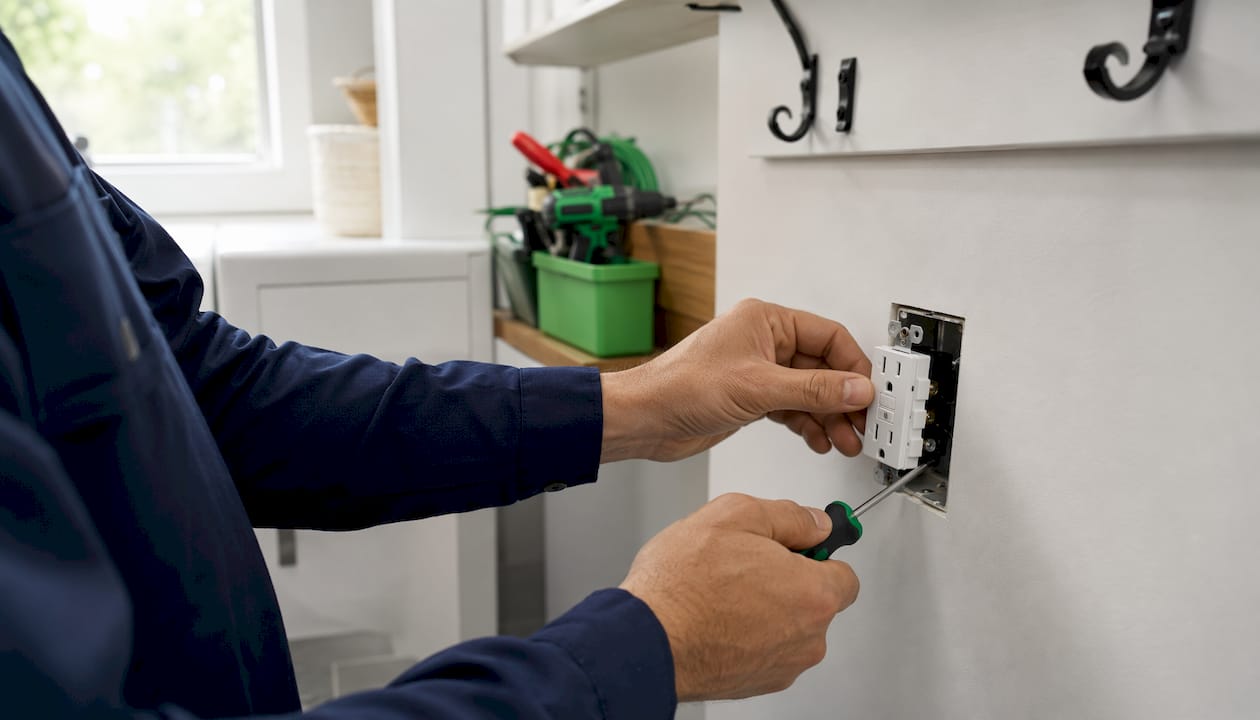
Where the sensing element sits changes everything after a trip. In a GFCI outlet, the sensing coil is inside the receptacle itself. When it trips, only that outlet and any downstream outlets wired through its LOAD terminals go dark. You reset it on the spot. In a GFCI breaker, the sensing coil is inside the panel. When it trips, the entire branch circuit loses power and you must go to the panel to reset it.
A GFCI outlet wired through its LOAD terminals can protect every downstream receptacle on that branch, but it does not protect the wiring between itself and the panel. A GFCI breaker protects the full circuit, including that upstream wiring run.
GFCI breaker vs outlet: side-by-side comparison
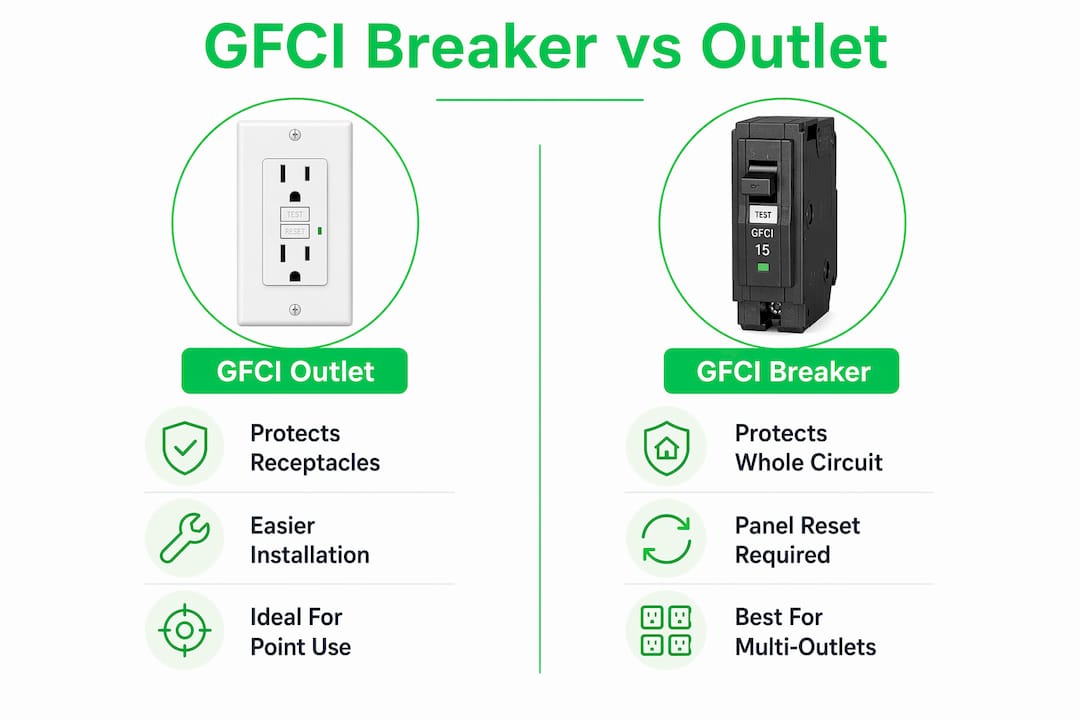
The table below covers the dimensions that matter most to a homeowner making this decision.
| Dimension | GFCI outlet | GFCI breaker |
|---|---|---|
| What it protects | The receptacle itself plus downstream outlets (via LOAD wiring) | Every outlet and load on the entire branch circuit |
| Reset location | Right at the wall receptacle | At the electrical panel |
| Fault localisation | Trip is visible at the outlet; easy to identify which circuit segment faulted | Whole circuit goes dark; fault could be anywhere on the branch |
| Installation complexity | Fits in existing box; no panel access needed | Requires panel access; must match panel brand and bus bar type |
| Typical cost per device | Lower per unit | Higher per unit; one breaker can cover multiple outlets |
| Best-for use cases | Bathrooms, kitchens, single outdoor outlets, retrofits | Hardwired appliances, long multi-outlet runs, pools, hot tubs |
| Maintenance/lifespan | Test monthly; self-test on modern units; replace if lockout occurs | Test monthly via panel button; same self-test standard applies |
| Code/compliance (Ontario) | Satisfies OESC when correctly installed and labelled | Satisfies OESC when correctly installed and matched to panel |
Pros and cons for homeowners
GFCI outlet
- Lower upfront cost per protected location
- Resets at the wall — no trip to the panel
- Clear fault localisation; you know exactly which outlet or downstream chain tripped
- Works in ungrounded older homes when labelled “NO EQUIPMENT GROUND GFCI PROTECTED”
- Requires box depth to accommodate the device; shallow boxes may need a slim-profile model such as Leviton SmartlockPro
GFCI breaker
- Protects every outlet and hardwired load on the circuit from one device
- Useful when individual outlets are behind appliances or otherwise inaccessible
- Higher per-unit cost, though one breaker covering six outlets can be cheaper than six individual receptacles
- Must be compatible with your panel brand (Square D QO, Homeline, Eaton BR, Siemens, etc.)
- A trip cuts all power on the branch, which can be disruptive in a kitchen or workshop
Pro Tip: If the person who will reset the device after a trip is the same person using the outlet, put the protection at the outlet. If that person cannot or should not access the panel, a GFCI breaker is the right call every time.
On long branch circuits with many loads, accumulated leakage current from multiple appliances can make a single upstream breaker more prone to nuisance trips. Distributed point-of-use outlets reduce that cumulative leakage and make it far easier to trace which device caused the fault.
Where do Canadian and Ontario rules require GFCI protection?
The Canadian Electrical Code (CEC) and the Ontario Electrical Safety Code (OESC) mandate ground-fault protection in locations where water and electricity are likely to be in close proximity. The following locations are commonly required:
- Bathrooms (all receptacles)
- Kitchen counter-area receptacles within a specified distance of a sink
- Garages and carports
- Outdoor receptacles
- Unfinished basements and crawl spaces
- Laundry areas
- Near pools, hot tubs, and spas
- Boathouses and similar structures near water
Both a GFCI breaker and a GFCI outlet can satisfy these requirements when installed correctly. The code does not mandate one form over the other for most residential applications.
Permit requirements in Ontario apply to most electrical work beyond simple receptacle replacement. When in doubt, contact the ESA or a licensed electrician before you begin.
What to expect when installing a GFCI outlet or breaker
GFCI outlet installation checklist
- Confirm box depth: standard GFCI receptacles are deeper than regular outlets; Leviton SmartlockPro slim models fit shallower boxes
- Identify LINE and LOAD terminals correctly; miswiring LINE and LOAD prevents protection from working
- In an ungrounded older home, use the supplied “NO EQUIPMENT GROUND GFCI PROTECTED” sticker on the receptacle
- Turn off the breaker and confirm power is off with a non-contact tester before touching any wires
- A competent DIYer can replace a single receptacle; if you are unsure, hire a licensed electrician
GFCI breaker installation checklist
- Confirm the breaker is compatible with your panel brand and bus bar type before purchasing
- Check available panel space; GFCI breakers are typically the same width as standard breakers but some dual-function models (CAFCI + GFCI, such as Square D QO Dual Function) occupy one slot
- Identify multi-wire branch circuits (two hots sharing one neutral); these require a two-pole GFCI breaker or a different protection strategy
- Panel work must be done by a licensed electrician. The main bus bar carries live voltage even when the main breaker is off.
- An ESA permit is required for breaker replacement in Ontario
Pro Tip: Buy modern, listed GFCI devices manufactured after 2015. Self-test functionality is standard on current products, which means the device checks itself automatically and locks out the reset button if it detects an internal failure. Older devices can fail silently.
Typical cost ranges vary by project. A single GFCI outlet replacement is a short job; a licensed electrician in the Greater Toronto Area typically charges for a service call plus labour. A GFCI breaker swap at the panel takes longer because of permit and inspection requirements. One breaker protecting six outlets on a circuit can cost less in total than six individual receptacles plus labour, so get a quote for the full project before deciding.
How to test your GFCI and when to replace it
Testing takes less than a minute and should be done monthly.
- Plug a lamp or small device into the GFCI outlet (or into a downstream outlet if testing a breaker-protected circuit).
- Press the TEST button on the outlet or breaker. The device should trip and the lamp should go off.
- Press the RESET button. The lamp should come back on.
- If the lamp does not go off when you press TEST, the device has failed and must be replaced immediately.
- If the RESET button will not stay in, the device may have reached end-of-life or may be miswired.
Modern GFCI devices manufactured after 2015 include automatic self-test circuitry that runs in the background. If the self-test detects an internal fault, the device locks out the reset button to signal that it needs replacement. This lockout is a safety feature, not a malfunction.
Maintenance schedule:
- Test manually every month
- Replace any device that fails the TEST/RESET sequence
- Replace devices that lock out and will not reset after a power cycle
- Replace any GFCI that is more than 10 years old as a precaution, even if it appears to pass the manual test
Never perform any work inside the electrical panel yourself. The main bus bar remains live even with the main breaker off. Panel testing and breaker replacement require a licensed electrician and, in Ontario, an ESA permit.
Which option fits your situation?
Bathroom
A GFCI outlet at the first receptacle, wired to protect downstream outlets via the LOAD terminals, is the standard approach. Reset is convenient, fault location is obvious, and the cost is low. Recommendation: GFCI outlet.
Kitchen counter
Counter-area receptacles near sinks require GFCI protection under the OESC. Individual GFCI outlets at each counter location give you precise fault localisation and easy reset without losing power to the whole kitchen. Recommendation: GFCI outlet.
Garage and outdoor outlets
Either option works. If you have several outdoor or garage outlets on one circuit, a single GFCI breaker at the panel covers them all and avoids multiple outlet replacements. If you only have one or two locations, individual outlets are simpler and cheaper.
Recommendation: GFCI breaker for multi-outlet circuits; GFCI outlet for one or two locations.
Unfinished basement
A GFCI breaker protecting the entire basement circuit is practical when outlets are spread across a large area or behind storage. It also covers any hardwired loads such as a sump pump or dehumidifier. Recommendation: GFCI breaker.
Pool or hot tub
Pools and hot tubs require dedicated circuits with specific protection levels under the CEC and OESC. A GFCI breaker on the dedicated circuit is the standard approach, and this work must be done by a licensed electrician with an ESA permit. Recommendation: GFCI breaker, installed by a licensed electrician.
Hardwired appliances
For any appliance with no accessible receptacle face, a GFCI breaker is the only practical option. There is no outlet to reset, so upstream breaker-side protection is the correct solution. Recommendation: GFCI breaker.
EV charger
See the section below for EV-specific notes.
One important caution across all scenarios: avoid installing both a GFCI breaker and a GFCI outlet on the same circuit. Redundant protection causes nuisance trips and makes it much harder to identify the original fault. Pick one form of protection per circuit and stick with it.
GFCI protection for home EV chargers: notes from an Ontario installer
Level 2 EV chargers (240V, typically 32A–48A) present specific considerations that differ from standard 120V GFCI applications.
- Most Level 2 chargers are hardwired or use a NEMA 14-50 receptacle on a dedicated 240V circuit. There is no standard GFCI outlet at 240V for residential use, so protection, when required, comes from the breaker side.
- The CEC and OESC do not universally require Class A GFCI protection on all EV charger circuits, but some installations, particularly in garages with concrete floors or near water, may trigger GFCI requirements under the AHJ’s interpretation. Your licensed electrician will confirm what applies to your specific installation.
- Ground-fault protection for equipment (GFPE, 30 mA) differs from personnel protection (Class A, 4–6 mA). Some EV charger manufacturers specify which type is acceptable; check the charger’s installation manual before specifying protection.
- In Ontario, every EV charger installation requires an ESA permit. The permit process includes an inspection that confirms the circuit, breaker, and any required protection devices are correctly installed.
- Panel capacity matters. A 100A panel serving a full household load may not have room for a 40A or 50A EV charger circuit without a panel upgrade. Smart load management systems such as EVEMS/DCC-12 can sometimes avoid a full upgrade by dynamically sharing available capacity.
Pro Tip: If your panel is already near capacity, ask your electrician about smart load management before committing to a panel upgrade. It can reduce installation cost significantly while keeping your EV charger on a protected, dedicated circuit.
Municipal variances in the Greater Toronto Area mean that what applies in one neighbourhood may differ slightly in another. Always confirm requirements with the licensed electrician handling your permit.
Key takeaways
A GFCI outlet is the right choice for most point-of-use locations; a GFCI breaker is the right choice when whole-circuit or hardwired protection is needed, and panel work always requires a licensed electrician.
| Point | Details |
|---|---|
| Protection level is equal | Both GFCI outlets and GFCI breakers deliver Class A protection in the 4–6 mA trip range. |
| Reset location drives the decision | Choose an outlet when the user needs to reset it on the spot; choose a breaker for hardwired or multi-outlet circuits. |
| Never stack both on one circuit | Installing a GFCI breaker and a GFCI outlet on the same circuit causes nuisance trips and complicates fault tracing. |
| Test monthly, replace on lockout | Press TEST, confirm power cuts, press RESET; replace any device that fails or locks out permanently. |
| Evchargerinstallationtoronto handles EV circuits | For EV charger GFCI strategy, panel upgrades, and ESA permits in the Greater Toronto Area, Evchargerinstallationtoronto provides licensed installation with permit handling included. |
What licensed electricians actually recommend
The conventional framing of this debate treats it as a cost question. It is not. The real question is: who needs to reset the device, and where are they when it trips?
In tenant-occupied homes and rental units, putting the reset at the panel is a practical problem. A tenant who loses power to a bathroom outlet at midnight should not need panel access to restore it. A GFCI outlet at the wall solves that immediately. For owner-occupied homes where the panel is accessible and clearly labelled, a breaker protecting a whole circuit is a perfectly reasonable choice, especially for garages, basements, and outdoor circuits where multiple outlets share a run.
The one recommendation I give consistently: never combine both on the same circuit. The nuisance trip problem is real, and more importantly, when two GFCI devices are stacked on the same circuit, a trip at the breaker tells you nothing about where the fault actually is. You end up resetting the breaker, walking the circuit, and still not knowing which outlet or appliance caused the problem. One form of protection per circuit keeps troubleshooting straightforward.
For hardwired equipment, the answer is almost always a breaker. There is no outlet face to reset, so point-of-use protection is not an option. EV chargers, pool equipment, and hardwired bathroom fans all fall into this category.
Evchargerinstallationtoronto: licensed GFCI and EV charger installation in Toronto
Choosing the right GFCI protection is straightforward once you know the circuit. Getting it installed correctly, permitted, and inspected is where a licensed electrician makes the difference, particularly for panel-side work and EV charger circuits.

Evchargerinstallationtoronto’s team of ESA-licensed electricians handles the full scope: GFCI breaker installation, panel upgrades for EV charger circuits, ESA permit applications, and inspections, all included in a single quoted price. Installations across the Greater Toronto Area are typically completed within a few hours, with same-week booking available. Pricing for EV charger installations starts from $1,800, and the team manages Ontario rebate applications worth up to $5,000 at no extra charge.
Use the free cost calculator to get an estimate for your installation, or book a free assessment to confirm which GFCI strategy fits your panel and circuit. Panel work is not a DIY project in Ontario; an ESA permit and licensed electrician are required, and municipal rules vary across the GTA.
Useful sources and further reading
When verifying GFCI requirements for your home or speaking with an electrician, the following official and manufacturer sources are the most reliable references.
- Electrical Safety Authority (ESA) Ontario — permit requirements, licensed contractor lookup, and the Ontario Electrical Safety Code
- Canadian Electrical Code (CEC), CSA Group — the national standard that the OESC is based on
- CPSC GFCI fact sheet — consumer guidance on receptacle and breaker-type GFCIs, installation safety, and labelling for ungrounded circuits
- Leviton GFCI Buyer’s Guide — product selection, slim-fit models, and lockout features for retrofit work
- ABB Electrification GFCI self-test product page — self-test functionality, LED diagnostics, and amp ratings
- Square D QO/Homeline Dual Function Breaker documentation — CAFCI + GFCI combination breaker specs and panel compatibility
What to bring when consulting an electrician or the AHJ:
- Your panel brand and model number (printed on the inside door)
- A rough circuit map showing which outlets share which breaker
- A list of the locations where you want GFCI protection
- The age of your home and whether circuits are grounded or ungrounded
Recommended
- Tesla Wall Connector Gen 3 vs Gen 2: Which Should You Install? (2026) | EV Install Pro Toronto
- Do I Need a Panel Upgrade for an EV Charger in Ontario? (2026 Guide) | EV Install Pro Toronto
- Tesla Wall Connector Installation Toronto | Certified Installer | EV Install Pro | EV Install Pro Toronto
- 200 Amp Panel Upgrade in Etobicoke | Licensed ESA Electrician | EV Install Pro Toronto
Get Your Free Installation Quote
Free assessment · ESA permit included · Same-week availability across the GTA