NACS vs CCS: the 2026 Canadian EV charging guide

How NACS and CCS compare for Canadian EV owners
NACS is the better choice for most new Canadian EVs in 2026. It is lighter, more ergonomic, and backed by a network with uptime over 99.5%, compared to the 70% to 85% uptime typical of fragmented CCS networks. CCS still matters for older vehicles and established public infrastructure, but its role is shifting to legacy support.
| Feature | NACS (SAE J3400) | CCS1 |
|---|---|---|
| Connector design | Compact 5-pin, single AC/DC port | Bulky “sandwich,” separate AC/DC pins |
| Weight | Under 1 lb | About 2 lbs |
| Max power | Up to 1 MW | Up to 350 kW |
| Uptime | >99.5% (Tesla network) | 70%–85% |
| Adapter support | Official NACS-to-CCS adapters available | Limited CCS-to-NACS options |
| Canadian market status | Emerging standard for new EVs | Legacy standard for pre-2025 vehicles |
| Best for | New EV buyers, future-proofing | Legacy CCS vehicles, rural CCS networks |
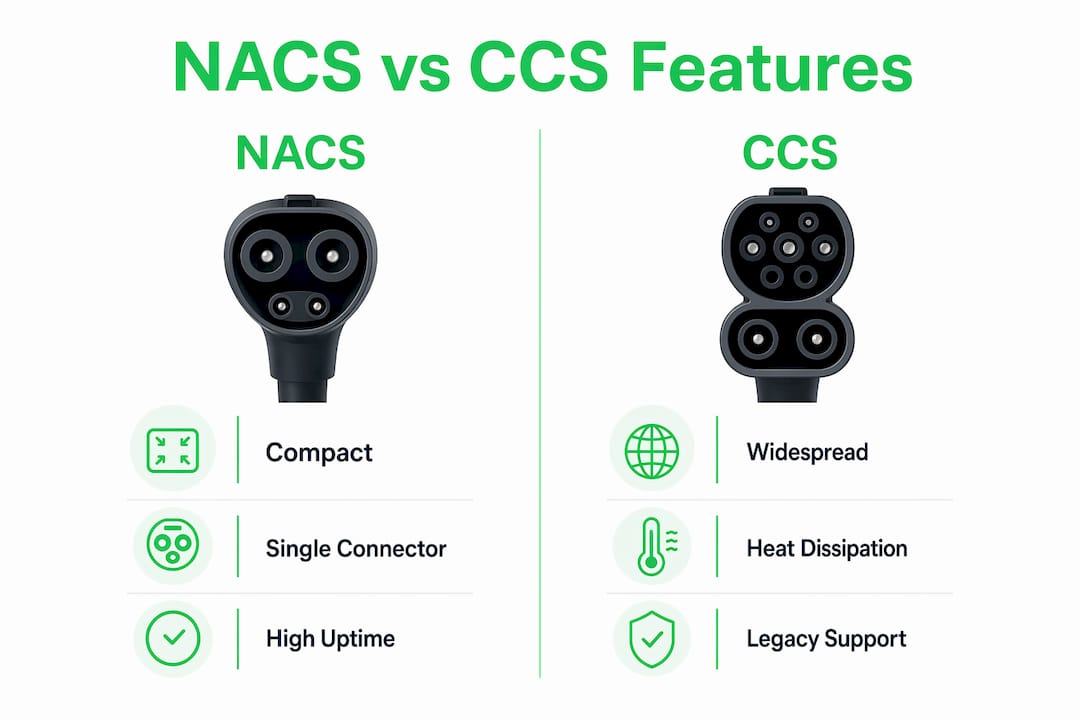
NACS advantages: compact design, single connector for AC and DC, high network uptime, lighter cable, growing automaker adoption.
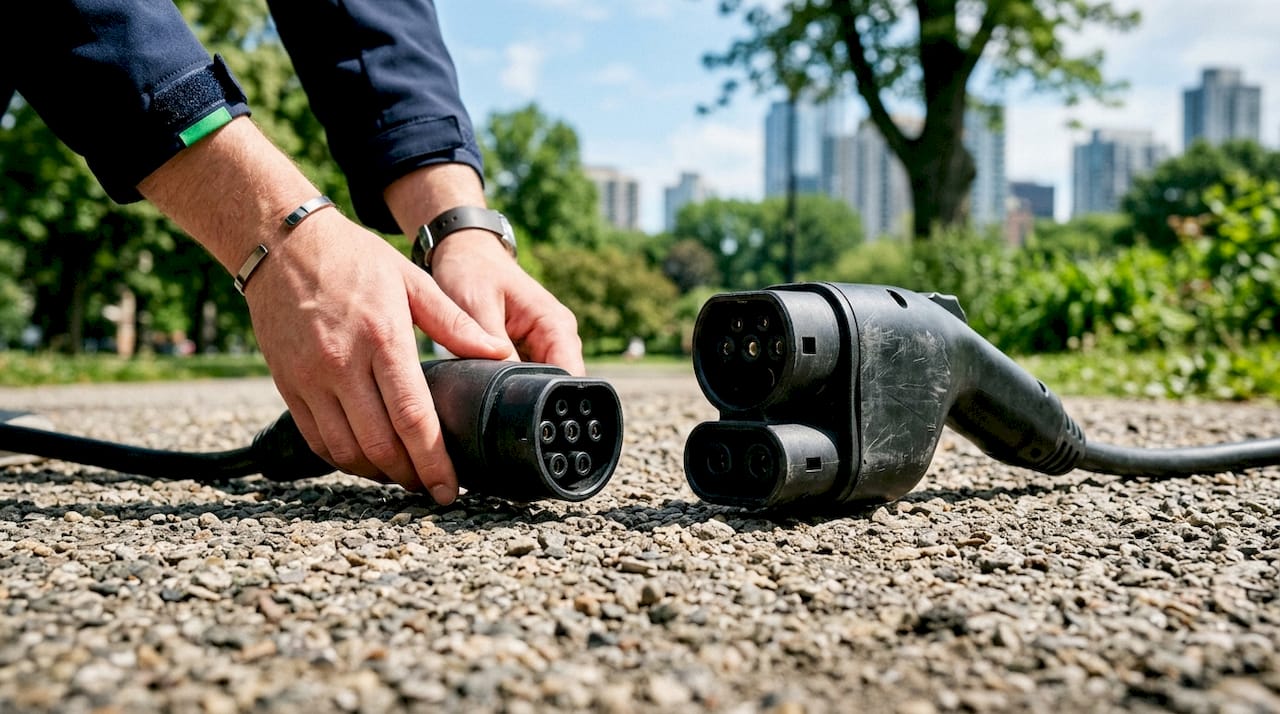
CCS advantages: widespread legacy infrastructure, natural heat dissipation at moderate power, no adapter needed for pre-2025 vehicles.
What is NACS and why is it taking over?
NACS, now formally standardised as SAE J3400, started as Tesla’s proprietary connector and became an open industry standard in 2023. Every major automaker selling EVs in Canada, including Ford, GM, Hyundai, Kia, and Rivian, has committed to NACS ports on 2025 and newer models.
Key facts about NACS:
- Single 5-pin connector handles both Level 2 AC and DC fast charging
- Weighs under 1 lb, making cold-weather handling noticeably easier
- Vehicle-side locking mechanism with no moving parts on the handle
- Supports voltages from 400V to 1,000V without speed penalties
- Plug & Charge via ISO 15118 protocol: plug in and billing starts automatically
What is CCS and who still uses it?
CCS (Combined Charging System) has been the default for non-Tesla EVs in Canada since the early 2010s. The North American variant, CCS1, adds two large DC pins below a standard J1772 AC connector, creating a two-piece “combo” plug. Most EVs sold in Canada between 2017 and 2024 use CCS1.
Key facts about CCS:
- Bulkier two-piece design weighing about 2 lbs
- Plastic latch on the handle side, prone to breaking in cold Canadian winters
- Supports up to 350 kW DC fast charging
- Still deployed at many public stations across Ontario
- Fragmented network experience requiring apps or RFID cards at most stations
Technical differences between NACS and CCS
The physical gap between these two connectors is bigger than most people expect. NACS weighs under 1 lb versus CCS1’s roughly 2 lbs, and that difference is felt immediately on a cold Toronto morning when cables stiffen.
On power delivery, NACS’s SAE J3400 standard supports up to 1 MW theoretically, well beyond CCS1’s 350 kW ceiling. For thermal management, the two standards take opposite approaches: NACS uses aggressive liquid cooling to keep its small pins from overheating at high currents, while CCS relies on passive heat dissipation through its larger pin surface area at moderate power levels. Above 350 kW, CCS also requires active cooling, which adds cable bulk.

Communication is another gap. NACS stations using ISO 15118 deliver a true Plug & Charge experience: the vehicle authenticates and billing starts without an app or card. Many CCS networks still require separate authentication steps, contributing to the lower uptime figures.
Pros and cons of NACS and CCS
NACS pros:
- Compact and lightweight, easier to handle in winter
- Single connector for both home Level 2 and public DC fast charging
- Network uptime above 99.5% on the Tesla Supercharger network
- Plug & Charge support eliminates apps and RFID cards
- Growing to support up to 1 MW for future heavy-duty vehicles
NACS cons:
- Relies on liquid cooling; thermal throttling can occur at peak loads
- Official OEM adapters required for CCS stations; third-party adapters risk warranty issues
- Adapter ecosystem still maturing for some vehicle brands
CCS pros:
- Passive heat dissipation works well at moderate charging speeds
- Massive legacy infrastructure across Ontario and Canada
- No adapter needed if you own a pre-2025 non-Tesla EV
CCS cons:
- Heavy, stiff cables become worse in cold weather
- Fragile handle-side plastic latch is the leading cause of charger downtime
- Fragmented network experience with inconsistent app and card requirements
- 350 kW power ceiling limits future scalability
Where NACS and CCS are used across Canada
Most new Canadian EVs now ship with NACS ports. CCS remains dominant on vehicles sold before 2025 and on a large portion of existing public charging infrastructure, particularly outside major urban centres.
In Ontario and Toronto specifically:
- Tesla Supercharger stations are NACS-native and widely distributed across the GTA
- Park+Charge locations at Loblaws stores across Ontario support NACS, CCS, and CHAdeMO
- SWTCH Charging Station deploys Level 2 and DC fast chargers at multifamily and workplace properties, supporting both standards
- Government programmes, including federal ZEVIP funding, have accelerated public charger deployment across the province
The adapter period is not short-term. Property managers and homeowners should plan for dual-standard support over the coming decade, as millions of CCS vehicles remain on Canadian roads. Ontario’s EV charger rebates can offset the cost of installing flexible dual-standard home units.
Toronto EV charging providers: NACS and CCS support compared
Six providers serve Toronto EV drivers across both standards. Their connector support, pricing, and accessibility vary considerably.
| Provider | Connector support | Charging speed | Pricing | Location | Rating |
|---|---|---|---|---|---|
| SWTCH Charging Station | CCS, NACS, Level 2 | Level 2 + DC fast | Not publicly listed | Multifamily, workplace, public | 4.1★ (13) |
| Tesla Supercharger | NACS native | Up to 350 kW | Per kWh via Tesla app | GTA-wide network | 3.2★ (12) |
| Tesla Destination Charger | NACS native | Level 2 AC | Varies by location | Hotels, restaurants | 3.2★ (12) |
| Park+Charge | NACS, CCS, CHAdeMO | Up to 150 kW | $0.47–$0.62/min + $1 fee + HST | Loblaws Ontario | 3.7★ (9) |
| EVC Canada Charging Station | CCS, NACS | DC fast | Not publicly listed | Toronto public locations | 2.7★ (6) |
| EV Connect Charging Station | CCS, NACS | DC fast | Not publicly listed | Toronto urban | 2.7★ (6) |
SWTCH Charging Station is the strongest option for property managers. Its OCPP-certified platform handles automated load management and billing, making it well suited to condos and workplaces where multiple vehicles charge simultaneously. The 24/7 maintenance support is a practical differentiator for building operators.
Tesla Supercharger delivers the most consistent fast-charging experience for Tesla owners and NACS-native EVs, with network uptime exceeding 99.5%. CCS vehicle owners can access select Magic Dock sites, though coverage is limited.
Park+Charge stands out for its no-app approach and transparent per-minute pricing: $0.47/min up to 50 kW, $0.54/min up to 100 kW, and $0.62/min up to 150 kW, plus a $1 connection fee and HST. It supports all three major connector types, making it the most accessible option for mixed-fleet retail charging in Ontario.
Tesla Destination Charger suits Tesla owners who want overnight or extended AC charging at hotels and restaurants. It is NACS-only, so CCS vehicle owners need an adapter.
EVC Canada and EV Connect both offer public multi-standard access in Toronto. Neither publishes detailed pricing or certifications publicly, so they are best treated as general-access options rather than primary charging destinations.
Which standard is better for Canadian EV owners?
NACS is the right choice for anyone buying a new EV in Canada today. The combination of lighter hardware, higher network uptime, Plug & Charge convenience, and a clear industry trajectory toward SAE J3400 makes it the practical standard for 2026 and beyond.
CCS remains relevant in two specific situations: you already own a pre-2025 non-Tesla EV, or you regularly drive routes where CCS infrastructure is denser than NACS coverage. For home charging on a Ford F-150 Lightning or similar NACS-native vehicle, the case for NACS is straightforward.
Key guidance:
- New EV buyers: choose a NACS-native model and a home charger that supports it natively
- Pre-2025 CCS owners: get your automaker’s official NACS adapter to access Supercharger networks
- Never use third-party adapters on the Tesla Supercharger network; Tesla’s terms prohibit them and firmware can block access mid-session
How to future-proof your EV charging setup in Canada
The transition from CCS to NACS will take years, not months. Planning now saves money and avoids hardware replacements later.
- Choose a home charger with field-swappable cables; many Toronto units already support both NACS and CCS plugs without replacing the entire unit
- If you manage a condo or multi-unit property, install a dual-standard unit or an OCPP-certified platform like SWTCH that can be updated remotely
- Confirm your automaker’s official adapter programme before purchasing any third-party adapter
- Use apps like the Tesla app or PlugShare to locate NACS and CCS stations before long trips
- Check available Ontario EV rebates before committing to a home charger model; incentives can cover a meaningful portion of installation costs
Pro Tip: Always use your vehicle manufacturer’s official NACS-to-CCS adapter. Third-party adapters can throttle charging speeds, trigger communication errors, and void your vehicle warranty. If your automaker offers a free adapter during the transition period, claim it immediately.
For off-grid or backup-power homes, confirm that your home energy system can supply sufficient amperage for a Level 2 NACS charger before installation.
What licensed Toronto installers say about NACS vs CCS
ESA-licensed electricians working on Toronto home installations consistently recommend NACS-compatible units for new builds and upgrades. The reasoning is practical: NACS connectors require less panel capacity for the same charging speed, and the lighter cable reduces wear on the wall outlet over time.
- Panel requirements: A standard 240V, 40-amp circuit handles most NACS Level 2 chargers. CCS installations for higher-power units sometimes require a 50-amp or 60-amp circuit, adding to panel upgrade costs.
- Permit and inspection process: Both standards require an ESA permit in Ontario. The process is identical regardless of connector type, but choosing a licensed installer who handles permits directly saves time and avoids compliance issues.
- Cost transparency: Home EV charger installation in Toronto typically starts from $1,800 for a straightforward installation. Panel upgrades, if needed, add to that figure.
Choosing an ESA-licensed installer is not optional in Ontario. It is a legal requirement, and it protects your home insurance coverage and your vehicle warranty.
Key takeaways
NACS is the preferred standard for new Canadian EVs in 2026, offering lighter hardware, higher network uptime, and a clear industry trajectory, while CCS remains essential for legacy vehicles and existing public infrastructure.
| Point | Details |
|---|---|
| NACS weight advantage | NACS weighs under 1 lb vs CCS1’s roughly 2 lbs, a real difference in cold Canadian winters. |
| Network uptime gap | Tesla’s NACS network exceeds 99.5% uptime; CCS networks average 70%–85% across North America. |
| Adapter rules matter | Only use your automaker’s official adapter; third-party adapters can void warranties and block Supercharger access. |
| Dual-standard planning | The adapter transition will span a decade; install field-swappable or dual-standard home chargers now. |
| Evchargerinstallationtoronto | ESA-licensed home installations begin at a few thousand dollars, with permit handling included and rebates available to support installation costs for Toronto homeowners. |
Your home NACS or CCS charger, installed right in Toronto
If you are ready to install a home charger that works with your EV today and the next one you buy, Evchargerinstallationtoronto offers a straightforward path. Unlike choosing a public network and hoping for uptime, a home installation gives you reliable overnight charging on your schedule.
Evchargerinstallationtoronto’s ESA-licensed electricians handle the full process: permit applications, inspections, and rebate paperwork worth up to $5,000, all included in the service. Installations typically complete within a few hours, and same-week bookings are available. Pricing starts from $1,800 with no hidden fees. Use the free installation cost calculator to get a transparent estimate for your home before you book.
Recommended
- EV Charger Guides & Blog | EV Install Pro Toronto | EV Install Pro Toronto
- EVEMS vs Panel Upgrade Toronto: Which Do You Actually Need for EV Charging? (2025) | EV Install Pro Toronto
- EV Charger Installation in a Toronto Condo or Apartment: The Complete 2025 Guide | EV Install Pro Toronto
- Best Home EV Charger for Kia EV6 in Toronto (2025 Guide) | EV Install Pro Toronto
Get Your Free Installation Quote
Free assessment · ESA permit included · Same-week availability across the GTA