Off-peak EV charging in Ontario: how to cut your costs
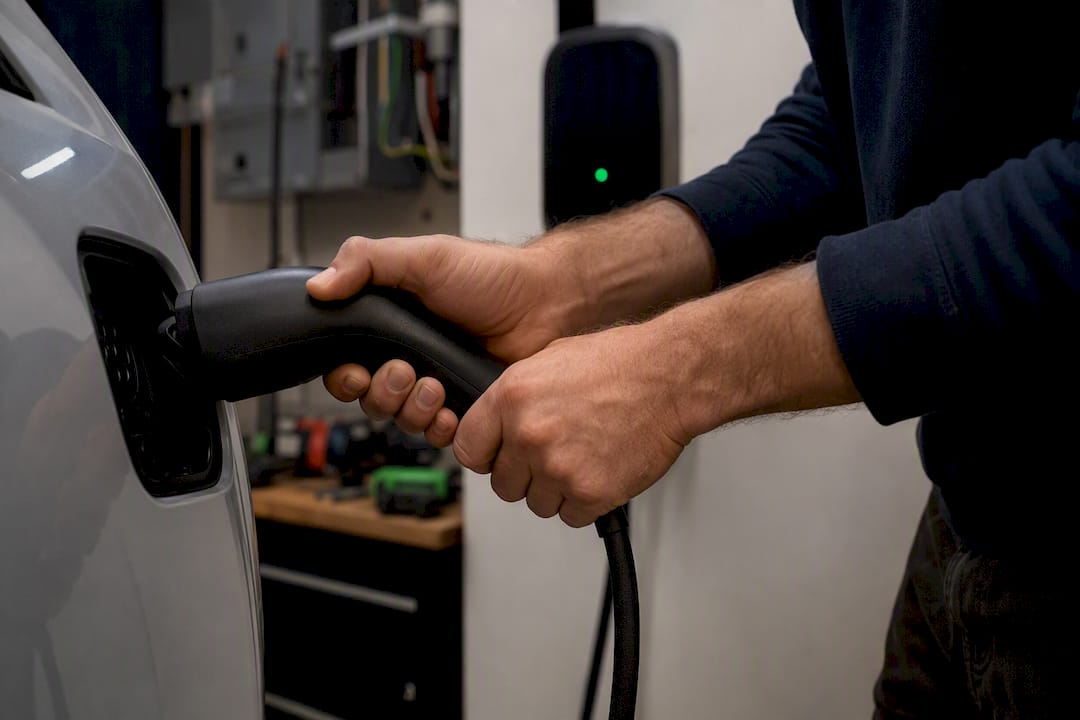
Schedule most of your charging between 11 p.m. and 7 a.m. and pair it with a smart charger or load management system, and you can significantly reduce your per-kWh electricity cost compared with charging on-peak. That’s the entire strategy behind off-peak EV charging in Ontario, and most homeowners can act on it this week.
Here’s what to do right now:
- Check your smart meter app or utility bill for your overnight usage pattern and current rate plan.
- Confirm your vehicle or charger has a delay-start or scheduling feature, and set it to begin after 11 p.m.
- Book an ESA-licensed electrician for a load assessment if you’re unsure whether your panel can handle a Level 2 charger.
The core math: Ontario’s Ultra-Low Overnight plan prices electricity at 3.9 cents per kWh overnight versus 39.1 cents on-peak, a tenfold difference. Get the timing right and the savings show up on your very first bill.
Key Takeaways
Scheduling EV charging into off-peak windows like Ontario’s 11 p.m. to 7 a.m. ULO period, combined with a smart charger or EVEMS, cuts charging costs dramatically without requiring a panel upgrade in most homes.
| Point | Details |
|---|---|
| ULO offers the steepest discount | Overnight rates of 3.9 cents per kWh compare with 39.1 cents on-peak, a tenfold spread. |
| EVEMS often replaces upgrades | Load management can keep calculated load within an existing 100A panel’s limits. |
| Assessment comes before spending | An ESA-licensed load assessment reveals whether you truly need a 200A service. |
| Timing precision matters | Set schedules with a buffer so charging doesn’t spill into mid-peak or on-peak hours. |
| Evchargerinstallationtoronto handles the full process | ESA-licensed electricians, pricing from $800, rebate handling up to $5,000, and a 4.9 rating. |
Table of Contents
- What off-peak EV charging actually means in Ontario
- Smart charging options: timers, smart chargers, and EVEMS
- Do you actually need a panel upgrade?
- How to match your rate plan and schedule to real savings
- What installation actually involves: permits, timeline, and cost
- Seven steps to start off-peak charging this week
- What homeowners get wrong about panel upgrades
- Skip the guesswork with a licensed load assessment
- Frequently asked questions
- Sources
What off-peak EV charging actually means in Ontario
Ontario’s electricity plans split the day into pricing windows, and knowing which one you’re on determines whether off-peak charging saves you real money or barely moves the needle. Time-of-Use (TOU) plans charge different rates for off-peak, mid-peak, and on-peak hours, with off-peak rates applying overnight and on weekends under Ontario Energy Board rules. Tiered plans, by contrast, charge one flat rate up to a monthly threshold regardless of when you use power.
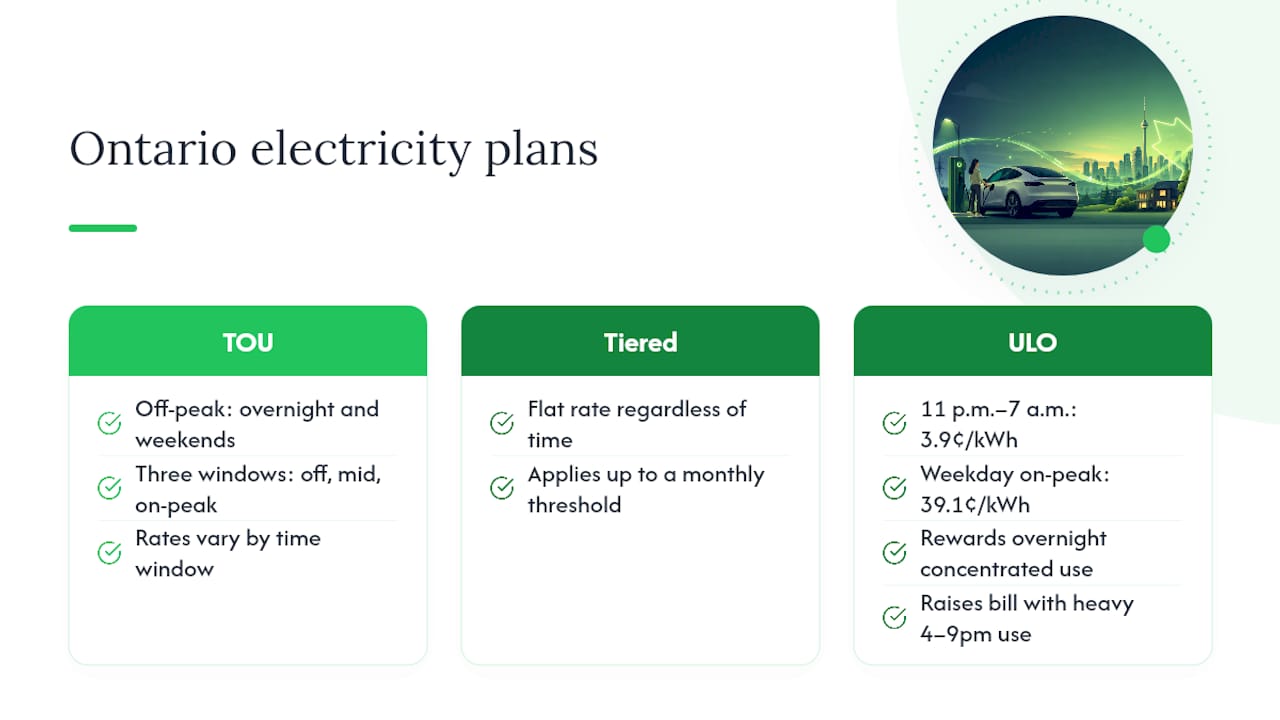
The newer option, Ultra-Low Overnight (ULO), goes further. It carves out an 11 p.m. to 7 a.m. window priced at 3.9 cents per kWh, a rate the government designed specifically to support EV adoption by lowering overnight charging costs. The tradeoff: weekday on-peak jumps to 39.1 cents.
Pro Tip: ULO rewards households that concentrate charging, laundry, and dishwashing overnight. If your household uses the stove, dryer, or heat pump heavily between 4 and 9 p.m., that same plan can quietly raise your bill rather than lower it.
Smart charging options: timers, smart chargers, and EVEMS
Not every home needs the same level of technology to hit off-peak windows. Three tiers exist, and picking the right one depends on your panel capacity and how many devices you’re trying to coordinate.
- Vehicle timer: Built into most EVs, free to use, but it only controls the car and can’t respond to what else is drawing power in the house.
- Standalone smart charger: Adds app-based scheduling, remote monitoring, and sometimes basic amperage limiting, typically for a few hundred dollars more than a non-networked unit.
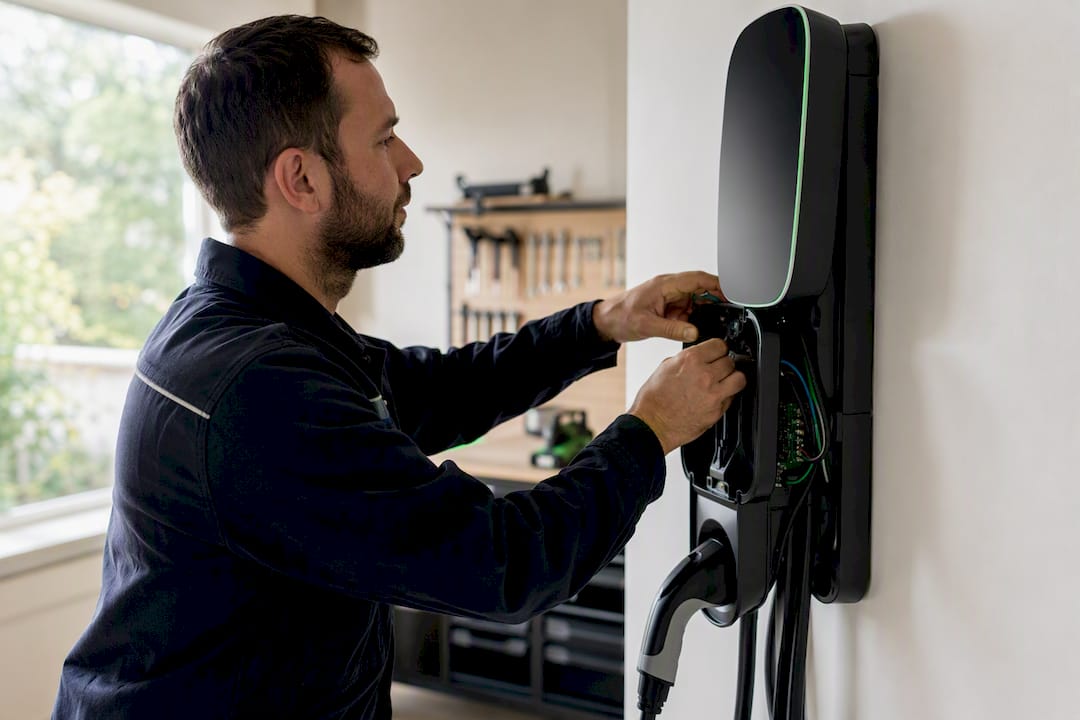
- EVEMS (EV energy management system): Coordinates the charger with your whole electrical panel using current transformers, dynamically throttling output so your total home load never exceeds a safe ceiling.
| Option | Cost tier | Load coordination | Avoids panel upgrade |
|---|---|---|---|
| Vehicle timer | Lowest | None | Rarely |
| Smart charger | Moderate | Charger only | Sometimes |
| EVEMS | Higher upfront | Whole-panel | Often |
Pro Tip: A standalone smart charger is usually enough if you live alone or your household rarely runs multiple large appliances at once. If you’ve got a heat pump, an electric dryer, and an EV all competing for amps, an EVEMS setup earns its cost back fast by letting you skip a service upgrade entirely.
Do you actually need a panel upgrade?
This is where most homeowners overspend. Electricians calculate your home’s “calculated load,” the sum of everything your panel is rated to support at once, and a 100A or 125A service often has more headroom than owners assume once a charger is added on top of existing appliances.
The Canadian Electrical Code allows load management systems to change that calculation. Under the provisions Eaton documents in its EVEMS technical guidance, an EVEMS-controlled charger’s calculated load equals the maximum the EVEMS allows it to draw, not the charger’s full rated output. That single distinction is often what turns an unaffordable 200A upgrade into a straightforward EVEMS installation instead.
Here’s the practical sequence:
- Pull your smart meter data to see your actual overnight and peak usage patterns.
- Book an ESA-licensed electrician for an on-site load assessment rather than assuming you need a bigger service.
- Ask specifically whether CT-based monitoring and EVEMS could keep you under your existing panel’s capacity.
- Get quotes for both paths, an EVEMS installation and a full panel upgrade, before deciding.
Field cases documented by Variablegrid show adaptive load control avoiding costly transformer and feeder replacements in real installations, not just on paper.
How to match your rate plan and schedule to real savings
Run the numbers before you commit to a plan switch. Start by pulling your exact off-peak and on-peak per-kWh rates from your utility bill or the Ontario Energy Board’s rate tables. Then measure how many kWh a typical full charge actually uses. Most EVs draw somewhere between 40 and 75 kWh for a substantial charge, depending on battery size and how depleted it was.
- Multiply your typical charge size by your off-peak rate, then by your on-peak rate, to see the dollar gap per session.
- Using Ontario’s ULO spread, a 50 kWh charge costs about $1.95 overnight versus $19.55 if it spills into the 39.1 cent on-peak window.
- Set your charger’s stop time with a buffer, not right at 7 a.m., so a slow charge doesn’t creep into the mid-peak window.
That gap, roughly $17.60 per full charge in this example, is why scheduling precision matters more than which charger brand you buy.
Pro Tip: If you’re also running solar or considering battery storage, pairing it with scheduled overnight charging can help smooth out your household’s overall demand curve. Partners like Atlas Kings Solar work with homeowners managing exactly this kind of combined load.
What installation actually involves: permits, timeline, and cost
A residential Level 2 installation in the GTA typically follows four steps: a site assessment to check your panel and calculated load, permit filing with the Electrical Safety Authority, running the dedicated circuit and wiring, then final inspection and commissioning. Most straightforward jobs are completed within a few hours once permits are approved.
- Costs climb when a panel upgrade, long conduit runs, or trenching for a detached garage are needed.
- Rebate programs for EV chargers and vehicle purchases are worth checking before you finalize your budget, since eligible amounts can reach $5,000.
Pro Tip: Don’t skip the ESA permit step to save time. An uninspected installation can void your home insurance coverage if something goes wrong later.
Seven steps to start off-peak charging this week
- Log into your utility account and confirm whether you’re on TOU, tiered, or ULO pricing.
- Review your smart meter’s overnight usage history for the past month.
- Decide whether a vehicle timer, smart charger, or full EVEMS fits your household’s load pattern.
- Book an ESA-licensed electrician for a panel and load assessment.
- Get a written quote comparing EVEMS installation against a panel upgrade.
- Set your charger’s schedule to start after 11 p.m. with a buffer before 7 a.m.
- Recheck your bill after 30 days to confirm the savings matched your estimate.
Ready to see actual numbers for your home? Try the installation cost calculator for a free estimate before you book anything.
What homeowners get wrong about panel upgrades
The most common mistake isn’t picking the wrong rate plan, it’s assuming a 200A panel upgrade is mandatory before you even get an assessment. Plenty of Toronto homes on 100A service can run a Level 2 charger safely once an ESA-licensed electrician measures the actual calculated load instead of guessing.
The households that save the most aren’t the ones who spend the most upfront. They’re the ones who get a proper load assessment first, then invest in scheduling and monitoring, sometimes an EVEMS, sometimes just a smart charger, sized to what their panel genuinely needs.
Skip the guesswork with a licensed load assessment
Evchargerinstallationtoronto gets GTA homeowners charging off-peak without paying for electrical work they don’t actually need. Where a generic installer might default straight to quoting a $6,000+ panel upgrade, our ESA-licensed electricians run a real load assessment first and, where the numbers support it, install EVEMS load management instead, often saving thousands over a full service upgrade.
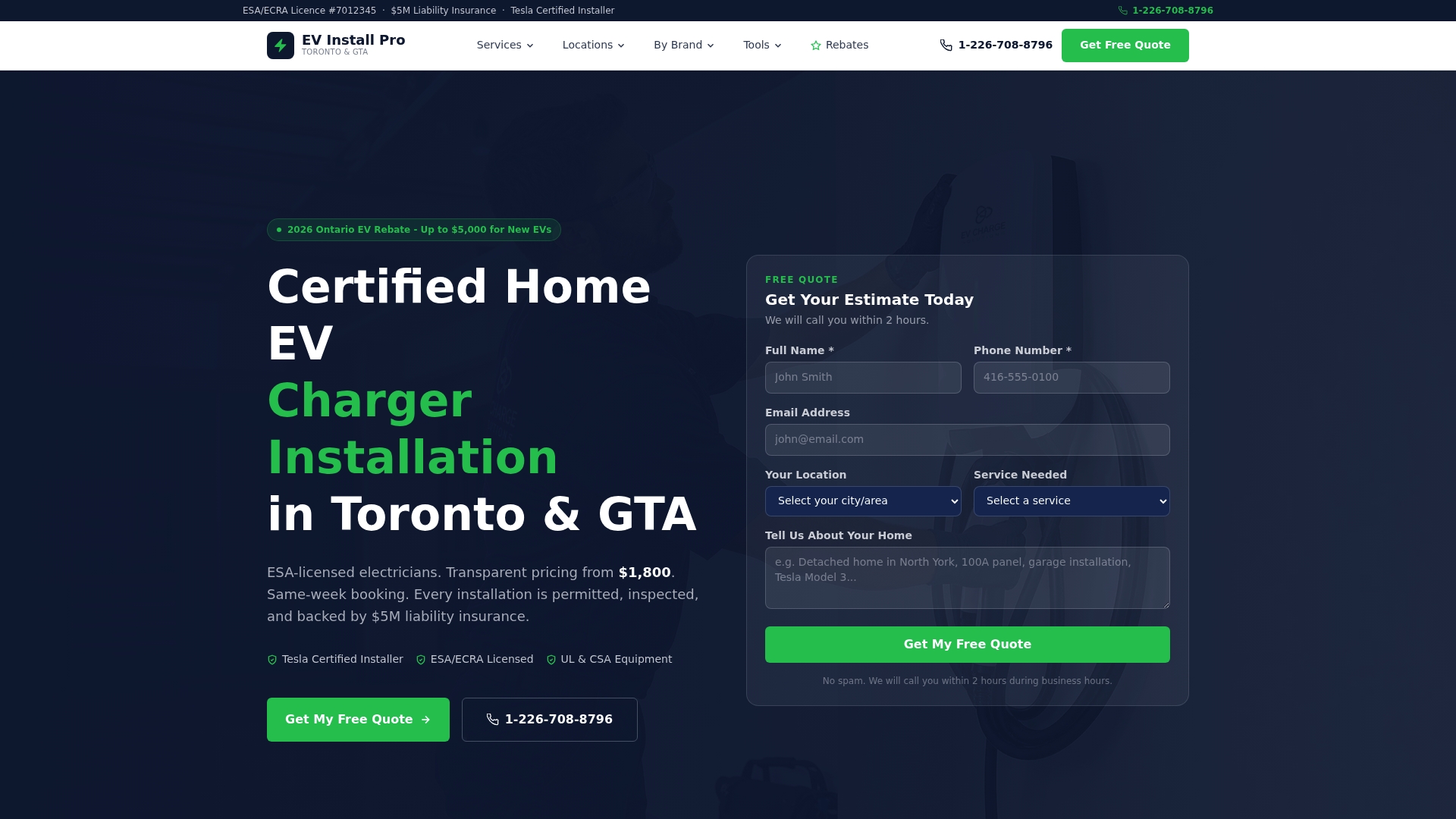
Every job comes with transparent pricing starting from $800, same-week booking, and installations typically finished within a few hours. We also handle your ESA permits and rebate paperwork at no extra charge, including applications worth up to $5,000, and we carry a 4.9 rating from GTA homeowners who’ve already made the switch. If you’re weighing an EVEMS installation against a panel upgrade, get a free, no-obligation quote through our cost calculator and know exactly what your home needs before you spend a dollar.
Frequently asked questions
What is off-peak EV charging? It means scheduling your vehicle’s charging session to overnight or low-demand hours when your utility charges its lowest per-kWh rate, rather than during the day or evening when demand and prices peak.
What time is Ontario’s off-peak EV charging window? Under the ULO plan, the ultra-low window runs from 11 p.m. to 7 a.m. daily at 3.9 cents per kWh. Standard TOU off-peak hours run overnight and all weekend at a higher, but still discounted, rate.
Do I need a panel upgrade to charge off-peak? Not always. An ESA-licensed electrician can assess your calculated load, and an EVEMS may let you install a Level 2 charger on your existing panel by managing how much power it draws at any moment.
How much can I save with off-peak charging? Using Ontario’s ULO rates, a 50 kWh charge costs roughly $1.95 overnight versus nearly $19.55 at the on-peak rate, a difference of about $17.60 per full charge.
Is Ultra-Low Overnight always the better plan? Not for every household. If you use significant power during the 4 p.m. to 9 p.m. on-peak window for cooking, laundry, or heating, ULO can raise your overall bill even as it cuts your charging cost.
This article is general information, not a substitute for advice from a qualified financial advisor. Consult a qualified financial professional about your own circumstances before acting on anything here.
Sources
- Guide to EV charger installations without service upgrades | Variablegrid
- Electricity rates | Ontario Energy Board
- Ontario Ultra‑Low Overnight (ULO) Rates 2026: Hours & Costs | Xolar
Recommended
- EV Charger Installation Toronto & GTA | EV Install Pro
- EV Charger Installation Cost Toronto 2026 | Full Breakdown + Rebates | EV Install Pro Toronto
- EV Charger Guides & Blog | EV Install Pro Toronto | EV Install Pro Toronto
- EV Charger Installation Cost in Toronto 2025: Complete Pricing Guide | EV Install Pro Toronto
Get Your Free Installation Quote
Free assessment · ESA permit included · Same-week availability across the GTA