11 p.m.–7 a.m.: Ontario EV Peak Hours, Costs and Installer Steps

Charge your EV overnight between 11 p.m. and 7 a.m. and you’ll almost always pay the lowest rate available in Ontario. Avoid summer weekday afternoons from 11 a.m. to 5 p.m. and winter mornings and evenings from 7 to 11 a.m. and 5 to 7 p.m., since those are the highest-cost windows on a Time-of-Use plan. Before you set a charging schedule, confirm which rate plan your account actually uses.
TL;DR:
- Charging an EV overnight between 11 p.m. and 7 a.m. consistently costs the least across all rate plans in Ontario, regardless of season or plan type.
- Seasonal on-peak hours change from 11 a.m. to 5 p.m. in summer to 7 to 11 a.m. and 5 to 7 p.m. in winter, requiring schedule adjustments to avoid higher rates.
- ULO plans apply a steep on-peak rate during weekday daytime hours, potentially outweighing overnight savings if daytime charging occurs frequently.
- The cost difference between off-peak and on-peak rates can be more than double, making timing critical to minimize charging expenses.
- Proper setup, including seasonal schedule updates and certified installation, ensures that EV charging stays within the lowest-cost windows reliably.
Table of Contents
- Ontario’s peak, mid-peak and off-peak hours, season by season
- How TOU, Tiered and ULO change the cost of a home EV charge
- Practical charging schedule and worked examples
- How to choose the right price plan for your household
- Home charging setup: charger levels, load management, and hiring a licensed installer
- Public charging and policy: the EVC rate, demand charges, and what drivers should expect
- Installer perspective: common mistakes before you schedule an installation
- How a licensed installer can simplify off-peak charging
- Sources
- FAQ
Ontario’s peak, mid-peak and off-peak hours, season by season
Ontario runs two Time-of-Use (TOU) schedules each year, and the clock hours that count as “peak” change depending on the season. From May 1 to October 31, summer TOU pricing puts on-peak between 11 a.m. and 5 p.m. on weekdays, when air conditioning drives demand across the province. From November 1 to April 30, the winter schedule flips: on-peak shifts to the morning and evening commute windows, 7 to 11 a.m. and 5 to 7 p.m. on weekdays, when heating and lighting use spikes.
Mid-peak and off-peak hours fill in around those windows and also shift with the season.
- Summer weekdays: off-peak runs 7 to 11 a.m. and 5 p.m. to 7 a.m.; mid-peak covers the rest, and on-peak is 11 a.m. to 5 p.m.
- Winter weekdays: off-peak runs 11 a.m. to 5 p.m. and 7 p.m. to 7 a.m.; mid-peak fills the gap; 11 a.m. to 5 p.m. is actually off-peak in winter, with mid-peak sitting between the two on-peak blocks.
- Weekends and statutory holidays: every hour of the day counts as off-peak year-round, regardless of season, under both summer and winter TOU schedules.
If your utility bills you on the ULO plan instead, the clock is simpler. Ultra-Low Overnight pricing applies an ultra-low rate every single day, weekday or weekend, from 11 p.m. to 7 a.m. Outside that window, ULO weekday on-peak pricing applies during the same hours TOU treats as peak, and it runs noticeably higher than standard TOU on-peak rates. Weekend and holiday hours outside the overnight window are billed at the ULO off-peak rate.
The practical upshot for an EV owner is that the overnight block, 11 p.m. to 7 a.m., is off-peak or better under every current plan in Ontario. That’s the one universal rule, no matter which rate structure your utility has you on. The seasonal switch matters mainly for daytime charging: a schedule that avoids peak pricing in July can accidentally land in the on-peak window come November if you never update it. Setting a calendar reminder for May 1 and November 1, or letting a smart charger handle the switch automatically, prevents that kind of surprise on your bill.
Weekends deserve a mention because they’re consistently the cheapest daytime option. If you need to top up your EV during the day rather than overnight, a Saturday or Sunday afternoon costs the same as 2 a.m. on a weeknight under TOU. That flexibility matters for households juggling multiple vehicles or errands that keep the car plugged in during daylight hours.

How TOU, Tiered and ULO change the cost of a home EV charge
Ontario offers three regulated electricity pricing structures, and which one you’re on changes how much a full EV charge actually costs. Understanding the mechanics behind each helps explain why the same charging session can cost noticeably different amounts depending on the plan and the clock.
- Time-of-Use (TOU) charges a different rate depending on when you draw power, using the seasonal windows described above. Current published TOU rates sit at 9.8 cents per kWh off-peak, 15.7 cents mid-peak, and 20.3 cents on-peak, as set by the OEB for the period running November 1, 2025 through October 31, 2026. Charging a typical 40 kWh session during the lowest-priced off-peak hours costs significantly less than charging the same session during on-peak hours, sometimes costing more than twice as much depending on the exact rates and time of use.
- Tiered pricing charges one flat rate for all electricity used up to a monthly threshold, then a higher flat rate for everything above it, with no regard for time of day. This structure can work out cheaper for households that use most of their electricity during the day, since there’s no penalty for running the dryer or charging the EV at 2 p.m. Tiered tends to lose its advantage for EV owners who could otherwise shift charging to a cheap overnight window, since it doesn’t reward that behaviour the way TOU or ULO does.
- Ultra-Low Overnight (ULO) offers the steepest overnight discount of the three but pairs it with the highest weekday on-peak rate. Some utility materials list ULO weekday on-peak pricing around 39.1 cents per kWh, roughly double standard TOU on-peak. For a household that reliably plugs in overnight and rarely draws heavy power during weekday peak hours, ULO’s rock-bottom overnight price can beat TOU’s off-peak rate. For a household that sometimes needs daytime charging on a weekday, the ULO on-peak penalty can wipe out those overnight savings fast.
The math favours whichever plan matches your actual behaviour rather than whichever plan sounds cheapest on paper. A single-EV household that plugs in every night after 11 p.m. and rarely touches the car battery during a weekday afternoon will typically do best on either TOU off-peak or ULO overnight pricing, since both land in a similar low range. A household running a second EV, a home office with daytime equipment loads, or an electric water heater on a timer during weekday hours needs to model both scenarios against real usage before assuming ULO is the better deal. The OEB’s electric vehicle guidance recommends running your own numbers through the bill calculator rather than guessing.
Practical charging schedule and worked examples
Once you know your plan, setting the actual charger timer is the easy part. For TOU customers, the safest default schedule is to start charging at 11 p.m. and let the session finish before 7 a.m., regardless of season, since that block sits inside off-peak hours year-round. For ULO customers, the same 11 p.m. to 7 a.m. window captures the ultra-low rate directly, and it’s worth setting your car or wall charger to start exactly at 11 p.m. rather than “whenever you plug in,” since even 30 minutes of early charging can land in a higher-priced block.
- TOU households: set the charger or vehicle app to begin at 11 p.m. and stop by 7 a.m., every day of the week.
- ULO households: use the identical 11 p.m. to 7 a.m. window; check your utility’s app to confirm the schedule updated correctly after each seasonal switch.
- Weekend flexibility: daytime charging on Saturdays and Sundays costs the same as overnight charging under TOU, so a weekend top-up won’t cost you a premium.
- Seasonal reminder: update or verify smart charging schedules on May 1 and November 1, since the clock hours for mid-peak and on-peak reverse between summer and winter.
Two worked examples show what this means in dollars. A 40 kWh charging session, roughly what a compact EV needs to go from a low battery to nearly full, costs about $3.92 charged entirely off-peak at 9.8 cents per kWh, versus about $8.12 if charged entirely on-peak at 20.3 cents per kWh, under current TOU rates. A larger 60 kWh session, closer to what a mid-size electric SUV might need for a fuller charge, runs about $5.88 off-peak versus about $12.18 on-peak, using those same published rates. In both cases, timing the charge for the overnight window roughly halves the cost compared with charging during a weekday on-peak block.
Statistic Callout: The gap between off-peak and on-peak TOU pricing is more than double (9.8 cents versus 20.3 cents per kWh), meaning identical charging sessions can cost twice as much depending purely on when you plug in.

The seasonal switch is the part most EV owners forget about. A charger scheduled to avoid summer on-peak hours, say a start time of 6 p.m., is running squarely inside winter’s evening on-peak block once November 1 arrives, since winter on-peak extends until 7 p.m. The fix is straightforward: build the 11 p.m. to 7 a.m. window into your default schedule year-round rather than optimizing around one season’s clock hours, since that window stays off-peak or ultra-low no matter which season it is.
How to choose the right price plan for your household
Picking between TOU, Tiered, and ULO isn’t a guess if you use the tools the OEB already provides. A short process gets you a clear answer based on your own usage rather than a generic recommendation.
- Find your current plan. Check a recent bill or log into your utility’s MyAccount portal (Hydro One, Alectra, or your local utility). The plan name, TOU, Tiered, or ULO, appears near the rate summary on every bill.
- Gather your usage history. Pull at least a few months of billed kWh data, ideally broken down by time of day if your utility’s portal offers that detail, then run those numbers through the OEB’s bill calculator to compare what you’d pay under each plan.
- Weigh your household’s daytime load. A home with a second EV, daytime appliance use, or a work-from-home setup running equipment during weekday peak hours may do better on Tiered or standard TOU than on ULO, since ULO’s weekday on-peak rate is steep.
- Factor in solar or battery storage. Households with solar panels or home battery storage often see the strongest case for ULO, since they can offset expensive daytime rates with self-generated power and still capture the cheap overnight EV charging window.
Pro Tip: Run your last twelve months of billed usage through the OEB bill calculator before switching plans. A single EV rarely changes which plan wins; your whole-home usage pattern usually decides it.
Most single-EV households land on standard TOU as the safer default, since it rewards overnight charging without the on-peak penalty ULO carries. ULO becomes the better call specifically for households that almost never draw significant power during weekday on-peak hours, which the OEB confirms should be assessed against actual usage rather than assumed from the plan’s marketing.
Home charging setup: charger levels, load management, and hiring a licensed installer
The charger you install determines how much of that cheap overnight window you can actually use. A standard 120-volt Level 1 charger, the kind that plugs into any household outlet, adds roughly 5 to 8 km of range per hour, which means an eight-hour overnight session might only replace 40 to 60 km of driving. A 240-volt Level 2 charger typically adds about 35 km per hour, enough to fully charge most EVs overnight within the standard off-peak or ULO window.
That jump from Level 1 to Level 2 is why most EV owners in Ontario eventually install a dedicated 240-volt circuit. Whether your home’s electrical panel can support that circuit without further work depends on your existing service size and how much spare capacity remains.
- 100-amp panels often need either a full upgrade to 200-amp service or a smart load management device to safely add a Level 2 circuit.
- 200-amp panels frequently have enough spare capacity to add a Level 2 charger directly, though an electrician needs to confirm the load calculation first.
- Smart load management devices, such as EVEMS or DCC-12 systems, can monitor total home load and automatically throttle EV charging when other high-draw appliances are running, which often avoids the cost of a full panel upgrade.
- Permits and inspections are required for any new EV charger circuit in Ontario, and an ESA-licensed electrician handles the paperwork as part of a proper installation.
Pro Tip: Ask any installer to check your panel’s spare capacity before assuming you need a full upgrade. A load management device is often the cheaper fix.
Hiring a licensed electrician for this work isn’t just a formality. An unlicensed or improperly permitted installation can void your home insurance in the event of an electrical fire, and the Electrical Safety Authority requires an inspection on any new circuit feeding a Level 2 charger. A properly licensed installer typically handles the permit application, schedules the ESA inspection, and can also walk you through available rebate paperwork for the charger purchase itself, steps that are easy to miss if you’re doing the wiring yourself or hiring uncertified labour.
Public charging and policy: the EVC rate, demand charges, and what drivers should expect
Public charging works differently from home charging, both in how it’s priced and in how Ontario is trying to make it cheaper to operate. The OEB introduced a new opt-in rate structure, the EVC Rate, through its Electric Vehicle Integration Initiative, aimed at reducing a cost component called retail transmission service rates for eligible public charging stations, with implementation folded into 2026 distribution rates.
The core problem the EVC Rate addresses is demand charges. Public fast chargers, particularly DC fast chargers, draw a large amount of power in short bursts, and utilities bill commercial customers partly based on their peak demand, not just total energy used. A charging station with low utilization, meaning it sits idle much of the day between charging sessions, still gets billed for that peak demand spike whenever a car does plug in, which pushes the effective cost per kWh higher than the energy itself would suggest.
- Higher utilization lowers per-kWh costs, since the same demand charge gets spread across more charging sessions.
- Low-traffic locations tend to carry higher posted prices, since fewer sessions share the fixed demand-charge burden.
- The EVC Rate is opt-in and applies only to eligible charging stations, not to every public charger automatically, so pricing still varies by network and location.
- Billing methods differ by network, and Natural Resources Canada notes that Canadian public stations commonly use time-based, flat-fee, or per-kWh pricing, so the posted rate isn’t always a direct kWh comparison.
For an occasional public charging user, the practical takeaway is to expect a noticeably higher cost per kWh than home charging delivers, even after the EVC Rate takes effect, since public infrastructure carries costs that a home outlet doesn’t. Checking a station’s pricing method before plugging in, and comparing network subscription options if you charge in public regularly, helps avoid surprises on cost per session. Workplace charging often falls into a similar category: if your employer bills by time rather than energy, a slower charging rate could quietly cost you more per kWh than expected, so it’s worth asking how the workplace charger is priced before relying on it daily.
Installer perspective: common mistakes before you schedule an installation
The most common mistake we see is a charger schedule that never gets updated for the seasonal TOU switch, quietly shifting from cheap to expensive the moment November or May arrives. The second is leaving a charger on its factory default schedule, which often starts charging the moment the car is plugged in rather than waiting for the off-peak window to begin.
Before booking an installation, have a recent electricity bill on hand, confirm driveway or garage access for the electrician, and decide your preferred overnight start time in advance. Licensed electricians matter here because an unpermitted circuit can create real insurance and safety risk, and proper permit handling protects you if anything ever needs to be verified later.
— Hafiz
How a licensed installer can simplify off-peak charging
Getting the charging schedule right only pays off if the circuit behind it is installed safely and sized correctly, which is where a licensed electrician earns their fee. A licensed electrician service works across the Greater Toronto Area with ESA-licensed electricians on every job, ensuring that the permit, inspection, and wiring all meet the legal standard your home insurance expects.
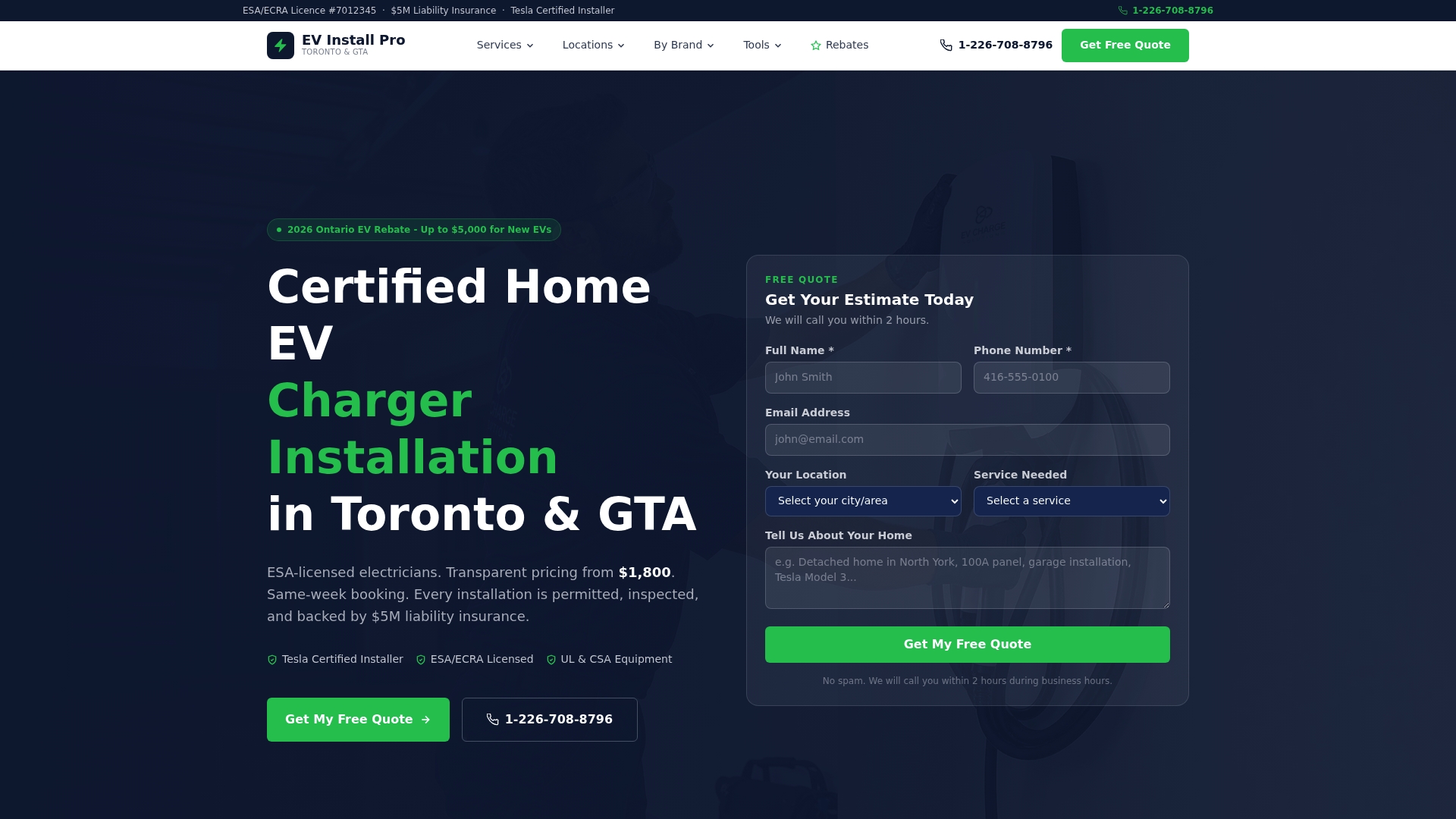
Core services include Level 2 Home Charger Installation, panel upgrades for homes without spare capacity, EVEMS/DCC-12 smart load management installation as a lower-cost alternative to a full panel upgrade, and condo or apartment installations for unit owners navigating shared electrical systems.
- Transparent pricing starts from $1,800 for a standard Level 2 home installation, with panel upgrade and combined packages priced separately.
- Same-week booking is available for most Greater Toronto Area addresses, so you’re not waiting weeks to get on an overnight rate.
- Permit and inspection handling is included at no extra charge, covering the ESA paperwork most homeowners would otherwise manage themselves.
- Rebate application support covers eligible rebates worth up to $5,000 on qualifying new EV purchases, with the paperwork handled as part of the installation.
To get started, request a quote through the main service page with your address, panel type if known, and preferred installation timeline. Having a recent electricity bill and your vehicle’s charging specs ready speeds up the assessment.
Sources
The OEB’s electricity rates page is the definitive source for current TOU, Tiered, and ULO hours and prices, and it hosts the bill calculator mentioned throughout this article. The OEB’s electric vehicle guidance covers ULO mechanics and load management devices in more detail. Ontario’s government charging guidance explains charger types and public charging locations across the province. The EMC/MEC provincial report offers grid modelling on how EV adoption affects winter peak demand.
FAQ
What are the off-peak hours for electricity in Ontario?
Off-peak hours under Time-of-Use pricing run overnight and on weekends and statutory holidays year-round, with the exact weekday hours shifting seasonally between the summer and winter TOU schedules. The overnight block from 11 p.m. to 7 a.m. is off-peak, or ultra-low under the ULO plan, in every season.
What is the cheapest time to do laundry in Ontario?
The cheapest time is any off-peak window, which includes all day on weekends and statutory holidays under Time-of-Use pricing, plus early mornings and late evenings on summer weekdays or midday on winter weekdays. Running laundry outside the seasonal on-peak block keeps the cost at the lowest published rate.
What is the least expensive time of day to use electricity?
The overnight window from 11 p.m. to 7 a.m. is consistently the least expensive time under every current Ontario rate plan, whether that’s TOU off-peak or ULO’s ultra-low overnight rate. This window applies every day of the week, regardless of season.
What’s the most expensive time to use your electricity?
The most expensive time depends on your plan and the season: TOU on-peak hits weekdays from 11 a.m. to 5 p.m. in summer and 7 to 11 a.m. plus 5 to 7 p.m. in winter, priced at 20.3 cents per kWh. ULO customers face an even steeper weekday on-peak rate during those same clock hours, making it the costliest option for daytime charging on that plan.
Get Your Free Installation Quote
Free assessment · ESA permit included · Same-week availability across the GTA