Does an EV charger need surge protection?
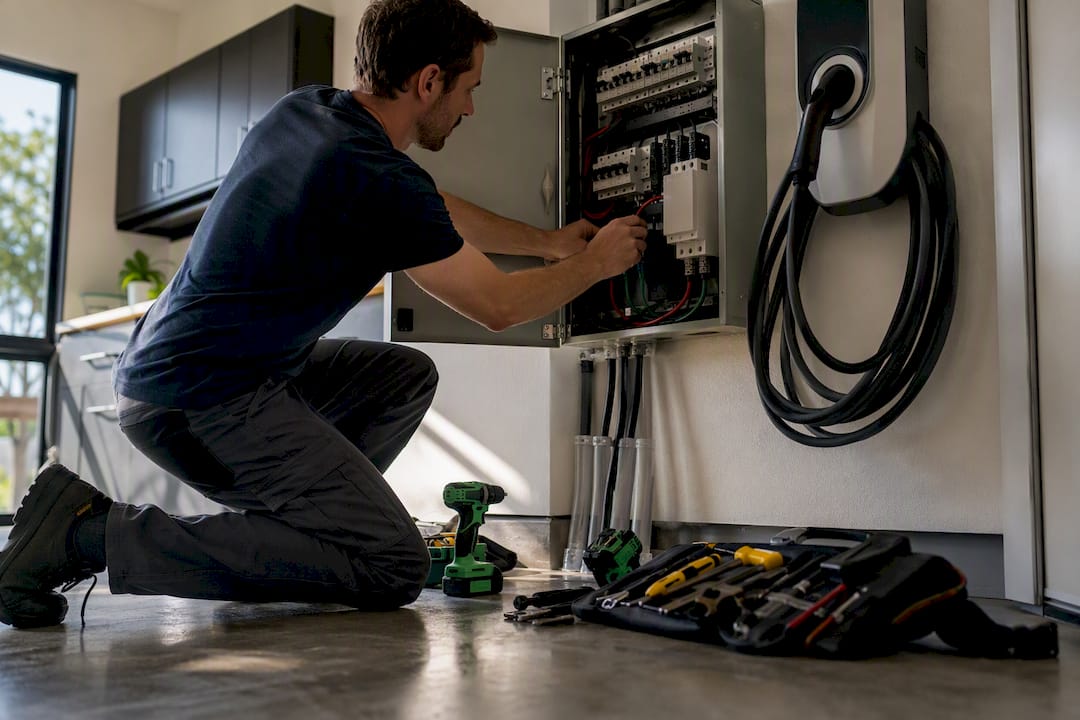
Yes. Most Level 2 EV chargers need surge protection, either through a panel-mounted SPD, a dedicated subpanel device, or at minimum a certified inline plug protector for temporary setups. Two standards drive this: IEC 61851-23 requires surge protection on the DC side of fast chargers, and NEC 2023 Section 230.67 requires SPDs on services supplying dwelling units in the US, a rule electricians increasingly apply to Level 2 EVSE circuits by default. A licensed installer like Evchargerinstallationtoronto can confirm what your local code demands and size the right device for your panel.
Before you call anyone, there are three things worth checking yourself.
- Pull up your charger’s spec sheet and look for a stated surge or SPD rating, not just a general “safety certified” label.
- Ask your electrician whether a panel or service-entrance SPD is already protecting your home, and if not, what it would cost to add one.
- If you’re using a plug-in NEMA 14-50 setup rather than a hardwired charger, consider a certified inline protector as a stopgap, not a permanent fix.
Key Takeaways
Surge protection for an EV charger is not optional in most modern installations. Panel-level Type 2 SPDs, backed by verified grounding and code-compliant lead lengths, give homeowners the most reliable protection available today.
| Point | Details |
|---|---|
| Panel SPDs cover the whole home | A Type 2 SPD at the main panel protects your charger and every other circuit from one device. |
| Standards drive the requirement | IEC 61851-23 and NEC 2023 Section 230.67 push panel or DC-side SPDs from optional to expected. |
| Inline protectors are a bridge, not a fix | Devices like the Southwire SurgeHero™ protect only the charger circuit and suit plug-in setups temporarily. |
| Lead length affects real performance | Keeping SPD wiring under roughly half a metre prevents inductive voltage from defeating the Up rating. |
| Evchargerinstallationtoronto handles it end-to-end | ESA-licensed electricians select, install, and document SPDs alongside permit and rebate paperwork. |
Where to check the original standards and guidance
Homeowners who want to go past the summary here have a few places worth reading directly. IEC 61851-23 covers the DC-side requirements referenced throughout this article and is worth a look if you’re considering a home DC fast-charging setup. IEC 61643-11 sets the AC SPD performance standards your electrician’s chosen device should meet. Raycap’s application paper walks through T1/T2 coordination for public and high-exposure installations in more technical detail than most homeowner guides offer. Exicom’s SPD overview is a clear starting point if you want the plain-language basics before diving into a manufacturer’s spec sheet. And the Southwire SurgeHero™ listing is useful simply to see what a certified inline protector actually looks like and what it claims to do.
Table of Contents
- Why EV chargers and vulnerable vehicles are exposed to voltage surges
- Standards and code guidance homeowners should know about
- Where to install surge protection: panel, subpanel, or at the charger
- SPD types and the specs worth checking before you buy
- Do EV chargers already have built-in surge protection?
- Comparing your realistic surge protection options
- Costs, maintenance, and what to ask your electrician
- Getting your surge protection installed correctly the first time
- Frequently asked questions about EV charger surge protection
- Sources
Why EV chargers and vulnerable vehicles are exposed to voltage surges
Three things make an EV charger a bigger surge target than your dishwasher or dryer. First, it sits outdoors or in a garage exposed to the same electrical service as everything else in the house, but it’s often the single highest-draw circuit you own. Second, it’s built around sensitive power electronics, rectifiers, relays, and control boards, that fail at voltage spikes a toaster would shrug off. Third, it creates a hardwired path straight into the vehicle’s battery management system, so a surge doesn’t just fry a charger, it can reach the car’s onboard electronics too.
The failure scenarios are ordinary, not exotic. A lightning strike a few blocks away induces a transient on the utility line. A utility switching operation, capacitor banks kicking in, a transformer tap changing, sends a momentary spike down your service. Even something inside your own home, a large motor starting or an HVAC compressor cycling, creates switching transients that ride the same wiring your charger uses.
- Lightning-induced surges travel through overhead or buried service lines even without a direct strike.
- Utility grid switching and transformer operations create voltage transients that occur far more often than lightning.
- Internal switching loads (well pumps, AC compressors, furnace blowers) generate smaller but frequent transients that add cumulative stress.
Coordinated protection matters because a surge rarely announces itself before it hits. A surge protection device works by diverting transient energy to ground, and for EV charging that protection often needs to combine a Type 1 device for lightning current with a Type 2 device for smaller transients, plus dedicated DC-side protection on fast chargers. SPDs are also sacrificial: they absorb energy and degrade over time, which is why periodic inspection matters more for a charger circuit than for a typical household outlet.
Standards and code guidance homeowners should know about
You don’t need to read the full text of an IEC standard to hire the right electrician, but knowing the names helps you ask sharper questions and spot an installer who’s cutting corners.
- IEC 61851-23 governs DC fast-charging stations and requires surge protection specified across (+)-PE, (−)-PE, and (+)-(−) modes, which matters if you’re considering a home DC unit rather than standard Level 2.
- IEC 61643-11 sets the performance and test requirements for AC-side SPDs, the type most homeowners will actually install at their panel.
- IEC 60364-7-722, part of the wider IEC 60364 wiring series, addresses electrical installations for EV supply equipment and is the basis many jurisdictions use to justify requiring transient protection at publicly accessible charge points, under Raycap’s application guidance.
- NEC 2023 Section 230.67 requires SPDs on services feeding dwelling units in the US, a provision electricians widely apply to justify panel SPDs when a Level 2 charger circuit is added.
- BS 7671 carries comparable transient-protection requirements for UK installations, referenced where local wiring regulations apply.
In practice, the requirement question comes down to who’s asking. An authority having jurisdiction (AHJ) reviewing your permit application will often expect an SPD as a default for new EV circuits, particularly in areas with frequent grid switching or lightning activity. Insurers increasingly ask about surge protection too, since an unprotected circuit raises the odds of a claim. Homeowners can sometimes document a formal risk acceptance and skip the SPD, but that puts the liability squarely on you if a surge does hit.
Pro Tip: Keep your SPD’s test certificate and datasheet with your electrical permit file, and ask your electrician to note the exact model number, Up rating, and whether it includes a remote dry-contact signal. You’ll want that paperwork if you ever file an insurance claim or sell the house.
Where to install surge protection: panel, subpanel, or at the charger
Surge protection works in layers, and where you place each layer changes what it covers and what it costs.
Service entrance or meter base. This is the first line of defence, typically a Type 1 device installed by the utility or your electrician right where power enters the home. It handles the largest lightning-related transients but isn’t always present on older homes, and installing one usually means coordinating with your utility.
Main panel. This is where most homeowners land. A Type 2 SPD mounted directly in or beside the main panel protects every circuit in the house, including your EV charger, refrigerator, and HVAC system, from one device. Citel’s residential guidance points to UL1449-listed panel SPDs as the standard recommendation for homes adding Level 2 charging, since the panel location protects the whole electrical system, not just the charger circuit.
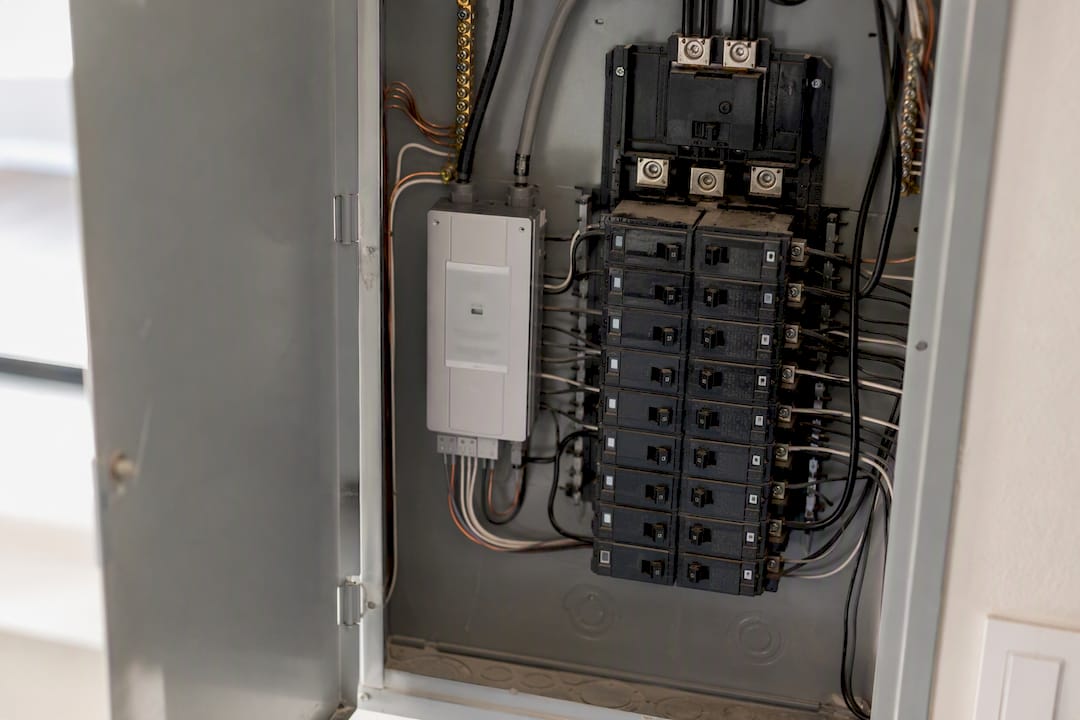
Subpanel or dedicated EV circuit. If your charger runs off a dedicated subpanel, adding a second SPD there gives more targeted protection and is common in detached garages or properties with a secondary panel.
At the charger itself. Equipment-level protection, either built into the unit or added as an inline device, catches what slips past the upstream layers. It’s the smallest layer of defence and the easiest to add after the fact.
- Service SPD (Type 1) catches the biggest lightning-related surges before they reach your panel.
- Panel SPD (Type 2) protects your whole home’s circuits, including the EV charger, from one installation point.
- Charger-level protection (built-in or inline) is your last line of defence and the easiest to retrofit.
For homes in areas with real lightning exposure or older service equipment, Raycap’s application guidance recommends coordinating a Type 1 device at the service entrance with a Type 2 device at the panel or charger supply point, rather than relying on either one alone.
SPD types and the specs worth checking before you buy
The labels on an SPD datasheet look intimidating, but you only need to understand a handful of terms to have a real conversation with your electrician.
Type 1 SPDs handle direct or nearby lightning current and are typically installed at the service entrance. Type 2 SPDs handle the more common transient surges from grid switching and internal loads, and this is the type most residential panel installations use. Type 3 devices are lower-capacity units installed close to sensitive equipment, closer to what you’d find built into a power strip than a panel.
For DC fast chargers, protection has to be specified separately across the positive-to-earth, negative-to-earth, and positive-to-negative paths, since AC-side protection alone doesn’t reach the vehicle-side electronics on a DC unit.
Here’s what actually matters on the spec sheet:
- Voltage protection level (Up): the peak voltage the SPD lets through during a surge. Lower is generally better, but it has to match your system’s operating voltage.
- Impulse current rating (Iimp): relevant for Type 1 devices, measuring how much lightning current the unit can handle.
- Nominal discharge current (In) and maximum discharge current (Imax): how much surge current the device handles repeatedly (In) versus once at its limit (Imax).
- Response time: how quickly the SPD reacts, measured in nanoseconds; faster is better for sensitive electronics.
- Uc: the maximum continuous operating voltage the SPD can sit at without triggering.
- Earthing system compatibility: whether the device suits a TN, TT, or IT earthing arrangement, which varies by region and home age.
Bourns’ technical guidance for specifying SPDs in EV charging applications recommends confirming Type, Uc, Iimp (for Type 1), In and Imax (for Type 2), maximum Up, and remote-monitoring capability before ordering any device, exactly the checklist to hand your electrician.
Installation quality matters just as much as the device itself. Industry guidance suggests keeping the total lead length from the SPD terminals to the live, neutral, and ground busbars under roughly half a metre, since longer leads add inductance that can quietly defeat even a well-rated Up. A residential Level 2 install typically needs less aggressive specs than a public DC fast-charging station, but the coordination principle, matching Type 1 and Type 2 devices so they share the surge load properly, applies at both scales.
Do EV chargers already have built-in surge protection?
Some do, but “some protection” and “adequate protection” aren’t the same thing. Most Level 2 chargers include basic transient suppression, often just a metal oxide varistor (MOV) inside the enclosure, which absorbs small spikes but has nowhere near the capacity of a properly specified external SPD. That built-in component protects the charger’s own circuit board. It does nothing for your refrigerator, your furnace control board, or anything else on the same electrical service.
When you’re reading a spec sheet, look for these specifics rather than a vague “surge protected” claim:
- An explicit SPD or surge rating with a stated joule or kA figure, not just a marketing phrase.
- A listed Up value you can compare against your panel SPD’s rating.
- Remote signalling or a dry-contact output that flags when internal protection has degraded.
- IEC or UL certification numbers you can look up independently.
If you have a hardwired Level 2 charger, treat any built-in MOV as a bonus, not your primary protection, and plan for a panel or subpanel SPD as the real defence. If you’re using a plug-in setup through a NEMA 14-50 outlet, your options are more limited since you can’t hardwire a panel device around a plug connection, which is where a certified inline protector becomes a reasonable interim step rather than an afterthought.
Comparing your realistic surge protection options
Three practical paths exist for most homeowners, and each fits a different situation.
A whole-house or service-level SPD installed by your electrician protects every appliance and circuit in the home from one device, typically the strongest option if your budget allows it. A panel or subpanel SPD dedicated to the circuit feeding your charger gives targeted protection at a lower cost than a full service-entrance unit, and it’s the option most electricians recommend for a straightforward Level 2 install. An inline plug-and-play protector, installed between a NEMA 14-50 outlet and a portable or plug-in charger, offers a lower-cost, no-permit option, but it only protects what’s downstream of the outlet and does nothing for the rest of your electrical system.
| Option | Coverage | Typical fit |
|---|---|---|
| Whole-house / service SPD | Entire home, all circuits | New construction, older services, high lightning exposure areas |
| Panel or subpanel SPD | Home or dedicated EV circuit | Most Level 2 charger installations |
| Inline plug-in protector | Charger only, downstream of outlet | Plug-in NEMA 14-50 setups, temporary or rental situations |
Products like the Southwire SurgeHero™ illustrate what an inline device typically offers: it installs between the outlet and the charger, carries a joule rating (commonly around 4,200 J), and includes a surge-spent indicator so you know when it needs replacing. Manufacturers like Raycap, Strikesorb, and Bourns produce the panel-level and DC-side SPD components electricians specify for the more robust installations described above. None of these inline units substitute for panel protection. They’re a partial layer, useful when hardwiring isn’t practical, but homeowners should verify local certification and availability before treating one as a permanent solution.
Costs, maintenance, and what to ask your electrician
A panel-mounted Type 2 SPD typically adds a modest cost to an EV charger installation once you factor in the device and an electrician’s labour to mount and wire it correctly. Inline plug-in protectors cost far less but only protect a single circuit. Installation for a panel SPD usually adds well under an hour to a same-day charger install, since the device mounts directly into or beside your existing panel.
Maintenance is simple but shouldn’t be skipped. Check the SPD’s visual indicator after any major storm or known grid event; most units show a clear colour change or a warning light when they’ve absorbed a large surge and need replacing. Even without a dramatic event, industry guidance suggests a general inspection every two to three years, since SPDs are sacrificial and degrade with cumulative smaller surges you may never notice.
Before you sign off on any installation, run through this checklist with your electrician:
- What’s the exact model, and can I see the datasheet showing Up, In, Imax, and Type rating?
- Is the grounding system verified and compatible with this SPD?
- What are the lead lengths from the SPD to the busbars, and do they meet the coordination guidance for minimizing inductive voltage add-on?
- Does the device include remote signalling or a dry contact, and how will I know if it’s failed?
- Will this installation be documented for my permit file, and does it affect my insurance or warranty?
Watch for a few red flags. An installer who can’t produce a datasheet for the specific SPD they’re quoting is one. So is a quote for a public or shared installation with no remote signalling, since remote monitoring is standard practice for commercial and shared charging points. And be cautious of unusually low In or Imax ratings quoted for anything beyond a single residential circuit.
A practical take on cost versus coverage
Balancing cost against risk on this comes down to one honest question: how exposed is your service, and how much does a callback cost you if you’re wrong? If your home has an older service panel, sits in a lightning-prone region, or you’re adding a dedicated subpanel anyway, a panel-level SPD is worth the incremental cost every time, because it protects your whole house, not just the charger. An inline plug-in protector earns its place only as a bridge, for renters, plug-in setups, or homeowners waiting on a bigger electrical project, not as a permanent answer. Permit requirements and your local AHJ’s expectations should usually settle any remaining doubt.
Getting your surge protection installed correctly the first time
Evchargerinstallationtoronto’s ESA-licensed electricians size and install SPDs as part of the same visit that gets your Level 2 charger running, so you’re not paying for a second callback or guessing whether your panel SPD and charger are properly coordinated.
Beyond the charger itself, the team handles the details that actually determine whether your protection works: verifying your grounding system, keeping SPD lead lengths within the coordination guidance electricians use to avoid defeating a device’s Up rating, and confirming your panel has the capacity for the added protection, or arranging a panel upgrade if it doesn’t. Every SPD model, its datasheet, and its documentation get filed alongside your permit paperwork, so you have what you need if an insurer or future buyer asks. The team also manages rebate applications worth up to $5,000 and handles all inspection paperwork at no extra charge. If you want a clear number before committing, run your project through the EV charger installation cost calculator to see what a properly protected installation runs in your area.
Frequently asked questions about EV charger surge protection
Do all EV chargers need a separate surge protector, or is built-in protection enough? Built-in protection, usually a basic MOV, guards only the charger’s own circuit board. It doesn’t protect the rest of your home’s electrical system, so most electricians still recommend a panel or subpanel SPD alongside whatever protection is built into the unit.
Is an inline plug-in surge protector a real substitute for a panel SPD? No. An inline device like the Southwire SurgeHero™ protects only the circuit downstream of the outlet it’s plugged into. It’s a reasonable temporary option for plug-in NEMA 14-50 setups but doesn’t cover the rest of your home.
What’s the difference between Type 1 and Type 2 SPDs for EV charging? Type 1 handles large lightning-related transients and typically sits at the service entrance. Type 2 handles the more frequent grid-switching and load transients and is the type most homeowners install at their main panel.
Does my insurance require surge protection for an EV charger? Requirements vary by insurer and jurisdiction. Some insurers now ask about surge protection when underwriting homes with EV charging equipment, and documented SPD installation can support a claim if a surge does cause damage.
How often should an SPD be inspected or replaced? Check the visual indicator after any major storm or known grid disturbance, and expect a general inspection every two to three years, since SPDs degrade with cumulative surge exposure even without a single dramatic event.
Sources
- Surge Protection Device (SPD) for EV Chargers | Exicom
- EV charger global application paper — Raycap
- EV charger surge protection: Is it required by IEC/NEC? — TrilPeak
- Southwire Surge Protector — Lowe’s product page
Recommended
- ESA Permit for EV Charger Installation Ontario | Do You Need One? | EV Install Pro | EV Install Pro Toronto
- Pedestal mount EV charger installation in Toronto | EV Install Pro Toronto
- EVEMS Installation Toronto | Smart Load Management | Skip the Panel Upgrade | EV Install Pro Toronto
- Find EV Chargers Near Me in Toronto & the GTA | Live Map | EV Install Pro Toronto
Get Your Free Installation Quote
Free assessment · ESA permit included · Same-week availability across the GTA