EV charger cable length: guide for homeowners and fleets
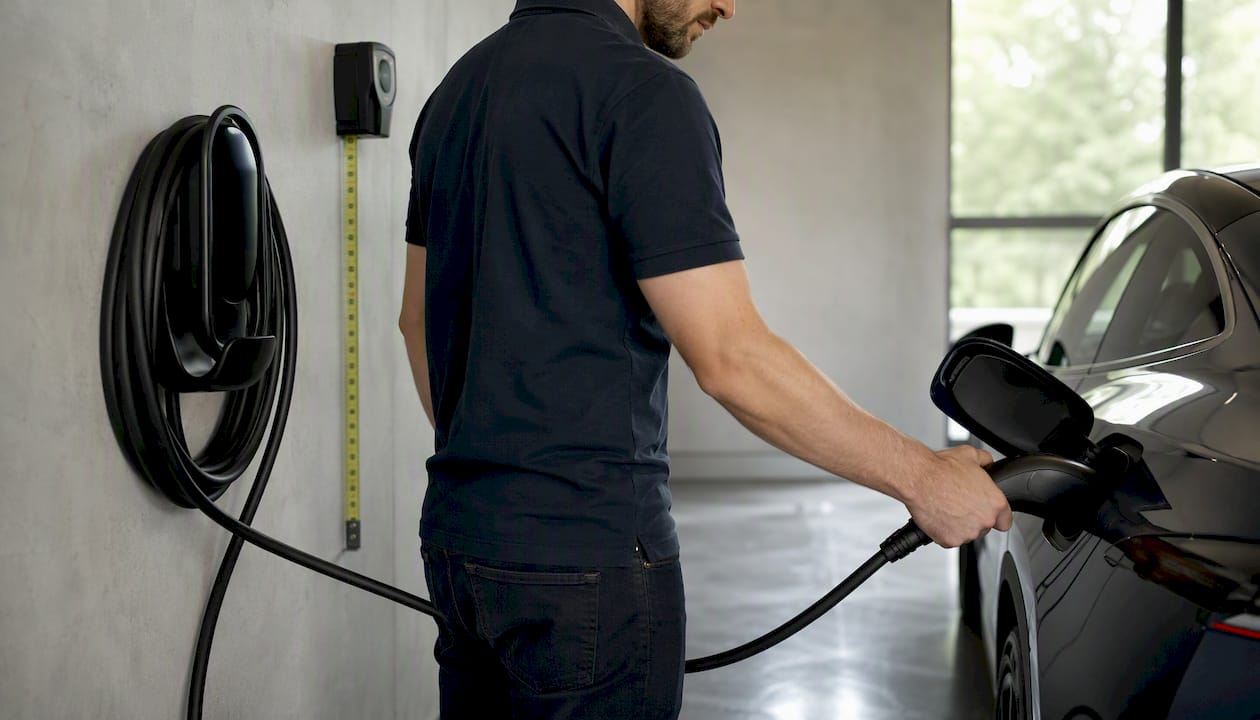
For most Canadian homes, a 7–8 m (23–26 ft) cable is the right choice. It covers the majority of garage and driveway layouts without adding unnecessary weight. If your parking spot is farther from the panel or you manage a fleet bay, 10 m (33 ft) may be needed — but only after you measure the actual route.
Here is how to size it correctly:
- Measure the cable route from the wallbox to your vehicle’s charging port (not a straight-line estimate — follow the actual path along walls and floor).
- Add roughly 1 m of slack to reduce connector stress and avoid tripping hazards.
- Round up to the next standard retail length: 5 m (≈16 ft), 7–8 m (≈23–26 ft), 10 m (≈33 ft), or 15 m (≈49 ft).
A survey of over 65 home chargers found that 25 ft (≈7.6 m) is the most common length shipped with home EV chargers — and for good reason. That length handles most single-car garages and standard driveways without leaving excess cable on the ground. If you are unsure, measure first, then consult a licensed installer before buying.
Key takeaways
For most Canadian homes, a 7–8 m (23–26 ft) cable covers the widest range of garage and driveway layouts — measure the actual route, add 1 m of slack, and round up to the next standard length.
| Point | Details |
|---|---|
| Recommended home length | 7–8 m (≈23–26 ft) suits most Canadian driveways and garages; 5 m works for tight garage installs. |
| Measure before you buy | Walk the cable route, add 1 m slack, and round up to the next standard length (5 m, 7–8 m, 10 m, 15 m). |
| Conductor sizing at 15 m+ | For fixed leads over 15 m, ask your installer to verify wire gauge to avoid voltage drop. |
| Match ampacity to your EVSE | Cable current rating (16 A or 32 A) determines charging speed; match it to both the EVSE and vehicle inlet. |
| Evchargerinstallationtoronto | ESA-licensed installation across the GTA, including site measurement, permit handling, and rebate support from $1,800. |
Table of Contents
- What EV charger cable length works for your parking situation?
- Why cable length is a trade-off, not just a reach question
- Which connector standard does your cable need?
- Tethered versus untethered: how length factors into the choice
- Routing and storing longer cables safely
- Buying checklist: what to confirm before you purchase
- What to do when your cable is too short
- Canadian safety and regulatory requirements
- What a licensed installer actually measures and checks
- The most common mistake Canadian EV owners make
- Evchargerinstallationtoronto handles the measurement, permit, and rebate for you
- Sources
What EV charger cable length works for your parking situation?
The right length depends on where your car parks and where the wallbox mounts. These are the four most common Canadian scenarios.
| Parking situation | Recommended length | Notes |
|---|---|---|
| Single-car garage, wallbox beside car | 5 m (≈16 ft) | Works when the charger mounts within arm’s reach of the port |
| Standard driveway or mixed orientation | 7–8 m (≈23–26 ft) | Covers most layouts; the most popular choice |
| Long driveway or detached garage | 10 m (≈33 ft) | Measure first; only choose this when the route requires it |
| Fleet bay or commercial parking | 10–15 m (≈33–49 ft) | 15 m Type 2 cables are available for multi-vehicle use |
Seven metres suits the largest number of domestic driveways; going to 10 m or longer makes sense only when your measured route genuinely requires it. The extra 2–3 m in a mid-range cable often solves inlet-side orientation issues — for example, when the port sits at the rear of the car and the wallbox is on the opposite wall.
For condo owners, the cable route is rarely a straight line. You may need to run the cable along a parking pillar, around a support beam, or across a stall divider. Measure every realistic parking position before deciding. A condo-specific installation guide covers building approval steps and common layout constraints in Toronto and the GTA.
Pro Tip: Walk the cable route with a tape measure in hand, not just your eyes. Corners, pillars, and vehicle overhangs add more distance than most people expect.
Why cable length is a trade-off, not just a reach question
Longer is not automatically better. Every extra metre adds weight, bulk, and potential wear.
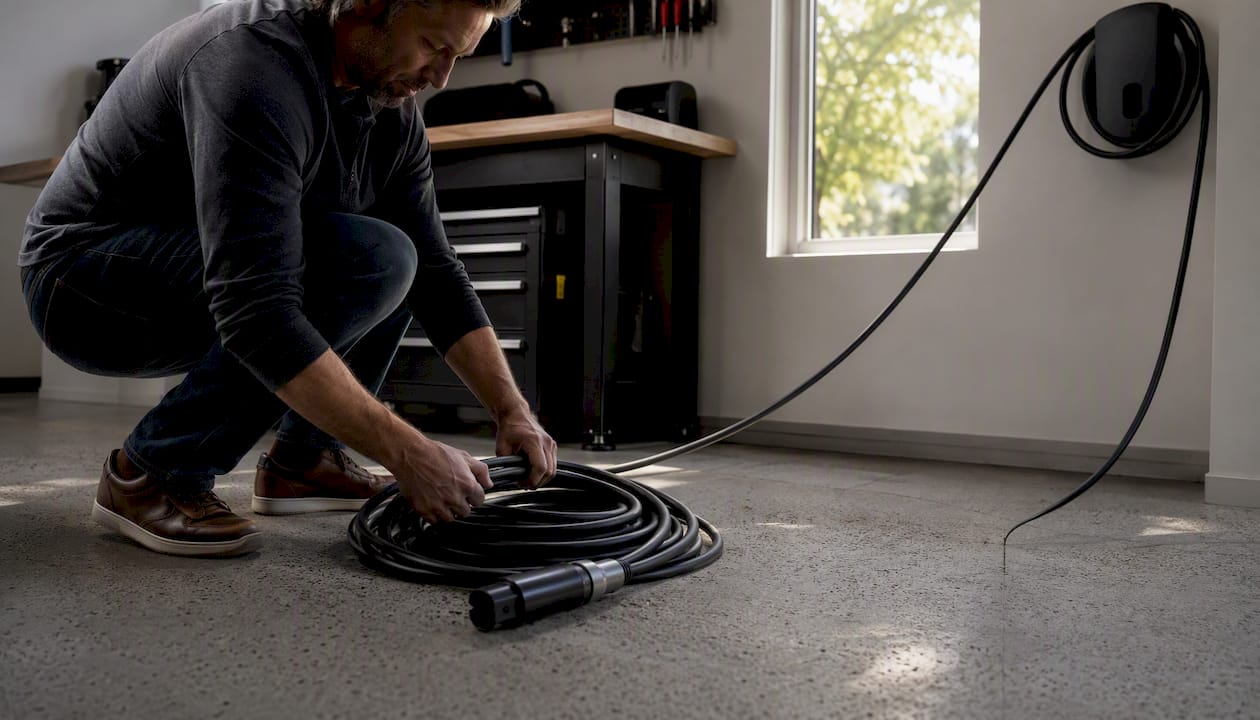
Manufacturers commonly sell home charger cables in the 5–10 m range, and weight grows noticeably with length. A 5 m cable is easy to coil and hang; a 10 m cable is noticeably heavier and needs a proper storage solution. At 15 m, you are dealing with a cable that most homeowners find awkward to manage daily.
Voltage drop is a secondary concern at typical home lengths. Quality cables up to about 10 m stay comfortably within acceptable voltage drop limits. At 15 m and above, conductor sizing matters — a thinner gauge wire over a long run can reduce charging efficiency. Your installer should verify conductor sizing for any fixed lead over 15 m.
Ampacity is separate from length. A cable rated at 16 A delivers less power than one rated at 32 A, regardless of how long it is. At 32 A on a 240 V circuit, a Level 2 charger delivers roughly 7.7 kW — enough to add about 40–50 km of range per hour for most EVs. Matching the cable’s current rating to both your EVSE and your vehicle’s onboard charger is what determines charging speed, not the cable’s length.
Connector wear is the third factor. A cable that is too long tends to pool on the ground or drag across the vehicle’s bumper. That repeated stress cracks the sheathing and stresses the connector pins over time. The right length keeps the cable taut enough to route cleanly without pulling on the port.
| Cable length | Typical weight | Voltage drop concern | Handling notes |
|---|---|---|---|
| 5 m (≈16 ft) | Light | Negligible | Easy to coil and store |
| 7–8 m (≈23–26 ft) | Moderate | Negligible | Manageable with a wall holster |
| 10 m (≈33 ft) | Heavier | Low | Needs a reel or dedicated bag |
| 15 m (≈49 ft) | Heavy | Check conductor sizing | Fleet/commercial use; verify gauge with installer |
Pro Tip: For any fixed lead over 15 m, ask your installer to confirm the conductor gauge meets the ampacity requirement for your EVSE’s rated output. A thicker gauge (lower AWG number) compensates for the longer run.
Which connector standard does your cable need?
Connector type is fixed by your vehicle and your EVSE — length is a separate decision made after you confirm compatibility.
- SAE J1772 (Type 1): The standard AC connector for most North American EVs, including older Chevrolet, Nissan, and Mitsubishi models. Single-phase only.
- IEC 62196 Type 2: Common on European-market vehicles and many newer EVs sold in Canada. Supports single- and three-phase AC charging.
- Combined Charging System (CCS): Used for DC fast charging (Level 3). Not relevant for home cable selection — DC fast charging uses fixed station cables.
- Tesla / NACS: Tesla vehicles use the North American Charging Standard connector. Tesla-branded home chargers ship with a NACS cable; adapters are available for J1772 public stations.
Most home AC cables in Canada are J1772 or Type 2. Check your vehicle’s owner’s manual and your EVSE’s socket type before buying a portable cable. A mismatch in connector standard or pin configuration means the cable simply will not connect — no amount of force will fix it.
Tethered wallboxes (fixed cable attached to the unit) remove the connector-matching step entirely, since the cable is pre-matched at installation.
Tethered versus untethered: how length factors into the choice
A tethered charger has a fixed cable permanently attached to the wallbox. An untethered charger has a socket on the unit, and you plug in a separate portable cable.
| Feature | Tethered | Untethered |
|---|---|---|
| Convenience | High — cable always ready | Lower — must retrieve and store cable |
| Cable length flexibility | Set at installation | Choose any compatible length |
| Theft risk | Higher (cable is exposed) | Lower (cable stored inside) |
| Multi-vehicle use | Limited to one connector type | Swap cables for different vehicles |
| Weight management | Not an issue — cable stays mounted | Matters — you carry the cable |
For most Canadian homeowners with a single EV and a dedicated parking spot, a tethered unit is the simpler choice. The cable length is confirmed at installation, the connector is pre-matched, and there is nothing to carry or store. For households with two different EV brands, or for fleet managers who need one EVSE to serve multiple vehicles, an untethered setup with a longer portable cable offers more flexibility.
Weight becomes relevant with untethered cables. A 10 m portable cable is heavy enough that most owners leave it in the car rather than carry it inside — which means it needs to survive temperature swings in a Canadian winter.
Routing and storing longer cables safely
A cable that is the right length still needs to be routed and stored correctly to stay safe and last.
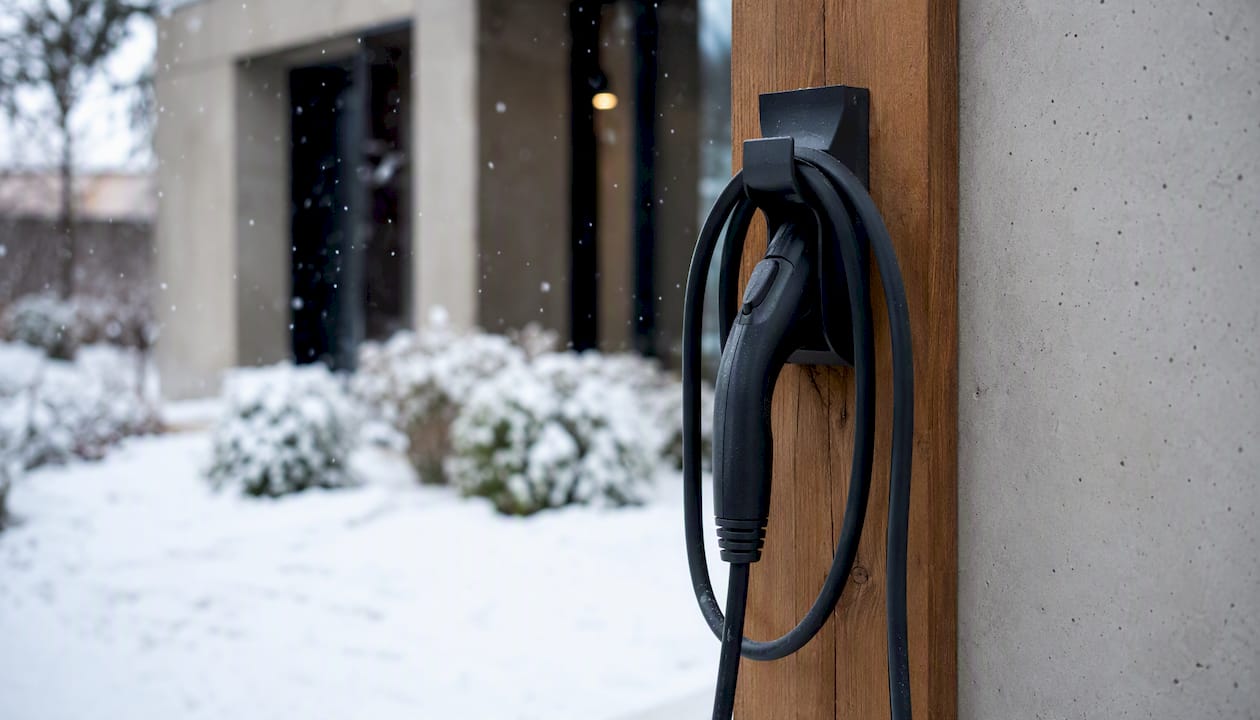
Site routing is the first priority. Keep the cable away from vehicle tyres, hot exhaust areas, and any moving parts. Route it along walls or overhead where possible, and avoid crossing pedestrian walkways without a cable protector ramp. For outdoor runs, use weatherproof conduit — an outdoor EV charger enclosure guide covers conduit and weatherproofing options for Toronto homeowners.
Storage options break down into three categories:
- Wall holsters: Inexpensive and effective for cables up to 7–8 m. Mount beside the wallbox and loop the cable after each session.
- Retractable reels: Better for 10 m cables. Keeps the cable off the floor and reduces coiling effort, though they add cost and require wall space.
- Cable bags: Portable and useful for untethered cables you carry in the car. Less convenient for daily home use.
If you are planning a broader garage reorganisation alongside your charger installation, garage organisation resources can help you plan holster placement and floor layout together.
Cold-weather handling matters in Canada. At temperatures below –10°C, standard PVC cable sheathing stiffens and becomes prone to cracking at sharp bends. Look for cables with TPU (thermoplastic polyurethane) sheathing, which stays flexible at low temperatures. Avoid coiling a cold cable tightly — let it warm slightly before storage if it has been outside.
Maintenance basics: Inspect the connector pins and sheathing every few months. Look for cracks, discolouration, or bent pins. A cable that shows visible sheathing damage should be replaced, not taped.
Buying checklist: what to confirm before you purchase
- Measure the route. Walk the actual cable path, add 1 m of slack, and round up to the next standard length per the LAMPS cable length guide.
- Confirm current rating. Match the cable’s ampacity (16 A, 32 A, or 40 A) to your EVSE’s rated output and your vehicle’s onboard charger limit. The lower of the two sets your actual charging speed.
- Check phase compatibility. Single-phase for most Canadian residential installs; three-phase for commercial or fleet setups.
- Verify connector standard. J1772 for most North American EVs; Type 2 for European-market vehicles; confirm pin configuration matches both ends. Choosing the right cable means matching ampacity to both the car and the EVSE.
- Check certifications. Look for IEC 62196 compliance and manufacturer specs confirming weather and temperature ratings.
- Review warranty terms. A reputable cable carries at least a two-year warranty covering sheathing and connector integrity.
- Plan accessories. Decide on a holster, reel, or bag before installation day so mounting points can be confirmed at the same time.
Quick yes/no checks for online shoppers: Does the listed length match your measured route plus slack? Is the current rating equal to or greater than your EVSE output? Does the weather rating cover Canadian winter temperatures? Is there a clear return policy if the connector does not fit?
What to do when your cable is too short
A cable that falls short by even half a metre creates real problems: connector strain, a cable lying across the floor, and a risk of tripping. Here are the safe options.
Move the wallbox. If the charger is mounted in a fixed position that does not suit your parking spot, an ESA-licensed electrician can relocate it. This is often the cleanest solution and may cost less than you expect.
Buy a longer certified cable. For untethered setups, replacing the portable cable with a longer certified one is straightforward. Confirm the new cable matches your connector standard and current rating.
Install a dedicated socket closer to the car. An installer can add a socket at a more convenient location, shortening the cable run you need.
What you should never do: use a household extension cord. Standard household extension cords are not rated for the sustained current draw of EV charging. They overheat, and that creates a fire risk. The same applies to improvised connectors or non-EV extension solutions. If you need an immediate workaround, call a licensed electrician for a temporary, code-compliant solution.
Canadian safety and regulatory requirements
EV charger installation in Canada is regulated at the provincial level. In Ontario, the Electrical Safety Authority (ESA) requires a permit for Level 2 charger installations, and the work must be performed by or under the supervision of a licensed electrical contractor. Other provinces have equivalent bodies — for example, the Technical Safety BC in British Columbia and the Safety Codes Council in Alberta.
Permits are not optional. An unpermitted EV charger installation can void your home insurance, create liability in the event of a fire, and result in a failed inspection when you sell your home. The ESA permit process exists to confirm that the installation meets the Ontario Electrical Safety Code — including conductor sizing, breaker rating, and proper grounding.
When reviewing cable specifications, look for IEC 62196 compliance and SAE J1772 connector references. These confirm the cable meets the relevant international standards for AC EV charging. For fixed leads over 15 m, the installer should document conductor sizing in the permit application.
Ask any prospective installer about their ESA permit process upfront. A licensed contractor handles the permit application, ESA notification, and post-installation inspection — you should not need to manage any of that paperwork yourself.
What a licensed installer actually measures and checks
When an ESA-licensed electrician assesses your site, they are doing more than confirming the cable will reach. Here is what a thorough site check covers:
- Wallbox-to-port route in every realistic parking position. If you park nose-in on Tuesdays and back-in on weekends, both positions need to work.
- Panel capacity. A 32 A Level 2 charger requires a dedicated 40 A breaker. If your panel is near capacity, the installer will flag whether a smart load management system (EVEMS) can avoid a full panel upgrade.
- Conduit and mounting height. The installer plans the conduit run and confirms the wallbox height suits your vehicle’s port location.
- Conductor sizing for longer runs. For fixed leads over 15 m, the installer verifies that the wire gauge supports the full rated current without meaningful voltage drop.
The typical installer rule of thumb: allow 1 m of slack, round up to the next standard length, and prefer a tethered lead for a dedicated parking position. Installers emphasise measuring the route in every realistic parking position and allowing at least one metre of slack to reduce connector stress.
Moving a wallbox or adding a longer fixed lead usually adds to the permit scope and cost — your installer can give you a firm number after the site visit. Rebate applications for Ontario homeowners can also be handled by the installer, which saves time and reduces the risk of a rejected claim.
The most common mistake Canadian EV owners make
Most people buy a cable that is too long. They assume longer means more flexible, so they default to 10 m when 7 m would have done the job. The result is a heavy cable that pools on the garage floor, drags across the bumper, and wears out faster at the connector end.
The best cable is the shortest one that reliably reaches every expected parking position. Measure first. Add your slack. Then buy the next standard length up — not two sizes up.
For fleet managers, the calculus shifts slightly. A heavier 10–15 m cable is worth the trade-off when it needs to serve vehicles parked at different angles across multiple bays. But even then, measure the longest realistic route before specifying.
Evchargerinstallationtoronto handles the measurement, permit, and rebate for you
Getting the cable length right is one part of the job. The other parts — ESA permit, panel assessment, rebate application, and code-compliant installation — are where most homeowners run into delays.
Evchargerinstallationtoronto’s ESA-licensed electricians serve homeowners and condo owners across the Greater Toronto Area. Every installation includes a site measurement to confirm cable length and conductor sizing, full ESA permit handling at no extra charge, and support for Ontario rebates worth up to $5,000. Installations typically complete within a few hours, with same-week booking available. Pricing starts from $1,800 with no hidden fees.
Use the free installation cost calculator to get an instant estimate based on your home’s layout, then book a site visit so an ESA-licensed electrician can confirm the right cable length and wallbox position for your specific parking setup.
Sources
The sources below cover cable length selection, connector standards, and Canadian regulatory requirements. Use the measurement guides first, then check product pages once you have confirmed your required length.
- EV Charger Cable Length Guide: 5m vs 8m vs 10m | LAMPS
- EV Cable Length Guide: How to Choose Between 5m, 7m, 10m and Longer | EV Cable Hub Journal
- EV Charger Cable Length - Electric Vehicle Geek
- EV charging cable guide: make the right choice - DEFA
- 15m Black Type 2 EV Cable | 22kW 3-Phase | UKCA Certified
This article is general information, not a substitute for advice from a qualified lawyer. Consult a qualified legal professional about your own circumstances before acting on anything here.
Recommended
- EV Charger Installation Cost Calculator Toronto | Free Estimate | EV Install Pro Toronto
- EV Charger Guides & Blog | EV Install Pro Toronto | EV Install Pro Toronto
- Ford EV Charger Installation Toronto | Level 2 Home Charging | EV Install Pro | EV Install Pro Toronto
- EV Charger Installation Cost in Toronto 2025: Complete Pricing Guide | EV Install Pro Toronto
Get Your Free Installation Quote
Free assessment · ESA permit included · Same-week availability across the GTA