Why is my EV charger tripping the GFCI, and is it safe?
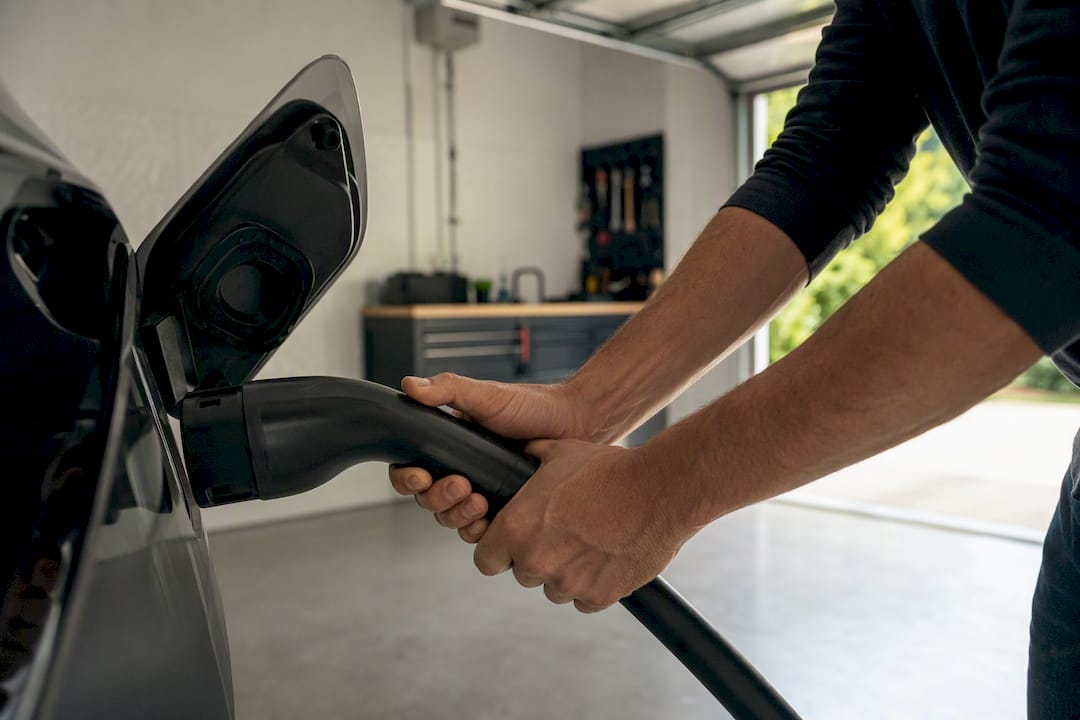
An instant trip the moment you plug in almost always means a ground fault. A trip within the first minute usually points to a circuit overload or wiring mistake. A trip after 20 or 30 minutes of steady charging usually means a thermal problem: a loose connection or an aging breaker working harder than it should.
Here’s your immediate move, based on what you’re seeing:
- Instant trip or any burning smell: stop charging now and call a licensed electrician. Don’t reset a second time.
- Occasional trip, no smell, no heat: reset once, note the exact time and conditions, and keep charging while you watch for a pattern.
- Hardwired charger: you’ve likely already sidestepped the most common nuisance-trip cause, since there’s no outlet-level GFCI fighting with the charger’s internal protection.
- Cord-and-plug charger: the outlet’s own GFCI may be too sensitive for your charger, and the fix is often different from what a hardwired setup needs.
Key Takeaways
The single most reliable fix for recurring EV charger GFCI trips is matching the installation method, hardwired versus cord-and-plug, to your home’s electrical setup and the charger’s listed protection.
| Point | Details |
|---|---|
| Trip timing tells the story | Instant trips point to ground faults, delayed trips point to thermal issues, weather-linked trips point to moisture. |
| Stacked protection causes nuisance trips | A sensitive outlet GFCI and a charger’s internal CCID rarely agree, and hardwiring often removes the conflict. |
| Never bypass safety devices | Removing or swapping a GFCI breaker for a standard one is a safety violation, not a fix. |
| One reset is the limit | Repeated reset-and-retry cycles carry fire risk and mean it’s time to call a professional. |
| Evchargerinstallationtoronto solves it at the source | ESA-licensed electricians run grounding checks under load and recommend hardwired installs starting from $1,800, with permits and rebate handling included. |
Table of Contents
- How to read an EV charger tripping breaker by timing
- What actually causes EV charger GFCI tripping, and how it gets fixed
- Why does a GFCI outlet keep tripping when the EVSE seems fine?
- What can you safely check before calling an electrician?
- When should you stop resetting and call an electrician?
- How a proper installation prevents future GFCI trips
- Ready for a compliant fix? Here’s what to ask for
- Frequently asked questions
- Sources
How to read an EV charger tripping breaker by timing
The clock tells you almost as much as the breaker itself. An instant trip, the kind that happens the second you plug in, usually means the charger’s ground-fault detection or its own self-test caught something wrong before current even started flowing normally. That’s your charger or vehicle protecting you, not malfunctioning.
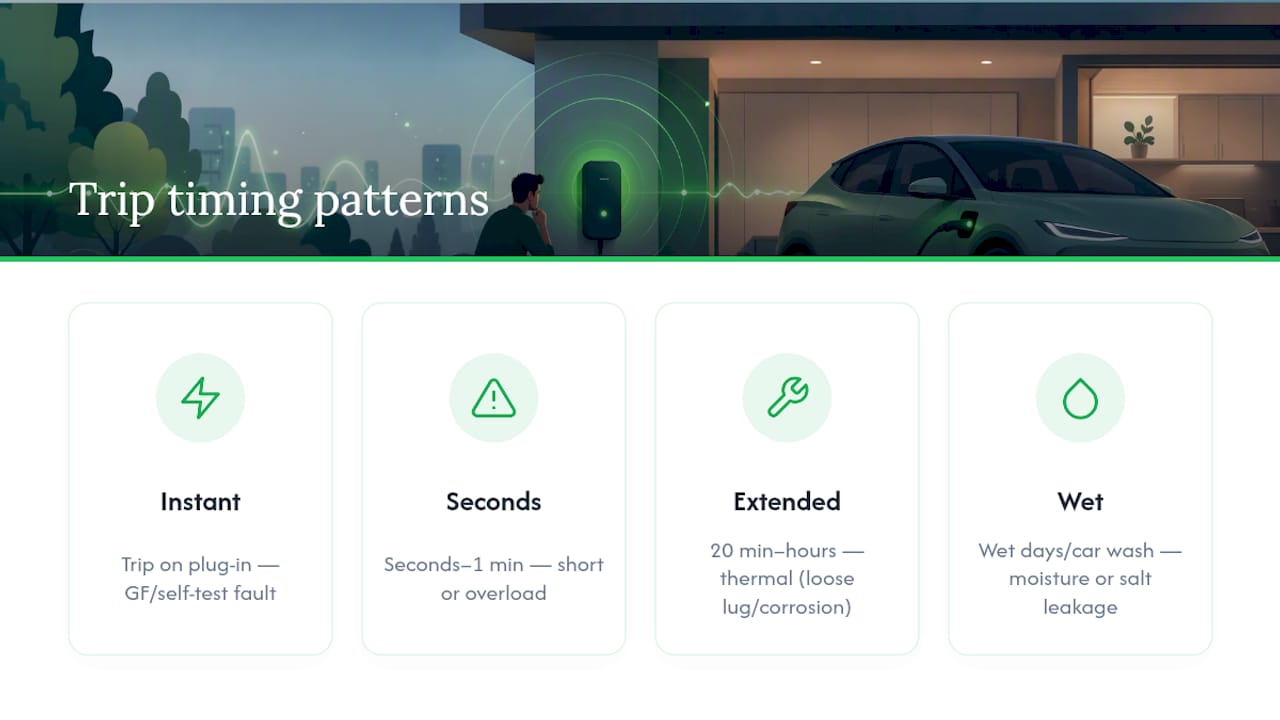
A trip within seconds to about a minute is a different story. That pattern usually points to a short circuit or an immediate overload, something drawing more current than the circuit or breaker can handle right out of the gate.
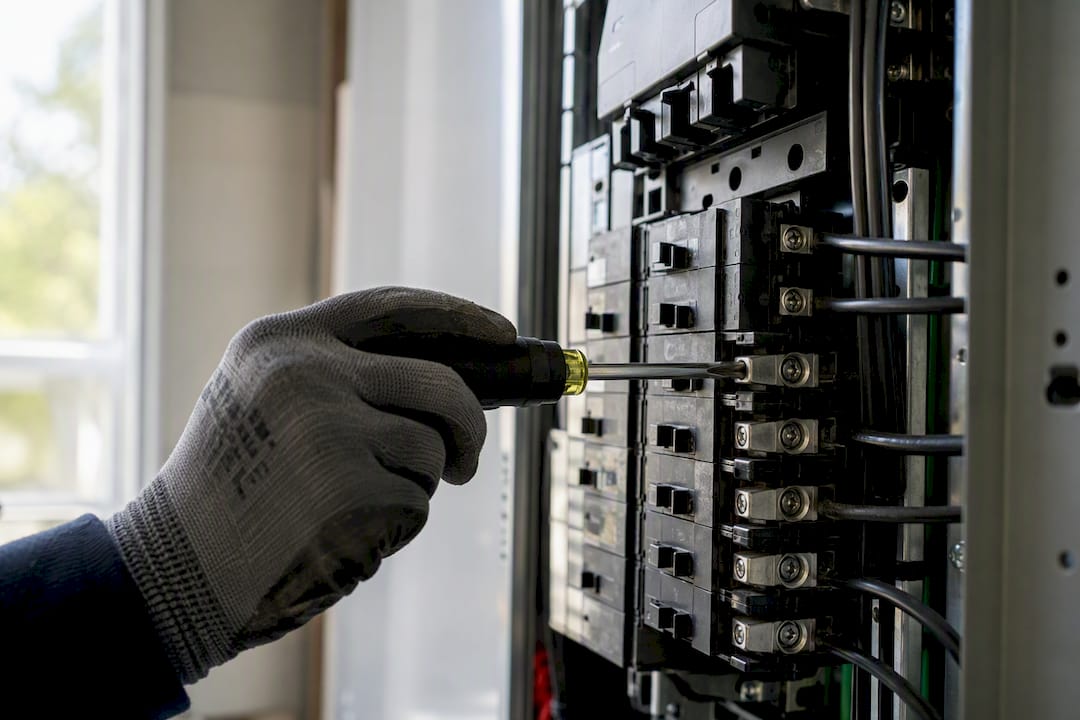
Trips that show up only after extended charging, say 20 minutes to a few hours in, tend to be thermal. A loose lug, a corroded splice, or a breaker that’s simply gotten tired with age will heat up under sustained load and eventually trip, even though everything looked fine at the start.
Weather adds its own wrinkle. Trips that cluster on rainy or humid days, or right after a car wash, usually mean moisture has found its way into the connector or the vehicle’s charging inlet. Winter road salt and slush make this worse, since salt residue conducts just enough current to trip a sensitive ground-fault device.
One pattern overrides everything else: any burning smell, visible heat, or scorch marks on the outlet or plug mean stop immediately and call a professional. As the field diagnostic guidance from Charge Papa lays out, trip timing is one of the most reliable clues a homeowner has for isolating the cause before an electrician even arrives.
What actually causes EV charger GFCI tripping, and how it gets fixed
Most nuisance trips trace back to one of five root causes, and each one has a fairly predictable fix.
- Stacked ground-fault protection. Your home’s outlet-level GFCI and your charger’s internal ground-fault detector are both watching for leakage, but they trip at different thresholds. When both are in the circuit, the more sensitive one usually wins, tripping even when nothing is actually wrong. The fix is often to switch to a hardwired installation or adjust the protection chain to match your electrical code’s requirements.
- Moisture or a dirty connector. Water, road salt, or grime on the pilot pins creates a leakage path that reads as a ground fault. An electrician cleans the contacts or replaces a damaged cable, and the trips stop.
- Circuit overload or wrong breaker size. If your charger is pulling more current than the circuit is rated for, you need a dedicated circuit sized correctly for your charger’s amperage, sometimes requiring a panel upgrade.
- Loose lugs or an aging breaker. These cause the delayed, heat-driven trips described above. An electrician tightens connections or replaces worn components after a proper inspection.
- Fault isolation between vehicle and charger. If you own or have access to a second EV, try charging it on the same station. If the second car charges fine, the first vehicle is likely the problem, not your installation.
Pro Tip: Before calling an electrician, write down whether the trip happened with a different vehicle, at a different time of day, or during rain. That single detail can cut diagnostic time in half.
Why does a GFCI outlet keep tripping when the EVSE seems fine?
This is the part most homeowners never get a straight answer on, so here it is plainly: a standard residential GFCI and your charger’s built-in protection are not the same device, and they’re not tuned to agree with each other.
Household GFCIs are built to trip at roughly 4 to 6 milliamps of leakage, a threshold designed for general safety around outlets, tools, and appliances. Most EV chargers, by comparison, ship with an internal charge circuit-interrupting device, often rated CCID20, paired with ground-monitoring circuitry built specifically for the steadier, slightly higher leakage that’s normal during EV charging.
- Residential GFCI sensitivity: about 4–6 mA
- Typical EVSE internal protection includes an internal device tuned for EV-specific leakage patterns
- Result when both are present: the more sensitive device trips first, often for no real fault at all
That mismatch is exactly why stacked GFCI protection is one of the most frequent sources of nuisance trips installers see in the field. Many electrical codes permit a hardwired EVSE installation without an upstream GFCI, provided the equipment’s own listed protection and your local authority having jurisdiction both sign off.
The charger isn’t malfunctioning when this happens. Two safety devices are doing their job at different sensitivities, and the more cautious one is winning.
Modern EVSEs increasingly add residual DC current detection as well, catching a type of fault that ordinary AC-only devices can miss entirely.
What can you safely check before calling an electrician?
A few checks are genuinely safe for a homeowner to run, and they’ll save your electrician time and save you a diagnostic callout fee.
- Log everything first. Write down the exact time of each trip, the weather, whether it happened immediately or after a delay, and any smell or heat you noticed.
- Test on a different outlet if your charger is portable. If the trips stop on a known-good circuit, the problem is almost certainly upstream, not in the charger itself.
- Lower the charging amperage if your charger allows it. If trips stop at a lower current draw, you’re likely dealing with an overload issue rather than a true ground fault.
- Inspect connectors visually, with the power off, for moisture or debris, then let them dry fully before your next attempt.
- Never remove, bypass, or swap out a GFCI breaker for a standard one. That’s not a fix, it’s a safety violation, and it’s outside the boundary of anything a homeowner should touch.
Pro Tip: If you’re troubleshooting a moisture-related trip after a storm, general connector inspection guidance from the RV electrical world applies surprisingly well. Outdoor charging equipment and RV shore power face nearly identical moisture challenges.
When should you stop resetting and call an electrician?
Some signs leave no room for a second guess. Stop charging and call a licensed electrician immediately if you see any of the following:
- The breaker trips every single time you plug in, with no exceptions.
- You smell burning, feel unusual heat from the outlet or plug, or notice scorch marks anywhere near the connection.
- Other circuits or appliances in the house start tripping too, which suggests a panel-level or breaker failure well beyond your charger.
- You feel any tingling or shock, or you see arcing. This is an emergency, not a troubleshooting step.
- You’ve already reset the breaker once and it tripped again. Repeated reset-and-retry cycles carry real fire risk and are never worth pushing through on your own.
How a proper installation prevents future GFCI trips
Most recurring trip problems trace back to how the charger was installed in the first place, not a defect in the charger itself. A hardwired Level 2 installation typically removes the outlet-and-upstream-GFCI conflict entirely, since the charger’s own listed protection becomes the only ground-fault device in the loop.
A correct installation also means:
- A dedicated circuit sized to the 80% continuous-load rule, so your charger never asks more of the wiring than it can safely deliver.
- A panel upgrade when your existing service can’t support the added load, evaluated honestly rather than assumed.
- Load management systems like EVEMS or DCC-12 for homes running multiple high-draw appliances or a second EV.
- Grounding continuity verified under actual load, not just at rest, since some ground-path failures only appear once current is flowing.
Evchargerinstallationtoronto’s ESA-licensed electricians run every one of these checks as standard on every installation, with transparent pricing starting from $1,800 and permits handled at no extra charge, which is exactly the kind of upfront work that keeps a GFCI from ever nuisance-tripping again.
A note from the field
Most recurring trips resolve with a proper grounding check or a switch to hardwired installation. Calling a licensed electrician early saves you time, money, and risk.
Ready for a compliant fix? Here’s what to ask for
A permit-inclusive site visit from an ESA-licensed electrician is the fastest way to know for certain whether you’re dealing with a wiring fault, a mismatched protection setup, or a charger that simply needs to be hardwired. When you book with Evchargerinstallationtoronto, ask specifically for a grounding continuity check under load, a clear recommendation on hardwired versus cord-and-plug, and a quote that already includes your permit, since that’s how you avoid a second invoice showing up later.

Pricing starts from $1,800, most installations across the Greater Toronto Area book the same week, and the team handles rebate paperwork worth up to $5,000 on qualifying new EV purchases as part of the job, not as an add-on. If you want a number before you pick up the phone, run your address and charger model through the EV charger installation cost calculator for a free estimate, or check the live service area map to confirm coverage where you live.
Frequently asked questions
Is it dangerous to keep resetting a tripped GFCI breaker for my EV charger? Resetting once to check the pattern is fine. Resetting repeatedly after it trips again is not. That behaviour carries real fire risk, and it means the underlying fault needs a licensed electrician, not another reset.
Can I just remove the GFCI protection to stop the tripping? No. Bypassing or replacing a GFCI breaker with a standard one defeats the safety protection your charger and your home depend on. If the trip is a coordination problem between your outlet’s GFCI and your charger’s internal CCID, the fix is a proper installation change, not removing protection.
Does a hardwired EV charger installation really stop GFCI tripping? In many cases, yes. Hardwiring removes the outlet-level GFCI from the circuit entirely, leaving only the charger’s own listed ground-fault protection in place, which eliminates the sensitivity mismatch that causes most nuisance trips.
Why does my charger only trip during or after rain? Moisture in the connector or the vehicle’s charging inlet creates a leakage path that reads as a ground fault. Dry the connector fully with the power off and inspect for damage before your next charging attempt.
When is EV charger tripping breaker behaviour a sign of a bigger electrical problem? If the trip happens every single time, involves heat or a burning smell, or coincides with other circuits tripping in your home, you’re likely looking at a panel-level or wiring issue that needs professional inspection right away.
Sources
- EV Charger Circuit Troubleshooting — Trips & Capacity | TestTalkHQ
- EV Charger Ground Faults Guide - Electric Vehicle Geek
- EV Charger Tripping Breaker? 6 Causes + Breaker Sizing Chart (2026) – Charge Papa
Recommended
- GFCI breaker vs outlet: what homeowners should choose | EV Install Pro Toronto
- EV Charger Installation Toronto & GTA | EV Install Pro
- EVEMS Installation Toronto | Smart Load Management | Skip the Panel Upgrade | EV Install Pro Toronto
- Find EV Chargers Near Me in Toronto & the GTA | Live Map | EV Install Pro Toronto
Get Your Free Installation Quote
Free assessment · ESA permit included · Same-week availability across the GTA