Should you use a subpanel for your EV charger?
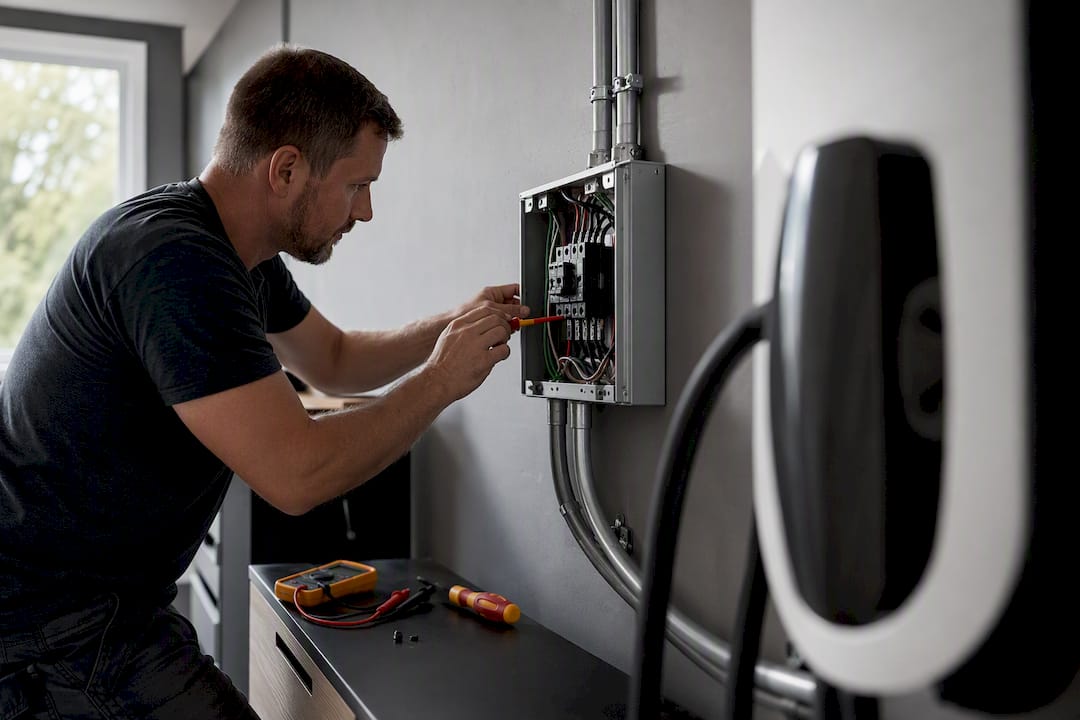
Yes, usually. A subpanel for an EV charger works fine if your main electrical service has spare calculated capacity once you add the charger at 125% continuous load. A subpanel moves breaker slots closer to the garage and simplifies wiring, but it does not add a single amp to your total service size. Your next step is a demand load calculation, or a call to a licensed electrician who can run one and tell you what permits apply.
TL;DR:
- A subpanel is sufficient only if your main panel has available capacity after the EV charger’s continuous load is factored in at 125%.
- Load calculations must be performed to determine if a subpanel or full service upgrade is necessary, especially for homes with high existing loads or all-electric systems.
- Installation costs vary widely, with subpanels typically costing between $1,500 and $4,000, and full upgrades taking several weeks due to utility scheduling.
- Proper sizing of breakers and feeders, correct subpanel wiring, and permit compliance are critical to avoid safety violations and inspection failures.
- Load management devices offer a cheaper, faster alternative for homes with modest EV charging needs or borderline capacity, avoiding the need for a full subpanel or upgrade.
Table of Contents
- Subpanel vs. service upgrade vs. load management: how to decide
- What a subpanel or service upgrade actually costs
- How electricians size breakers and feeders for EV circuits
- Permits, inspections, and the code mistakes that fail
- Cheaper or faster alternatives to a subpanel
- What to ask before you hire an electrician
- What real installs tell us about subpanel problems
- Common troubleshooting and maintenance for EV subpanels
- Why the math matters more than the panel
- Get your subpanel or panel upgrade done right, without the guesswork
- Sources
Subpanel vs. service upgrade vs. load management: how to decide
The decision comes down to one question: does your main service have room left after the charger is added? Electricians answer that with a load calculation, similar in structure to the process outlined in NEC Article 220, which adds up your existing connected loads, then layers on the EV charger at 125% of its continuous amperage rating. If the math lands at or above that threshold, no subpanel configuration fixes the underlying shortage. ChargeRight’s comparison of subpanels and service upgrades frames this correctly: the subpanel question is really a capacity question wearing a wiring disguise.
A few signs point clearly toward a subpanel:
- Your main panel has open breaker slots but the electrician confirms amperage headroom too, not just physical space
- The garage or driveway sits far enough from the main panel that a dedicated subpanel simplifies the wire run
- You want extra circuits near the charging spot for a workshop, air compressor, or future second charger
- Your home is gas-heated, gas-hot-water, and doesn’t run large electric loads like a heat pump or electric range
Other signs point toward a full 200-amp service upgrade instead:
- The load calculation shows you’re already near or over your panel’s rated capacity before the EV charger enters the equation
- Your home is all-electric, with electric heating, a heat pump, or an electric range already drawing heavily
- You’re planning for two EVs, a pool, or a future heat pump conversion within the next few years
- Your existing panel is a brand flagged in past safety recalls, which means replacement is coming regardless of the EV question
Not every 100 or 150-amp home actually needs 200 amps. Electrification guidance from Rewiring America points out that plenty of households electrify successfully on smaller services when they make power-smart equipment choices. That’s exactly where a smart load-management device or a lower-amperage charger earns its place: if your calculated load lands just over the comfortable threshold, throttling charging automatically during peak household demand can be cheaper than either a subpanel or an upgrade.
Pro Tip: Ask your electrician to show you the load calculation numbers on paper, not just the recommendation. A one-page worksheet takes them ten minutes and saves you from paying for capacity you don’t need.
What a subpanel or service upgrade actually costs
Pricing swings more than most homeowners expect, and the reasons are almost always physical: distance from the main panel, wire gauge, whether conduit needs to be run through finished walls, and whether the garage is attached or detached.
A straightforward 60 to 100-amp subpanel installation, fed from a main panel with spare capacity, tends to land at the lower end of the cost spectrum when the run is short and the walls are accessible. Full service upgrades cost considerably more because they often involve utility coordination, a new meter socket, and sometimes a service-entrance conductor replacement. Market cost data compiled by FixUpFirst puts typical panel upgrade costs somewhere in the $1,500 to $4,000 range, with subpanel work generally sitting below that band when a full upgrade isn’t required.
Timeline differs just as much as price. A subpanel with an available main breaker slot is often a same-day or one-day job. A service upgrade frequently takes several weeks, mostly waiting on the utility to schedule a meter swap or service-line inspection, not because the electrical work itself is slow.
A properly itemized quote should list:
- Subpanel or main panel model and amperage rating
- Feeder conductor size and length
- Breaker sizes for the EV circuit and any other new circuits
- Permit fees and who is pulling the permit
- Inspection scheduling and sign-off responsibility
Treat a quote missing a load calculation, or one that gives you a lump price with no breakdown of wire gauge and breaker sizes, as a reason to ask more questions before signing anything.
How electricians size breakers and feeders for EV circuits
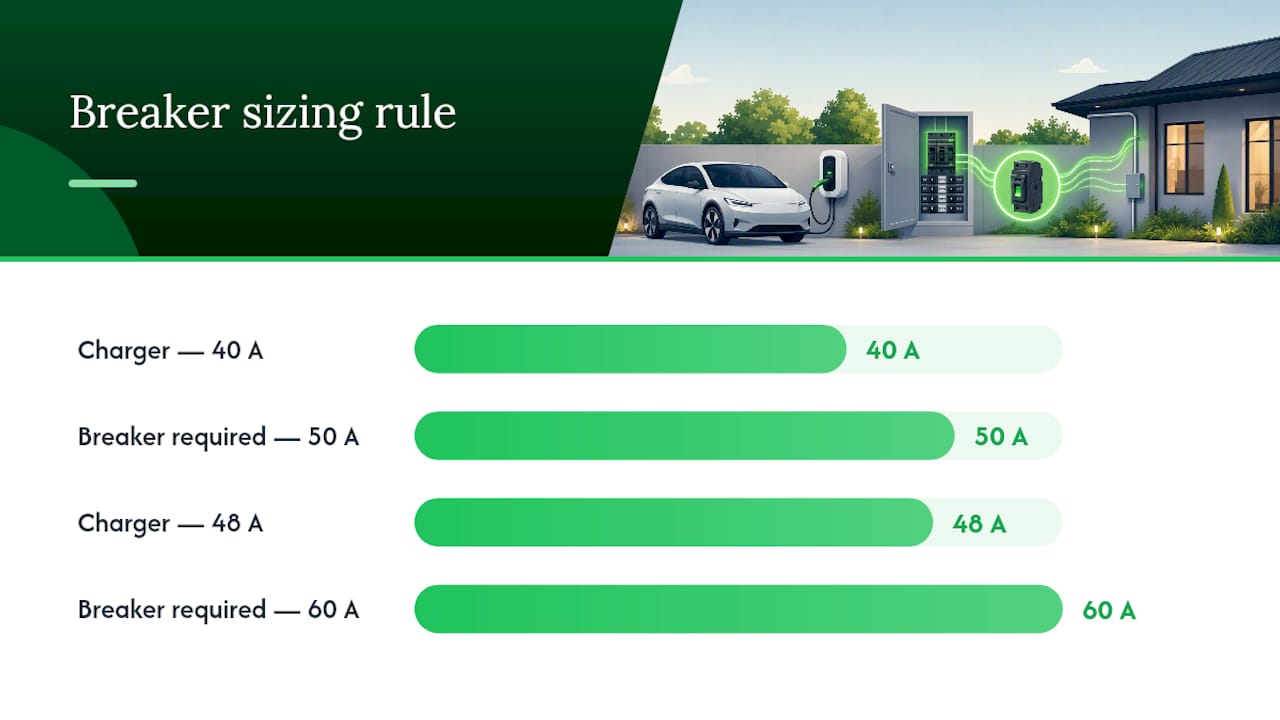
Every EV charging circuit gets sized using the same rule: the continuous-load factor. Electricians rate the circuit at 125% of the charger’s continuous amperage, not the charger’s nameplate rating alone. A 40-amp charger requires a 50-amp breaker and matching conductor. A 48-amp charger requires a 60-amp breaker. This isn’t a rounding convention, it’s how NEC Article 220-style continuous-load calculations account for equipment that draws steady current for hours at a stretch.
The subpanel itself needs a correctly sized feeder running back to the main panel, and that feeder has to carry four wires: two hots, a neutral, and a ground. The feeder breaker at the main panel sets the ceiling for how much the feeder conductor can carry, so undersizing either half of that pair creates a bottleneck or a code violation.
One detail trips up more DIY and even some professional installs than any other: the neutral and ground must stay isolated inside the subpanel. Community troubleshooting discussions, including a detailed thread on DIY Stack Exchange covering subpanel wiring for EV chargers, repeatedly flag bonded neutral and ground bars in subpanels as one of the most common failures electricians and inspectors catch. In a main panel, neutral and ground bond together. In a subpanel, that bonding screw or strap needs to come out, and the two bars stay electrically separate, with bonding happening only once, at the main service.
A few sizing and grounding rules worth knowing before you talk to an electrician:
- Detached garages or structures usually need their own grounding electrode, separate from the one at the house, unless the feeder already carries an equipment ground back to the main service ground.
- A NEMA 14-50 outlet requires a neutral conductor because it’s designed for appliances that need one; a NEMA 6-50 does not, since EVSEs on that outlet type don’t use neutral.
- Even if your current charger doesn’t need a neutral, running one anyway during installation costs little extra and avoids reopening walls or conduit later if you switch equipment.
Pro Tip: If your electrician mentions “bonding jumper” for your subpanel installation, that’s your cue to ask directly whether it’s being removed, not installed. A bonding jumper belongs at the main service, never in a downstream subpanel.
Permits, inspections, and the code mistakes that fail
Skipping the permit step feels like an easy shortcut, and it’s the one that causes the most expensive regret. Permits and inspections exist because subpanel wiring errors are common enough that authorities check for them specifically, and going without one can void your home insurance coverage or disqualify you from rebate programs entirely. Plug’n Drive’s installation guidance treats permitting as a standard, non-optional part of any charging station project, not an upsell.
The failures that show up again and again during inspection follow a pattern:
- Neutral bonded to ground inside the subpanel instead of isolated
- Feeder conductors undersized for the breaker protecting them
- Ground conductor used in place of neutral, or vice versa
- Missing grounding electrode at a detached structure fed by the subpanel
One inspector-facing detail is worth repeating on its own: separate neutral and ground bars in a subpanel are treated as non-negotiable by most inspectors, and it’s the single most-cited reason subpanel installs fail on the first pass.
Before you accept any quote, ask for the electrician’s licence number, proof of insurance, and confirmation that they’ll pull the permit themselves rather than leaving that step to you. A licensed electrician should also walk you through the load calculation results, referencing the same 125% continuous-load sizing principle covered above, before finalizing any number on paper.
Cheaper or faster alternatives to a subpanel
A subpanel isn’t always the right answer, and sometimes it isn’t even necessary. Smart load-management systems, often called EVEMS or dynamic circuit control, sit between your panel and your charger and throttle the charging current automatically when household demand climbs. Natural Resources Canada’s work on open-standard load management describes exactly this kind of hardware as a way to manage EV charging loads without adding panel capacity, and the equipment costs a fraction of a full service upgrade.
A few situations where an alternative beats a subpanel outright:
- Your daily driving needs are modest and a lower-amperage charger, paired with scheduled overnight charging, covers your battery needs without stressing the panel at all
- Your load calculation lands right on the edge, and a load-management device lets you avoid both a subpanel and an upgrade
- You have existing circuits serving low-priority loads, like a hot tub or workshop, that can be reassigned or shared temporarily while you plan a longer-term panel strategy
None of these options are downgrades. They’re often the smarter first move, especially in a home where the math doesn’t clearly favour bigger electrical work yet.
What to ask before you hire an electrician
A short list of direct questions separates a solid quote from a guess dressed up as a quote.
- Will you run a load calculation before pricing the job, and can I see the numbers?
- Are you ESA-licensed, insured, and will you personally pull the permit?
- What’s included in the quote: panel or subpanel model, feeder wire gauge, breaker sizes, conduit, permit fee, and inspection?
- What happens if the inspection flags an issue, and is that covered under the original price?
Any electrician who recommends a full service upgrade without showing you the math, or who resists listing wire gauge and breaker sizes in writing, is a red flag worth walking away from. Compare quotes item by item rather than as a single bottom-line number, since two similar prices can hide very different scopes of work. Once the job is done, keep your permit paperwork and inspection sign-off. You’ll need both for insurance records and for any future rebate applications tied to the installation.
What real installs tell us about subpanel problems
Field experience across ESA-licensed installations tends to surface the same handful of issues, over and over, regardless of the neighbourhood or the home’s age. EV Install Pro’s electricians report that most subpanel projects for EV charging fall into one of a few repeatable patterns, each with a known fix.
- A homeowner’s main panel technically has open slots but not enough calculated capacity, resolved by running the load calculation first and either right-sizing the charger or adding load management
- A previous DIY or unpermitted subpanel install has neutral bonded to ground, resolved by isolating the bars and verifying the feeder protection size before energizing anything
- A detached garage subpanel lacks its own grounding electrode, resolved by installing one before the inspection is booked, not after a failed one
- A borderline load calculation gets resolved with an EVEMS installation instead of a costlier service upgrade
Installations completed by EV Install Pro’s ESA-licensed team typically wrap up within a few hours for straightforward subpanel work, with transparent pricing starting from $1,800, permit handling included at no extra charge, and rebate paperwork support worth up to $5,000 for qualifying new EV purchases. Customer feedback reflects that consistency, with a 4.9 rating from homeowners across the Greater Toronto Area.
Common troubleshooting and maintenance for EV subpanels
Once a subpanel is installed and inspected, it needs very little ongoing attention, but a handful of warning signs are worth knowing.
A breaker that trips repeatedly during charging usually means the circuit is undersized for the charger’s actual draw, or the charger’s amperage setting was never adjusted to match the circuit after installation. Check the charger’s onboard settings before assuming the wiring is at fault. Warm or discoloured breaker faces, buzzing sounds, or a burning smell near the subpanel are not normal and warrant an immediate call to a licensed electrician rather than a wait-and-see approach.
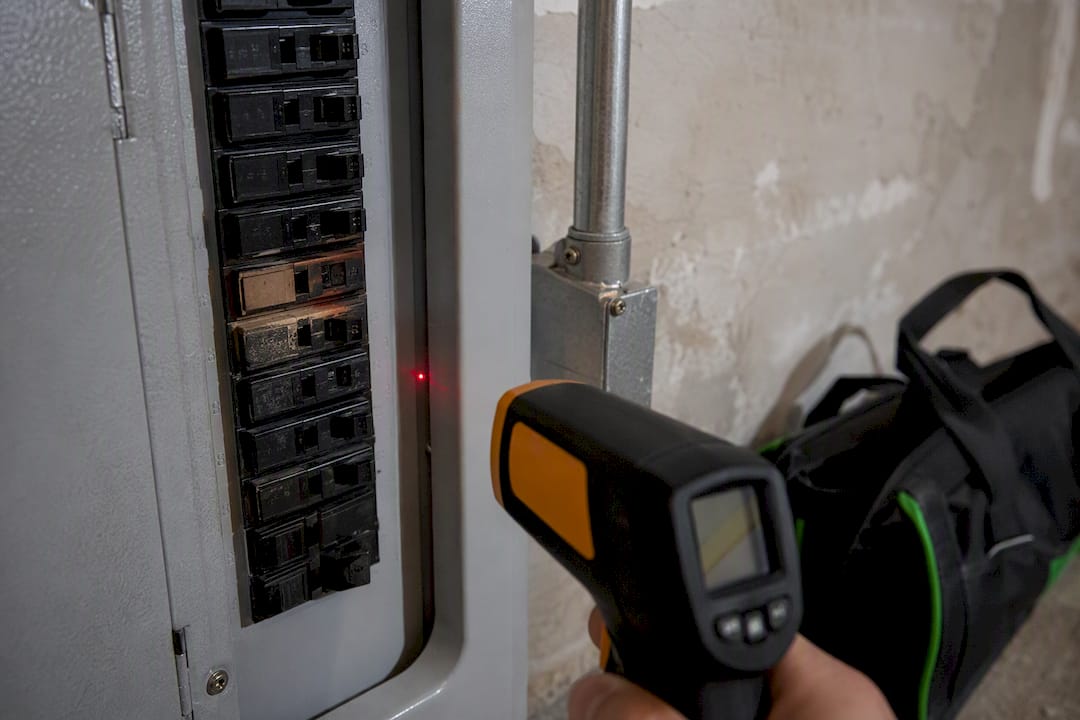
Loose lug connections at the feeder terminals are a slower-building problem. Vibration and thermal cycling from repeated charging sessions can gradually loosen connections over the years, which is why a periodic check, roughly every couple of years, or sooner if you notice intermittent charging interruptions, is worth scheduling. Corrosion at outdoor subpanel enclosures is another slow failure point, particularly in unheated garages or detached structures exposed to humidity swings.
Keep the subpanel’s cover secure and the area around it clear of storage. Electricians need access for any future inspection or troubleshooting call, and blocked panels slow down diagnosis when something does go wrong. None of this requires special tools or a service contract, just the same basic vigilance you’d apply to any electrical equipment running daily.
Why the math matters more than the panel
The most overrated piece of advice in this entire topic is the blanket suggestion that every EV owner needs a 200-amp service. It isn’t true, and it leads homeowners to spend thousands more than necessary. What actually determines the right answer is the load calculation, done properly, before a single wire is priced out.
The conventional advice skips straight to hardware. A better approach starts with arithmetic: what your home actually draws, what headroom exists, and whether a subpanel, a load-management device, or a genuine upgrade is what the numbers demand. Homeowners who ask for that calculation in writing consistently end up with cheaper, faster, and more defensible installations than those who accept a recommendation on faith.
If there’s one thing to prioritize, it’s this: don’t let anyone quote your job before they’ve done the math. Everything else, wiring, permits, inspection, follows naturally once that number is right.
— Hafiz
Get your subpanel or panel upgrade done right, without the guesswork
EV Install Pro handles the entire process homeowners just read about: the load calculation, the permit, the inspection, and the actual installation, all under one ESA-licensed team instead of juggling separate contractors and utility calls yourself.
Pricing starts from an affordable base, with permit handling and rebate paperwork support included at no extra charge, and most subpanel jobs are completed within a few hours of arrival. If you’re not sure yet whether your home needs a subpanel, a full service upgrade, or an EVEMS setup, run your numbers through the EV charger installation cost calculator for a free estimate, or book a no-obligation assessment and let a licensed electrician run the load calculation for you before you commit to anything.
Sources
- Natural Resources Canada — open standard load management for EV chargers
- Sub-Panel vs Service Upgrade for an EV Charger: Which Saves You $2,000+ (2026) - ChargeRight
- EV Charger - Subpanel Changes — DIY Stack Exchange
Recommended
- Do I Need a Panel Upgrade for an EV Charger in Ontario? (2026 Guide) | EV Install Pro Toronto
- Do I Need a Panel Upgrade for an EV Charger? (Toronto & GTA Guide 2026) | EV Install Pro Toronto
- EVEMS Installation Toronto | Smart Load Management | Skip the Panel Upgrade | EV Install Pro Toronto
- Do you need a dedicated circuit for an EV charger? | EV Install Pro Toronto
Get Your Free Installation Quote
Free assessment · ESA permit included · Same-week availability across the GTA