Two EVs, one charger: your practical home guide
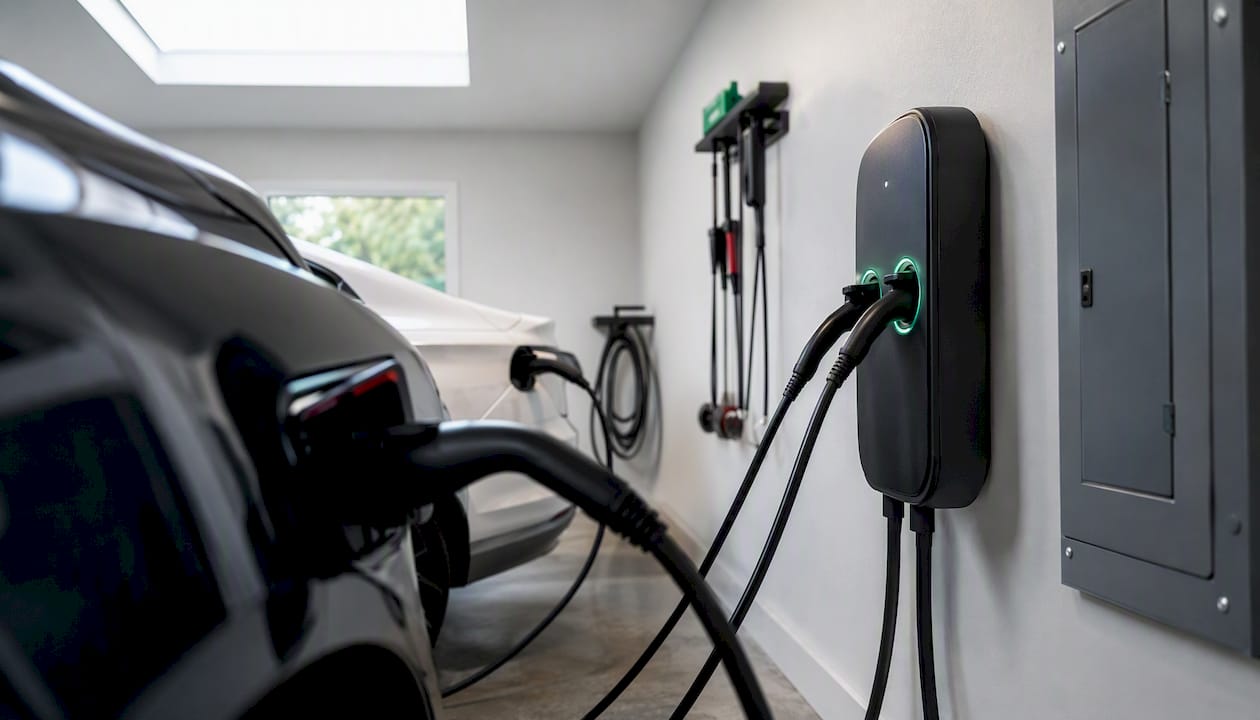
Yes, two EVs can share one charger in most Canadian homes. The right approach depends on your panel capacity, how often both vehicles need to charge at the same time, and your budget. Here is what to do right now:
- Check your main service size. Look at your electrical panel for a label showing 100 A, 150 A, or 200 A. That number tells you how much room you have to work with.
- Count available breaker slots. If you have two or more open double-pole slots, a second circuit or a dual-port charger is likely feasible without a panel upgrade.
- Decide whether simultaneous charging matters. If both drivers leave early in the morning, you need power to both vehicles overnight. If schedules differ, sequential charging on a single Level 2 charger may be all you need.
- Book a site check with an ESA-licensed installer if you are unsure about any of the above. A load calculation takes less than an hour and gives you a clear answer before you spend anything.
The four practical methods are: scheduled sequential charging (lowest cost), a dual-port charger (one circuit, two outlets), smart load sharing via an EVEMS or DCC-12 device (two chargers, one circuit), and two fully independent circuits. Each one suits a different home setup and budget.
Key takeaways
Charging two EVs at home is achievable in most Canadian homes without a panel upgrade, provided you match the approach to your panel capacity, daily driving needs, and budget.
| Point | Details |
|---|---|
| Four practical approaches | Sequential charging, dual-port charger, EVEMS load sharing, and two independent circuits each suit different panel sizes and budgets. |
| Dual-port speed trade-off | A 40 A dual-port unit like the HCS-D50P delivers 20 A per port when both cars charge, providing 19 miles (30 km) of range per hour per vehicle—enough to replenish typical daily driving needs. |
| 200 A panel flexibility | A 200 A service often has enough spare capacity for two 32 A chargers without an upgrade, but a formal load calculation is required first. |
| Permits are mandatory in Ontario | All residential EV charger circuits require an ESA permit and inspection; only a licensed electrical contractor can pull the permit. |
| Evchargerinstallationtoronto | Handles ESA permits, rebate paperwork, and EVEMS or dual-port installs across the GTA, with pricing starting at $1,800 and same-week booking. |
Table of Contents
- How can two EVs share one electrical supply?
- What hardware is available in Canada and how do the specs affect charging?
- What does your home electrical system need to support two EVs?
- What permits and licensed electricians do you need in Canada?
- How do you choose the right option for your home?
- What most homeowners get wrong about charging two EVs
- Evchargerinstallationtoronto makes two-vehicle charging straightforward in the GTA
- Useful sources for further reading
How can two EVs share one electrical supply?
Charging two EVs at home does not always require doubling your electrical infrastructure. Four approaches cover the full range of home setups, from a 100 A panel with no spare breakers to a 200 A service with room to spare.
Sequential or scheduled charging
You plug one car in, it charges overnight, then you swap the connector to the second vehicle. With built-in vehicle timers, you can schedule Car A to charge from 11 PM to 3 AM and Car B from 3 AM to 7 AM. No additional hardware is needed beyond your existing Level 2 charger. This works well when both drivers cover modest daily distances and the vehicles are home by evening. It is the lowest-cost option and meets most households’ needs when simultaneous charging is not required.
If one vehicle is a low-mileage second car, pairing a Level 2 charger for the primary vehicle with the included Level 1 cord for the second car is another practical, low-cost strategy.
Dual-port (dual-head) chargers
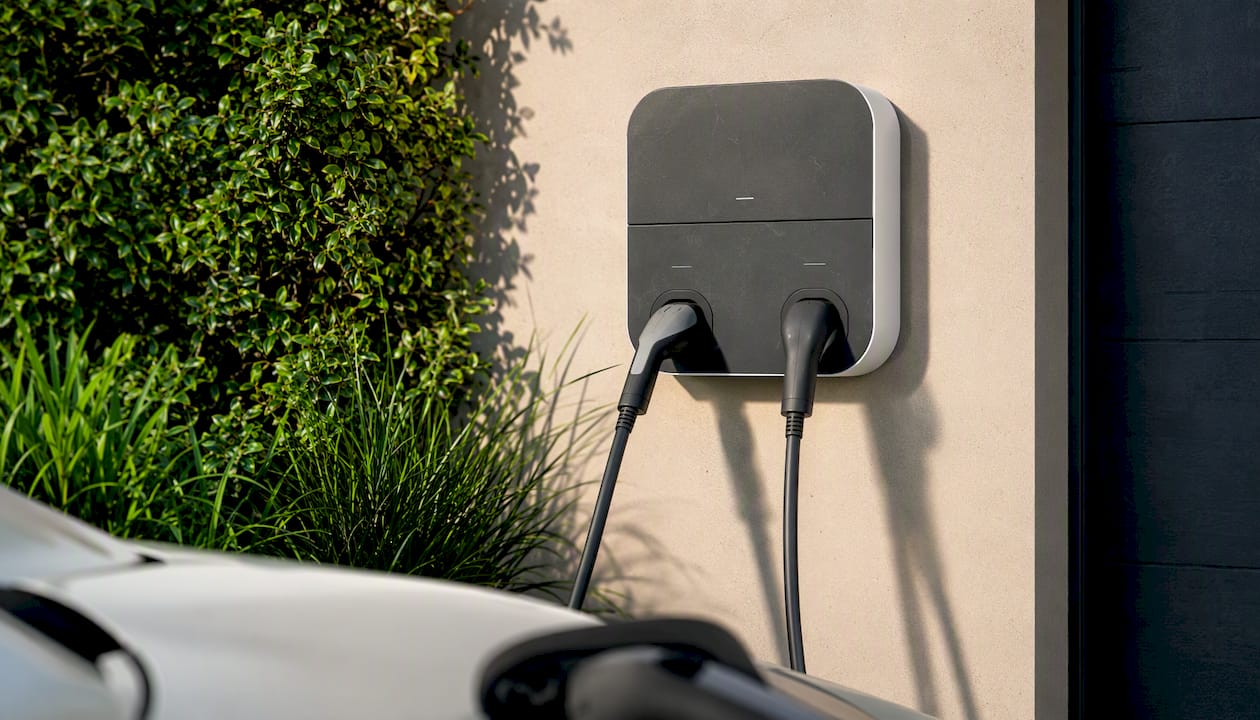
A single wall unit with two outlets lets both vehicles plug in at the same time. Power splits automatically: when only one car is connected, it gets the full amperage; when both are plugged in, each gets half. One circuit, one installation run, two cars charging simultaneously. Dual-port units generally cost less than installing two separate charge stations because they share a single housing and a single installer run.
Smart load sharing: EVEMS and DCC-12 devices
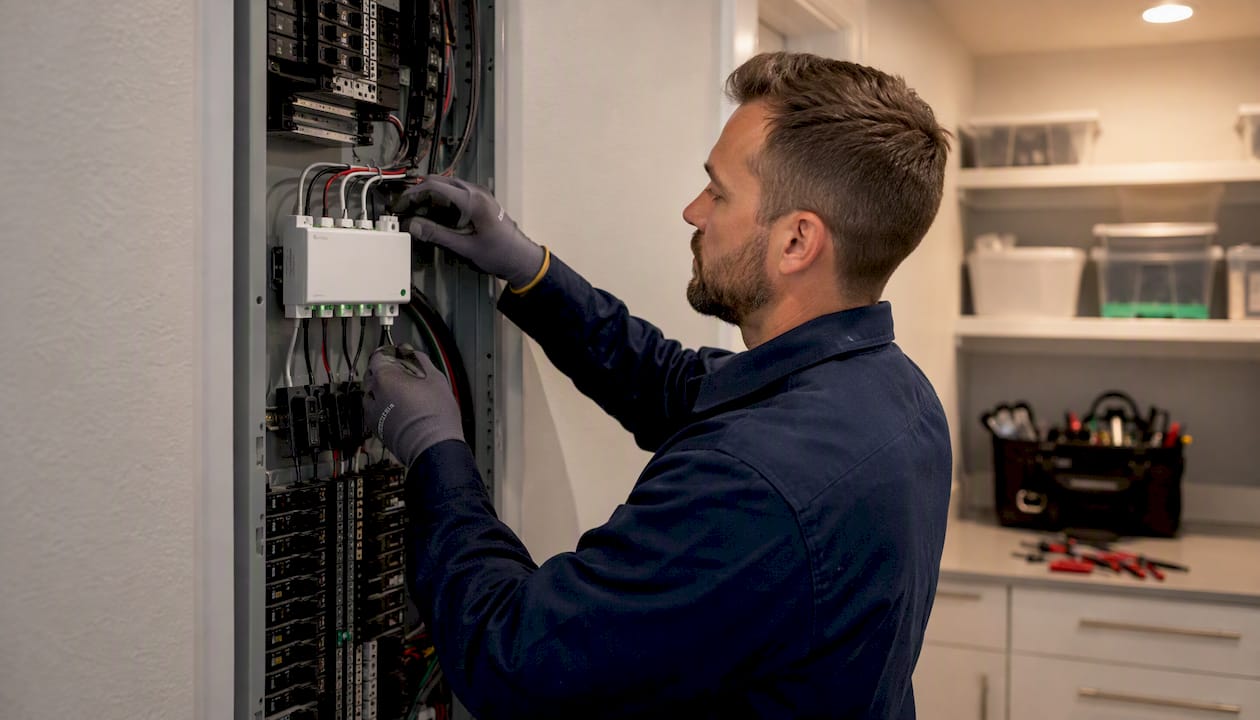
An EVEMS (Electric Vehicle Energy Management System) uses current transformers on your main service to monitor total household draw in real time. When your dryer, oven, or air conditioner kicks in, the system throttles EV charging automatically to prevent a breaker trip. When demand drops, it ramps charging back up. Two chargers operate from one circuit without overloading the panel. This approach frequently avoids a costly panel upgrade and is particularly useful where adding a second circuit is not feasible.
Two dedicated circuits
Two independent Level 2 chargers on separate circuits deliver full-speed charging to both vehicles at the same time, with no power sharing or throttling. The trade-off is panel capacity: two 50 A circuits require 100 A of spare breaker capacity, and two 60 A circuits require 120 A. Most 200 A panels can support this if household load allows, but a formal load calculation is required before installation.
Pro Tip: If your panel is already near capacity, an EVEMS or DCC-12 device is often the smarter call over a full panel upgrade. The hardware typically costs $300–$1,000 plus installation, compared to several thousand dollars for a service upgrade.
What hardware is available in Canada and how do the specs affect charging?
Concrete specs matter here. The amperage a charger delivers per port translates directly into how quickly each vehicle recovers range overnight.
ClipperCreek HCS-D50P
The ClipperCreek HCS-D50P is a 40 A dual-port unit with 25-foot cables on each outlet. When only one vehicle is connected, it delivers the full 40 A. When both are plugged in, it splits to 20 A per port automatically. At 40 A solo, you can expect up to 38 miles per hour of charging. At 20 A per port with both cars charging, that reduces to 19 miles per hour per vehicle—enough for overnight charging.
The HCS-D50P plugs into a NEMA 14-50 outlet, which requires a 50 A circuit. It does not require hardwiring, which simplifies installation and can reduce labour time.
EVEMS / DCC-12 load management devices
An EVEMS or DCC-12 style device is not a charger itself. It is a controller that sits between your panel and two separate chargers, monitoring whole-home energy use and dynamically allocating available amperage. When household demand is low, both chargers run near full speed. When a large appliance draws power, the controller reduces EV charging to stay within the panel’s safe limit. The result is coordinated charging without overload and, in many cases, without a panel upgrade.
| Hardware type | Simultaneous charging | Amps per port (both connected) | Circuit required | Typical hardware cost |
|---|---|---|---|---|
| ClipperCreek HCS-D50P (dual-port) | Yes | 20 A each | 50 A dedicated | See retailer |
| EVEMS / DCC-12 (load management) | Yes, dynamically | Varies with household load | Shares existing circuit | $300–$1,000 |
| Two independent Level 2 chargers | Yes, full speed | 32–48 A each | Two dedicated circuits | Varies by unit |
| Single Level 2 charger (sequential) | No | Full amperage to one car | One dedicated circuit | Varies by unit |
Spec note: On a 50 A circuit, a dual-port charger delivers up to 38 miles of range per hour to one vehicle, or 19 miles per hour per vehicle when both are charging simultaneously. That translates to roughly 114–152 km of range recovered overnight per vehicle in a typical six-to-eight-hour window.
What does your home electrical system need to support two EVs?
Your panel’s service size is the starting point for every decision here.
Breaker sizing: the 125% continuous load rule
Level 2 EV chargers are classified as continuous loads under the Canadian Electrical Code. A continuous load must not exceed 80% of the breaker’s rated amperage. Stated the other way: the breaker must be sized to 125% of the charger’s draw.
- A 32 A charger requires a 40 A breaker
- A 40 A charger requires a 50 A breaker
- A 48 A charger requires a 60 A breaker
Never install a charger on an undersized breaker. Nuisance trips are the best-case outcome; overheating is the worst.
When load sharing beats a second circuit
- You have a 100 A or 150 A service with limited spare capacity.
- Your panel has no open double-pole breaker slots.
- A panel upgrade would cost more than the EVEMS hardware plus installation.
- Both vehicles do not need simultaneous full-speed charging every night.
Red flags that point to a panel upgrade
- The panel feels warm to the touch or breakers trip frequently under normal household use.
- There are no open breaker slots and no tandem breakers available.
- Your service is 60 A or less (common in homes built before the 1970s).
- You are adding two 40 A or larger chargers and the load calculation shows insufficient spare capacity.
A panel upgrade assessment for Ontario homeowners can clarify whether your specific setup needs a service upgrade or whether load management is the right path. For a side-by-side comparison of both options, the EVEMS vs panel upgrade guide walks through the decision in detail.
What permits and licensed electricians do you need in Canada?
In Ontario, residential EV charger installation is regulated work. You cannot legally do it yourself, and you cannot hire an unlicensed contractor to do it for you.
Why an ESA-licensed electrician is required
The Electrical Safety Authority (ESA) governs electrical work in Ontario. Any new circuit, panel modification, or charger installation in a home requires a permit and an inspection by the ESA. Only a licensed electrical contractor can pull that permit. If work is done without a permit and something goes wrong, your home insurance may not cover the damage.
The typical installation process
- Rebate paperwork. Once the permit is closed and the inspection is approved, the installer submits rebate documentation on your behalf. Understanding your ESA permit requirements before booking helps you prepare the right documentation.
Safety and code points
- Every Level 2 charger circuit must be a dedicated circuit. Sharing with other appliances is not permitted.
- GFCI protection is required for chargers installed in garages and outdoors under the Canadian Electrical Code.
- Load-sharing devices (EVEMS) must be listed and approved for use in Canada. Confirm UL or CSA listing before purchase.
- Charger mounting height, conduit routing, and weatherproofing all have specific code requirements that vary by installation location.
Permit and rebate tip: Keep a copy of your ESA permit number, the inspection approval, and the charger’s serial number. Most rebate programmes in Ontario require all three documents before they process a payment. An installer who handles this paperwork on your behalf saves you several hours of follow-up.
Pro Tip: Ask your installer to photograph the completed installation and provide the permit closure documentation in writing. You will need these if you sell your home or make an insurance claim.
Timeline
Most single-charger or dual-port installs in the GTA complete within one to three days of booking, including the permit and inspection. EVEMS installs or panel upgrades may take three to seven days depending on ESA inspection scheduling. Same-week booking is available for straightforward jobs.
Reducing your out-of-pocket cost
- Check Ontario EV charger rebate eligibility before purchasing hardware. Rebates can offset a significant portion of the installed cost.
- Combine an EV charger install with other planned electrical work (panel upgrade, outdoor outlet, subpanel) to reduce the total labour cost.
- Confirm that your charger model is on the eligible equipment list before you buy. Not every unit qualifies.
When planning a dual-charger setup in a garage, some homeowners take the opportunity to refresh the space at the same time. A durable epoxy garage floor finish holds up well under the foot traffic and drip marks that come with a two-vehicle charging area.
How do you choose the right option for your home?
Work through these questions in order. Your answers will point you to one of the four approaches.
Questions to ask your electrician before booking
- What is the result of the load calculation, and how much spare capacity does my panel have?
- Which breaker size does the recommended charger require?
- Will I need a permit, and will you handle the ESA submission?
- Does the recommended hardware qualify for Ontario rebates?
- Can you handle the rebate paperwork as part of the installation?
Red flags to watch for
- An electrician who quotes work without a site visit or load calculation.
- A quote that does not include permit fees.
- Hardware that is not CSA or UL listed for Canadian use.
- Charger speed below what your daily driving requires (calculate: daily km ÷ km per hour of charging = hours needed).
Quick worksheet for your site call
| Question | Your answer |
|---|---|
| Both cars need simultaneous charging? | Yes / No |
| Daily km per vehicle | Car A: / Car B: |
Bring this to your site visit. A good installer will work through every row with you in under 20 minutes.
What most homeowners get wrong about charging two EVs
The most common mistake is treating this as a hardware problem when it is actually a capacity planning problem. Homeowners buy a second charger, call an electrician, and then discover their panel cannot support it without a $3,000 upgrade. The charger sits in a box for weeks.
The sequence matters. Start with the load calculation, not the product search. Once you know your spare capacity, the hardware choice becomes obvious. A 200 A panel with 80 A of spare capacity points clearly to two 32 A chargers on independent circuits. A 100 A panel with 20 A of spare capacity points just as clearly to an EVEMS device or sequential charging.
The second mistake is underestimating how well sequential charging works. Most households have staggered schedules. If one driver leaves at 7 AM and the other at 9 AM, a single Level 2 charger running from 11 PM to 7 AM covers the first vehicle completely. The second vehicle plugs in at 7 AM and charges for two hours before departure. No additional infrastructure, no permit, no cost. The load sharing and sequential charging options are genuinely underused because they feel too simple.
The third mistake is skipping the rebate check. Ontario programmes can materially reduce the net cost of a dual-port or EVEMS installation. An installer who handles the paperwork removes the friction that causes most homeowners to leave money on the table.
Evchargerinstallationtoronto makes two-vehicle charging straightforward in the GTA
Getting two EVs charged at home without a panel upgrade is possible for most GTA homeowners. Evchargerinstallationtoronto’s ESA-licensed team handles the load calculation, permit, installation, and rebate paperwork as a single end-to-end service. You get a clear recommendation before any work begins, transparent pricing from $1,800, and a completed installation typically within the same week.
Whether your home needs a dual-port charger, an EVEMS load management device, or a full panel upgrade, the right answer starts with a site visit. Use the free cost calculator to get an instant estimate, or request a quote to book your site visit. Ontario rebates of up to $5,000 may apply to your installation. Check your rebate eligibility before you book to maximise your savings.
Useful sources for further reading
- Enphase — Charging multiple EVs at the same time
- ClipperCreek HCS‑D50P dual EV charger (Enphase store)
- Can You Charge Two Electric Cars at Home? (Load Sharing Guide 2025–2026) - EV Charging
- Charging two EVs at home: installation options (AJ Long Electric)
- How to charge two EVs at home (EnergySage)
- Can You Charge Two EVs On One Home Charger? (EVBattery.us)
- Charge 2 EVs at Home Without a Panel Upgrade (CheapEVCharger)
- EVEMS installation Toronto | Smart load management | EV Install Pro Toronto
Recommended
- Best home EV chargers in Canada: 2026 Toronto guide | EV Install Pro Toronto
- EVEMS Installation Toronto | Smart Load Management | Skip the Panel Upgrade | EV Install Pro Toronto
- EV Charger Guides & Blog | EV Install Pro Toronto | EV Install Pro Toronto
- EV Charger Installation in a Toronto Condo or Apartment: The Complete 2025 Guide | EV Install Pro Toronto
Get Your Free Installation Quote
Free assessment · ESA permit included · Same-week availability across the GTA