Aluminum vs copper wire: which is right for your project?
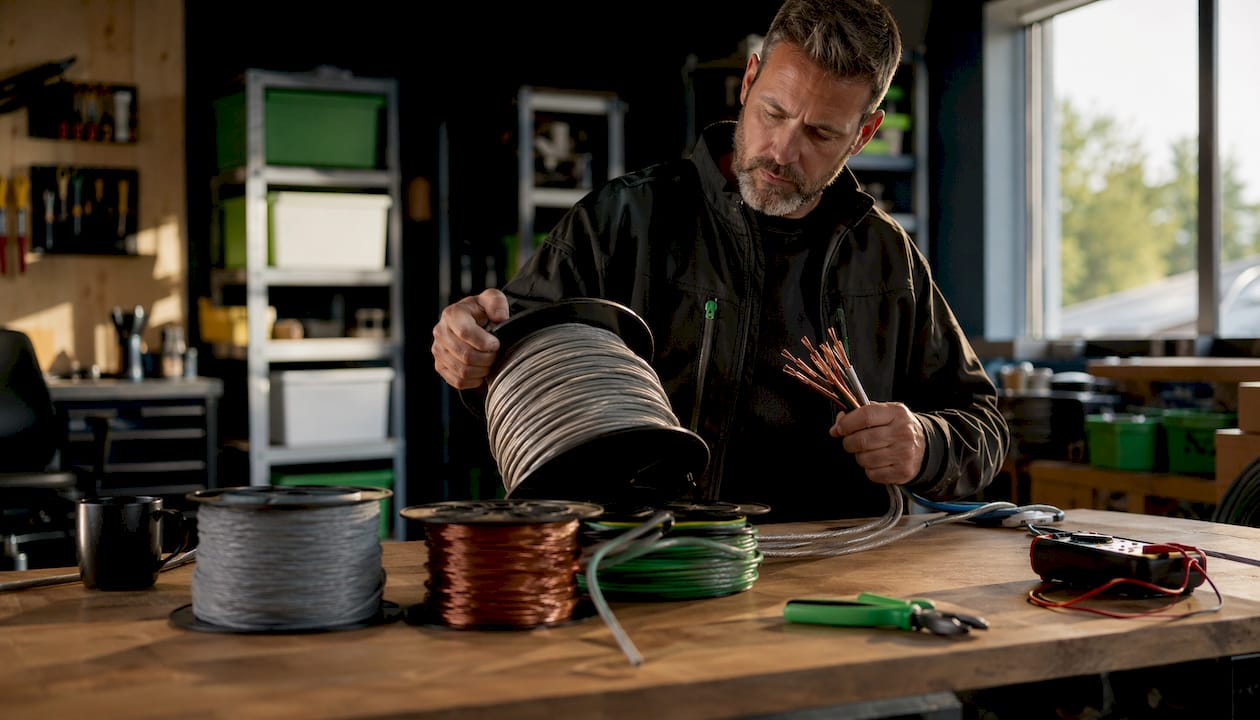
How aluminum and copper wire actually compare
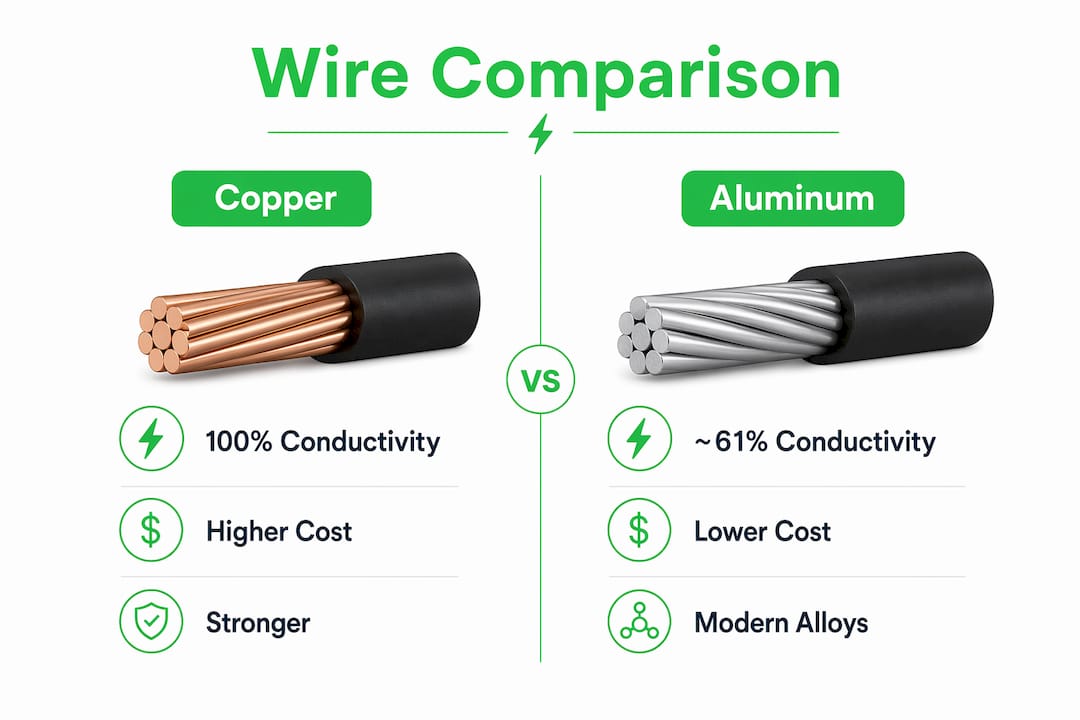
The choice between aluminum and copper wire comes down to four factors: conductivity, cost, safety behaviour at connections, and where each material belongs in your electrical system.
Conductivity: Copper is the benchmark. Aluminum carries roughly 61% of copper’s conductivity for the same cross-section, so an aluminum conductor must be one to two sizes larger to carry the same current.
Cost: Aluminum wins on upfront material price, often dramatically so at large gauges. A 200A service run using 4/0 aluminum costs substantially less than the equivalent 2/0 copper for a 30-foot run. That gap widens further at 250 kcmil and above.
Safety and thermal expansion: Aluminum expands about 40% more than copper under temperature changes. Over thousands of heating and cooling cycles, that movement works connections loose, which is why torque specs and AL/CU-rated connectors are non-negotiable with aluminum.
Typical applications:
- Branch circuits (outlets, switches, lights): Copper is the standard. Small termination spaces and many connection points favour copper’s stability and smaller diameter.
- Service entrances and feeders: Aluminum is the industry standard. Licensed electricians and utilities across Canada use it routinely for 200A services and EV charger feeders because the cost savings are substantial and performance is fully code-compliant when installed correctly.
- EV charger wiring: Aluminum AA-8000 series alloy is the go-to for the feeder from your panel to a Level 2 charger, provided the installer uses anti-oxidant compound and AL/CU-rated lugs.
Modern alloys matter: The historical stigma around aluminum wiring traces back to 1960s–70s small-gauge branch circuit failures using the older AA-1350 alloy in devices designed for copper. Modern AA-8000 series aluminum alloy, installed with proper connectors and anti-oxidant treatment, meets current Canadian Electrical Code requirements and performs reliably for high-current applications.
Table of Contents
- A deeper look at every dimension that matters
- Ready to book your EV charger installation in the GTA?
- Key takeaways
A deeper look at every dimension that matters
Conductivity and wire sizing
Copper serves as the 100% IACS benchmark (International Annealed Copper Standard). Aluminum’s lower conductivity means a larger conductor diameter, which affects conduit fill calculations and panel space. For a 200A residential service, that translates to 2/0 AWG copper versus 4/0 AWG aluminum. Both are code-compliant under the Canadian Electrical Code’s residential service table.
Cost differences in Canada
At small gauges (12–14 AWG branch circuit wire), the per-foot price difference between copper and aluminum is minor. The math shifts dramatically at feeder sizes. At 200A, aluminum saves $300–$600 on a typical 30-foot run compared to copper. For a full 200A panel upgrade with a new service entrance, that is a meaningful reduction in material cost without any compromise in safety or performance.
Thermal expansion and connection safety
Aluminum’s greater thermal expansion is the central safety consideration. Under-torqued aluminum connections loosen progressively, creating resistance, heat, and eventually a fire risk. The fix is straightforward: torque every lug to the manufacturer’s specification using a calibrated torque wrench, apply anti-oxidant compound (Noalox or Penetrox are common choices in Canadian trades), and use only connectors stamped CU/AL or AL-CU. Copper is more forgiving at terminations, which is why it remains the default for branch circuits with many connection points.
Pro Tip: Never connect bare aluminum directly to bare copper without a listed CU/AL connector. Galvanic corrosion at that junction is a documented failure point. Use a Polaris or equivalent split-bolt connector rated for both metals, and apply anti-oxidant to the aluminum side.
Application suitability: EV charger wiring
For a hardwired Level 2 EV charger, the feeder from your electrical panel is typically 40–60 feet of large-gauge wire. Aluminum AA-8000 series is the practical choice here. It costs less, weighs less, and performs identically to copper when installed correctly. Hardwired EV charger connections are also preferred over plug-in outlets because electrical codes since 2020 require GFCI protection for plug-in chargers, which can cause nuisance tripping when the breaker’s protection overlaps with the charger’s internal protection. A hardwired installation avoids that entirely. If you are planning a residential EV charger installation in the GTA, your certified electrician will specify the correct wire gauge and type for your panel-to-charger run.
For EV charger installations across the UK, residential EV charger best practices follow similar principles around wire sizing and hardwired connections.
Mechanical strength, flexibility, and lifespan
Copper has roughly twice the tensile strength of electrical-grade aluminum and significantly higher fatigue endurance. It handles vibration, repeated bending, and tight junction boxes better. Aluminum is lighter (roughly 50% lighter when upsized to match copper’s ampacity), which is why overhead transmission lines are almost universally aluminum. In residential walls and conduit, both materials last decades when installed correctly. Aluminum requires more rigorous maintenance attention due to oxidation risk; anti-oxidant compound and periodic inspection keep it performing reliably.
Canadian code compliance
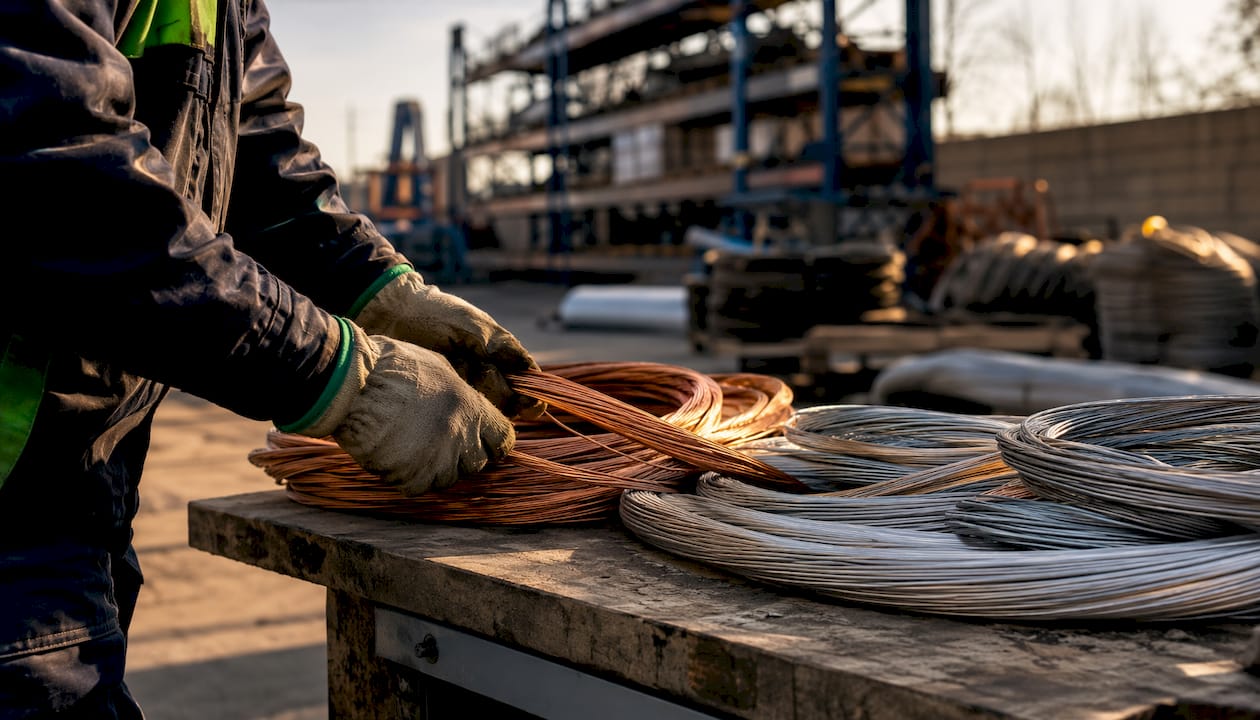
The Canadian Electrical Code permits aluminum conductors for service entrances, feeders, and conductors larger than 6 AWG. The the Electrical Safety Authority (ESA) in Ontario requires copper for most small-gauge branch circuit wiring (outlets, switches, interior lighting) due to connection stability concerns. Any aluminum installation must use AL/CU-rated devices and follow torque specifications. certified electricians are familiar with these requirements and pull the necessary permits.
Comparison table: aluminum vs copper wire
| Factor | Copper | Aluminum |
|---|---|---|
| Conductivity | 100% IACS benchmark | ~61% of copper; requires larger gauge |
| Cost (200A feeder) | higher cost per foot for 2/0 AWG copper compared to 4/0 AWG aluminum. | |
| Thermal expansion | Minimal; stable at terminations | ~40% greater; requires precise torque |
| Application suitability | Branch circuits, motors, grounding | Service entrances, feeders, EV charger runs |
| Installation considerations | Works with standard devices; no anti-oxidant needed | Requires AL/CU-rated connectors, anti-oxidant compound, torque wrench |
| Environmental impact / recyclability | Widely recycled; high scrap value | Widely recycled; lighter weight reduces transport emissions |
Ready to book your EV charger installation in the GTA?

Choosing the right wire is one decision. Having an ESA-licensed electrician handle the installation, permits, and inspections is another. EV Install Pro installs Level 2 EV chargers across the GTA, starting from $800, with same-week booking and a 4.9 customer rating. Use the free installation cost calculator to get an estimate for your home, or book a no-obligation assessment today.
Key takeaways
Aluminum is the industry standard for service entrances and EV charger feeders in Canada; copper remains the correct choice for branch circuits due to connection stability and code requirements.
| Point | Details |
|---|---|
| Conductivity gap | Aluminum carries ~61% of copper’s conductivity, requiring one to two larger wire sizes. |
| Cost advantage | At 200A, aluminum saves $300–$600 on a typical 30-foot feeder run versus copper. |
| Thermal expansion risk | Aluminum expands ~40% more than copper; correct torque and AL/CU connectors are mandatory. |
| EV charger feeders | AA-8000 series aluminum is the standard choice for panel-to-charger runs when installed by a licensed electrician. |
| Branch circuits | Copper remains the code-required and practical choice for outlets, switches, and lighting circuits. |
Related guides
Get Your Free Installation Quote
Free assessment · ESA permit included · Same-week availability across the GTA