Licensed electrician for EV charger installation in Toronto
Who are the top licensed EV charger installers in Toronto?
Finding a qualified electrician for EV charger work in Toronto means looking beyond a basic licence. You need someone with ESA certification, permit experience, and hands-on knowledge of residential and condo electrical systems. The providers below cover the full range of installation needs across the Greater Toronto Area.
| Provider | Best For | Certifications | Permit Handling | Additional Services | Rating |
|---|---|---|---|---|---|
| Juice Box | Residential and commercial | ESA-compliant | Yes | Hardware supply, local support | 4.9★ (153) |
| Flo Charging Station | Residential and multi-unit | ESA-compliant | Yes | Smart networking, multiple Toronto locations | 3.9★ (7) |
| FLO Charging Station | Homeowners and condo dwellers | ESA-compliant | Yes | Versatile charger options, local accessibility | 3.9★ (7) |
| SWTCH Charging Station | Multifamily and workplace | OCPP-certified | Yes | Smart load management, 24/7 monitoring | 3★ (3) |
| EV Connect Charging Station | Commercial and property managers | ESA-compliant | Yes | Cloud-managed systems, app integration | 2★ (2) |
| Jule Charging Station | Retail and hospitality | Not publicly listed | Not publicly listed | DC fast charging, battery storage | — |
| ChargePoint Charging Station | Organizations and fleets | Not publicly listed | Not publicly listed | AI-powered management, fleet support | — |
Key trust factors to look for in any provider:
- ESA licensing: Ontario requires an ESA-licensed Electrical Contractor for every EV charger installation. DIY is not permitted.
- EVITP certification: The Electric Vehicle Infrastructure Training Program credential confirms specialized EVSE knowledge beyond a standard electrician licence.
- Permit handling: Your installer should pull the permit in their name, not yours.
- Insurance and warranty protection: Uncertified installations risk voiding your charger warranty and triggering insurance claim denials.
How do these providers compare on service and specialization?
The providers above serve different segments of the Toronto market, and the differences matter depending on your property type.
Juice Box has a strong local presence across Toronto for both residential and commercial properties. Its hardware supply and customer support make it a practical choice for homeowners who want a single point of contact from equipment to installation.
Flo and FLO Charging Station are the same brand operating under its full and abbreviated names. Both Flo and FLO specialize in smart-networked chargers suited to single-family homes and multi-unit residential buildings, with several convenient Toronto locations for local support.
SWTCH is the standout option for multifamily and workplace properties. It offers turnkey EV charging services including design, installation, electrical upgrades, and 24/7 monitoring under its SWTCH Care programme. Its OCPP-certified platform supports advanced energy management, which is particularly valuable in condos where panel capacity is limited.
EV Connect targets commercial operators and property managers, offering cloud-managed charging systems with app integration for remote monitoring and billing.
Jule takes a different approach entirely. It specializes in battery-integrated DC fast charging with microgrid energy storage, making it best suited to retail stores, hospitality venues, auto dealerships, and fuel stops rather than residential installations.
ChargePoint provides integrated hardware and software solutions with AI-powered management and fleet operations support. It is built for organizations managing multiple vehicles and charging sites, not the typical Toronto homeowner.
How do you choose the right licensed electrician for your EV charger?
The licence alone is not enough. Ask these questions before you hire anyone.
- Are you ESA-licensed in Ontario? Verify the licence number directly with the Electrical Safety Authority. This is the legal minimum for any home EV charger wiring in the province.
- Do you hold EVITP certification? have completed specialized training on EVSE installation requirements, continuous load calculations, and NEC Article 625 compliance. Not every licensed electrician has this credential.
- How many EV charger installations have you completed? An electrician who has done dozens of installs in Toronto will price more accurately and move faster than one learning on your job.
- Will you pull the permit in your name? If they ask you to pull a homeowner permit so they can bypass licensing, walk away.
- Do you carry liability insurance and offer a workmanship warranty? Both protect you if something goes wrong after the job is done.
- Are you familiar with smart load management systems? In condos and older Toronto homes, an EVEMS or DCC device can often eliminate the need for a costly panel upgrade.
Pro Tip: Ask specifically about EVITP certification and continuous load EV charger wiring experience. An electrician who can explain the NEC 80% continuous load rule without prompting is one who has done this work before.
What does EV charger installation actually cost and involve in Toronto?
Ontario permit and licensing requirements
Ontario law requires an ESA-licensed Electrical Contractor for every EV charger installation. Your electrician files for an ESA permit before work begins, and the installation must pass a formal inspection before the charger is energized. There are no exceptions for condos, detached homes, or rental properties.
Typical costs in Toronto
Installation pricing in Toronto varies based on panel capacity, run distance, and whether a panel upgrade is needed. A standard Level 2 install with no panel work typically covers charger hardware, electrician labour, and the ESA permit. If your panel lacks headroom, a 200A upgrade adds significant cost on top of the base installation. Get written quotes that break out hardware, labour, and permit separately so you can compare them accurately.
The installation process
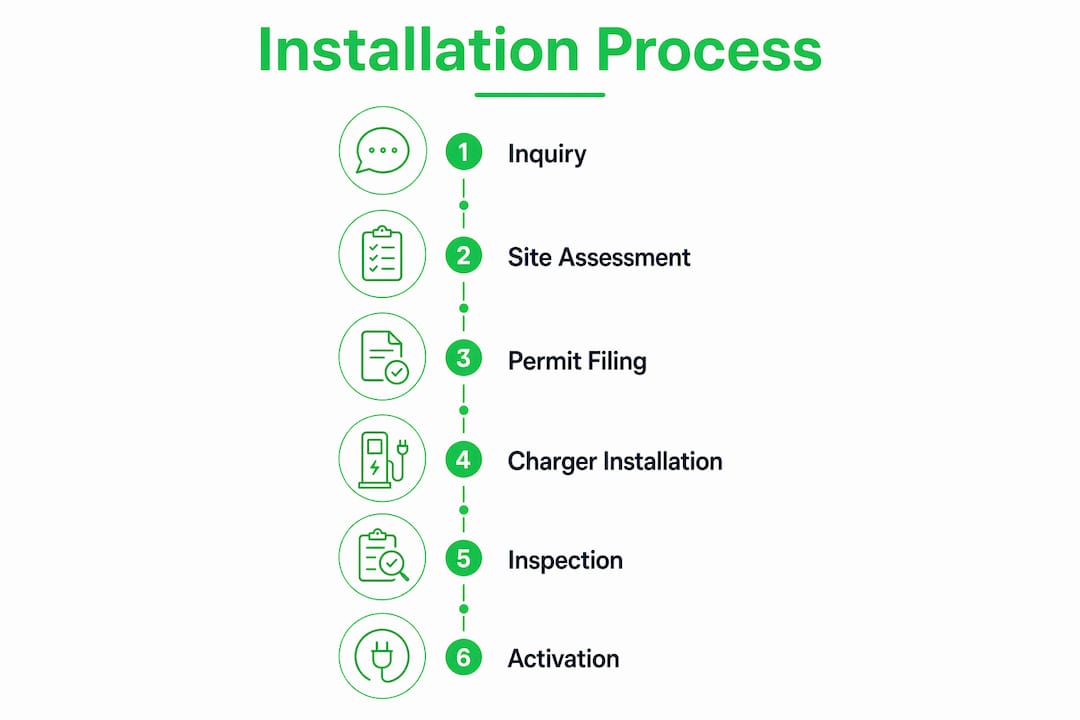
- Assessment: Your electrician inspects your panel and runs a load calculation using NEC 220.82 to determine available capacity.
- Permit filing: The ESA permit is filed before any work begins. This step protects you legally and keeps your insurance valid.
- Physical installation: Running the dedicated 240V circuit, installing the breaker, mounting the charger or NEMA 14-50 outlet, and wiring the connection. This work typically takes 2–6 hours.
- Inspection: An ESA inspector verifies the installation meets code before the charger is activated.
Panel upgrades and smart load management
A hardwired Level 2 charger supports up to 48 amps continuous on a 60-amp breaker, while a plug-in NEMA 14-50 outlet is capped at 40 amps continuous. Whether your panel can handle either depends on a proper NEC 220.82 load calculation. Do not accept “you’ll be fine, trust me” from any contractor. Demand the written calculation.
Smart load management devices (EVEMS and DCC systems) can prioritize household loads and prevent overloads, often making a panel upgrade unnecessary in condos and older homes. This is worth asking about before agreeing to any upgrade quote.
Statistic callout: The physical installation takes 2–6 hours, but the full project timeline from first call to final inspection typically runs 1–3 weeks once permit approvals and inspection scheduling are factored in.
Which EV charger brands do Toronto electricians commonly install?
Toronto’s certified installers work with a range of hardware, and the brand you choose affects both charging speed and long-term flexibility.
- Juice Box: A popular choice for residential and commercial properties in Toronto, with strong local support and a reliable hardware track record.
- Flo / FLO: Widely used across single-family homes and multi-unit buildings, with smart networking built in for remote monitoring and scheduling.
- SWTCH: Preferred for multifamily and workplace properties where energy management and OCPP compliance matter. Supports multiple chargers on a single platform.
- EV Connect: Cloud-managed hardware suited to commercial sites and property managers who need app-based billing and monitoring.
- Jule: Battery-integrated DC fast chargers designed for retail, hospitality, and auto dealerships. Not a typical residential option.
- ChargePoint: Integrated hardware and software with AI-powered fleet management. Best for organizations running multiple vehicles.
On the technology side, most Toronto homeowners choose a hardwired Level 2 charger for permanent installs, while a NEMA 14-50 outlet suits renters or anyone planning to move. DC fast chargers are a commercial-grade option requiring significantly more electrical infrastructure.
EV Install Pro: certified EV charger installation across Toronto
EV Install Pro operates under the Evchargerinstallationtoronto brand and serves homeowners and condo owners across the Greater Toronto Area with a fully certified installation team.
What the service includes:
- ESA-licensed electricians on every job
- EVITP-trained technicians with hands-on EVSE experience
- Residential and condo Level 2 charger installation
- 200A panel upgrades when required
- Smart load management (EVEMS/DCC) to avoid unnecessary panel work
- Full ESA permit handling and inspection coordination at no extra charge
- Rebate application support for eligible Ontario programmes
Pricing starts at $800, with same-week booking available. Every installation is completed within a few hours once the permit is in hand.
Evchargerinstallationtoronto: end-to-end EV charger installation for Toronto homeowners
Evchargerinstallationtoronto gives you a faster, more transparent path to a compliant Level 2 charger than coordinating hardware, permits, and inspections separately.
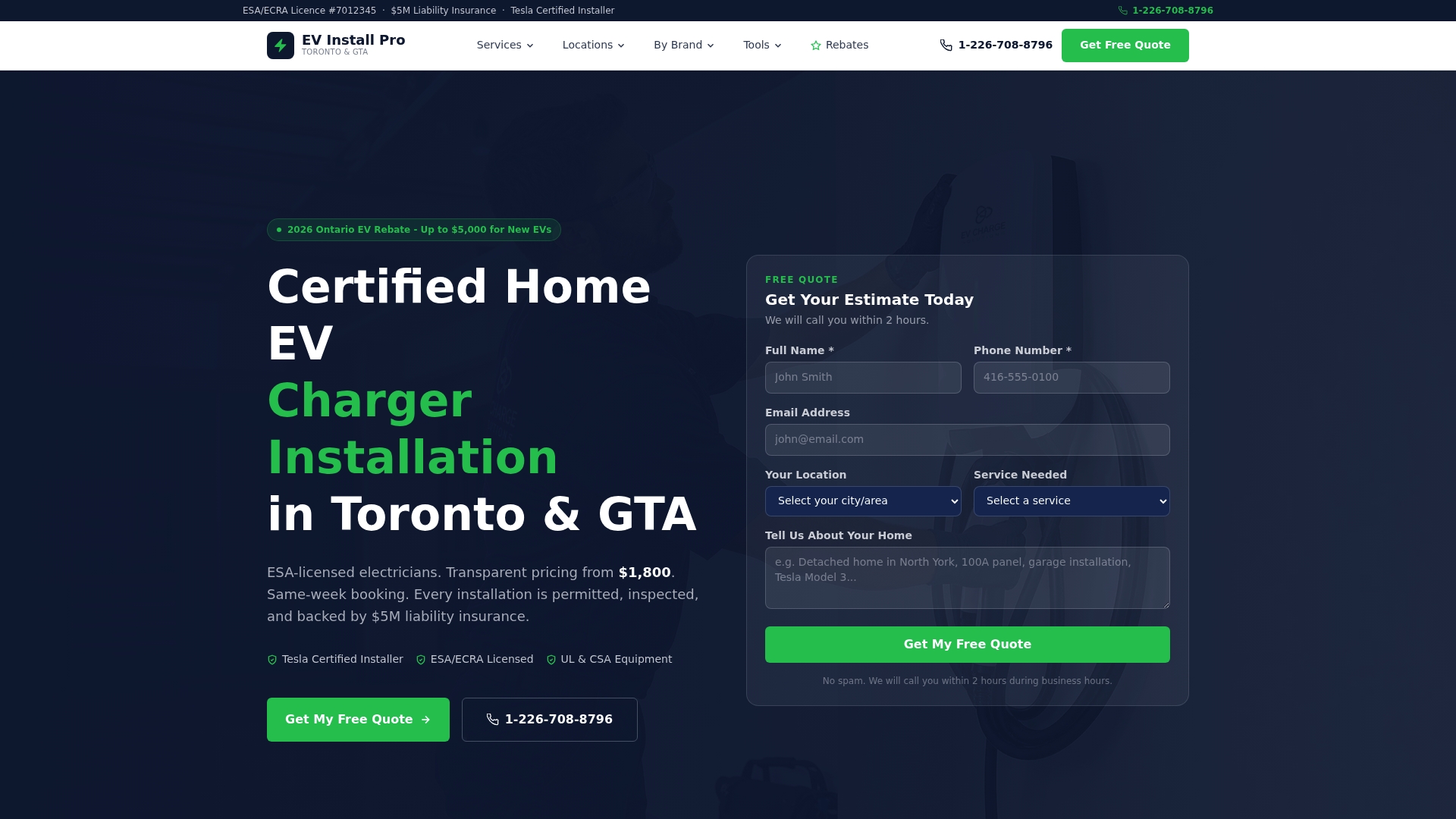
Pricing starts at $800 with no hidden fees. The team handles your ESA permit from filing to final inspection, and can apply for Ontario rebates worth up to $5,000 on your behalf. If your panel needs attention, 200A upgrades and EVEMS smart load management are both available through the same booking. Use the free cost calculator to get an instant estimate for your property before you call. Same-week appointments are available across Toronto and the GTA.
Key takeaways
A licensed, EVITP-certified electrician is the only legal and safe choice for EV charger installation in Toronto, and the permit and inspection process is what separates a compliant install from a costly liability.
| Point | Details |
|---|---|
| ESA licence is mandatory | Ontario law requires an ESA-licensed Electrical Contractor for every EV charger installation; DIY is prohibited. |
| EVITP certification matters | Ask for EVITP credentials to confirm your electrician has specialized EVSE training beyond a standard licence. |
| Timeline typically runs 1–3 weeks, depending on permit approvals and inspection scheduling. | Physical installation takes 2–6 hours; permit approvals and inspection scheduling extend the full project to 1–3 weeks. |
| Smart load management saves money | EVEMS and DCC devices can eliminate the need for a panel upgrade in condos and older Toronto homes. |
| Evchargerinstallationtoronto | Offers end-to-end installation from $800, including ESA permits, rebate support, and same-week booking across Toronto. |
Recommended
- EV Charger Installation Toronto & GTA | EV Install Pro
- Home Ev Charger Installation in Toronto | Licensed ESA Electrician | EV Install Pro Toronto
- Ev Charger Installation in Toronto | Licensed ESA Electrician | EV Install Pro Toronto
- Level 2 Ev Charger Installation in Toronto | Licensed ESA Electrician | EV Install Pro Toronto
Get Your Free Installation Quote
Free assessment · ESA permit included · Same-week availability across the GTA