ESA certificate of acceptance for EV chargers in Ontario
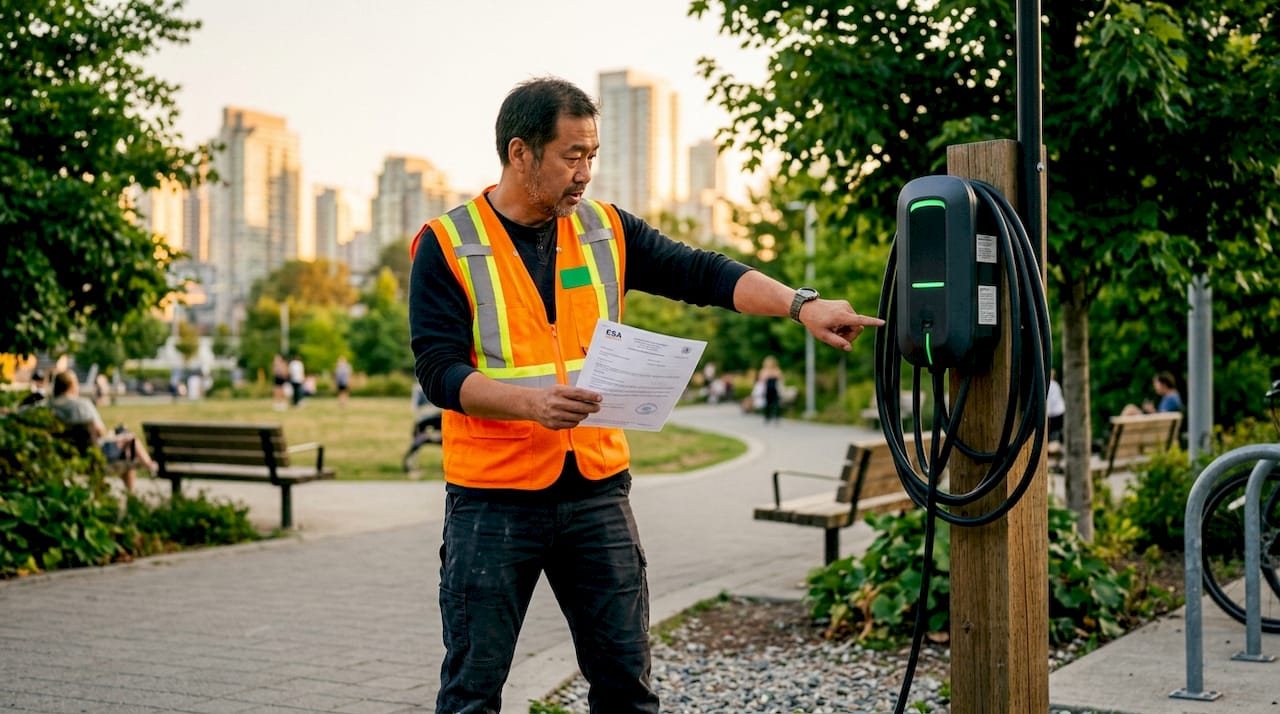
The ESA certificate of acceptance is the official document proving your EV charger installation meets Ontario’s Electrical Safety Code and is legally approved for use. Formally called the Certificate of Inspection, this document is issued by the Electrical Safety Authority after a licensed inspector confirms your installation passes all required standards. Without it, your home insurance may be void for any electrical incident, and selling your property becomes complicated. For Toronto homeowners adding a Level 2 charger, getting this certificate is not optional. It is the legal finish line for every EV charger installation in Ontario.
What is an ESA certificate of acceptance?
The ESA certificate of acceptance is officially called the Certificate of Inspection, and it is the final legal endorsement confirming your electrical installation complies with the Ontario Electrical Safety Code (OESC). The ESA issues it only after one of its inspectors physically verifies the work on site. No inspection, no certificate.
The process begins before any wiring is touched. A Licensed Electrical Contractor (LEC) must file an ESA notification, which is the permit, before work starts. That notification triggers the inspection requirement. Once the installation is complete, the inspector visits, checks every connection and circuit, and either approves the work or flags deficiencies.

Certificates are issued electronically within 24 hours of a passed inspection. The document includes the property address, the contractor’s licence number, a description of the work, the permit number, and the inspector’s confirmation of code compliance. Store this document with your property records. You will need it for insurance and for any future sale.
One terminology note worth knowing: some contractors and older documents use “Certificate of Acceptance” and “Certificate of Inspection” interchangeably. Both refer to the same ESA document. The current official term used by the ESA is Certificate of Inspection.
Pro Tip: Request a digital copy of your certificate immediately after it is issued. The ESA sends it electronically, but having your own saved copy prevents delays if you need to produce it for an insurer or real estate lawyer.
Who can pull an ESA permit in Ontario?
Only a Licensed Electrical Contractor can file an ESA notification for work at a property they do not own. This is the standard path for the vast majority of Toronto homeowners. The LEC holds an ECRA/ESA licence, carries liability insurance, and has a Master Electrician on staff who takes legal responsibility for the installation.
Verify any contractor’s LEC status through the ESA’s public online registry before signing anything. Your contract and quote should include the ECRA/ESA licence number and the Master Electrician’s name. If a contractor cannot provide these details, do not hire them.
Homeowners do have one alternative. The Homeowner Notification allows you to self-permit and self-perform electrical work, but only at your primary residence. The rules are strict:
- The work must meet the exact same OESC standards as professional work.
- You must book and pass an ESA inspection, just like a contractor would.
- Insurance companies deny claims if unpermitted or failed inspection work causes an incident.
- The Homeowner Notification does not apply to rental properties or secondary suites.
The practical reality for most Toronto homeowners is that a dedicated 240V circuit for a Level 2 charger involves load calculations, panel work, and conduit runs that carry real risk if done incorrectly. The cost of a failed inspection and rework almost always exceeds the savings from self-permitting.
Pro Tip: Always ask your contractor whether re-inspection is covered in their quote. A clear re-inspection clause in the contract protects you from unexpected costs if the first inspection flags a deficiency.
What do ESA inspectors check for EV charger installations?
An ESA inspection for a Level 2 EV charger circuit focuses on confirming compliance with the Ontario Electrical Safety Code and CSA C22.1 standards. Inspectors are not doing a general home electrical audit. They are verifying the specific work described in the permit notification.
The key items an inspector checks include:
- Correct wire gauge and type for the amperage of the circuit, typically a 40 or 50 amp dedicated circuit for a Level 2 charger.
- Proper load calculations confirming the panel can support the added circuit without overloading existing service.
- Secure clamping and strain relief on all wiring connections to prevent wear and arc-flash risks.
- Correct breaker sizing matched to the wire gauge and charger specifications.
- Proper mounting and weatherproofing if the charger or outlet is installed in a garage or outdoors.
- No concealed wiring that the inspector cannot visually verify.
That last point is critical. Concealing electrical work before inspection is prohibited under Ontario rules. If a contractor drywalls over wiring before the inspector arrives, the homeowner may face costly rework to expose the wiring again. This is one of the most common and avoidable causes of project delays.
If the inspector finds deficiencies, they issue a written notice. The contractor must correct the issues and book a re-inspection. Corrections and re-inspection are covered at no extra cost to the homeowner when the original contract includes a re-inspection clause. This is why that contract term matters so much.
| Inspection item | Common failure reason |
|---|---|
| Wire gauge | Undersized wire for circuit amperage |
| Load calculation | Panel capacity not documented |
| Wiring clamps | Missing or improperly installed strain relief |
| Breaker sizing | Breaker does not match wire and charger specs |
| Work concealment | Drywall installed before inspection visit |
How does the ESA inspection process work from start to finish?
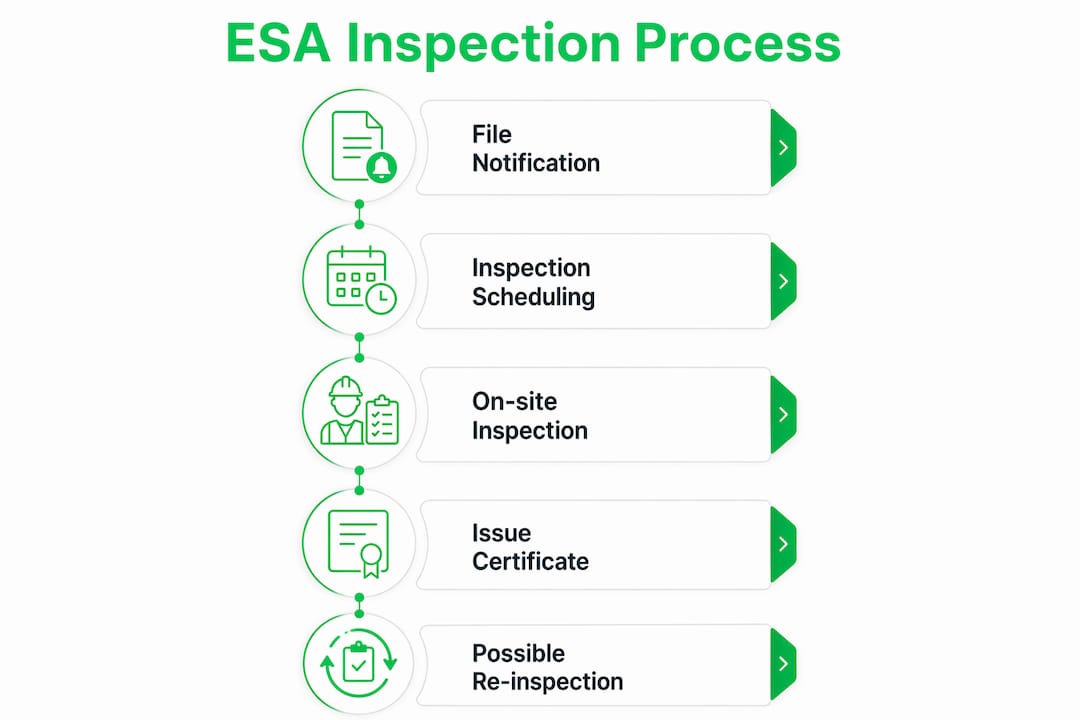
The full process from permit to certificate follows a clear sequence. Knowing each step helps you avoid delays and coordinate with your contractor effectively.
-
Contractor files the ESA notification. Your LEC submits the permit online before any work begins. ESA permit fees for residential EV circuits in Ontario range between $100 and $280 depending on scope. This fee covers both the permit and the inspection.
-
Installation is completed. Your contractor installs the dedicated circuit, mounts the charger, and leaves all wiring exposed and accessible for the inspector.
-
Inspection is booked. The contractor or homeowner contacts the ESA to schedule the inspection. Booking by phone typically results in faster scheduling than using the online portal. For Toronto homeowners on a tight timeline, this is a practical advantage worth using.
-
Inspector visits the property. The ESA inspector reviews the installation against the permit notification and the OESC. The visit typically takes 30–60 minutes for a standard EV charger circuit.
-
Pass or deficiency notice is issued. If the work passes, the inspector approves it on site. If deficiencies exist, a written notice is issued and corrections must be made before re-inspection.
-
Certificate of Inspection is issued electronically. Within 24 hours of a passed inspection, the ESA sends the certificate to the contractor and the homeowner. This certificate serves as legal proof of compliance for property records and insurance purposes.
-
Store the certificate securely. File it with your home’s property documents. Your insurer may request it if you ever make a claim involving your electrical system.
The entire process from permit filing to certificate receipt typically takes one to two weeks for a straightforward residential EV charger installation in Toronto, assuming no deficiencies and prompt inspection booking.
Key takeaways
The ESA Certificate of Inspection is the legal proof that your EV charger installation meets Ontario’s Electrical Safety Code, and without it, your insurance coverage and property resale documentation are at serious risk.
| Point | Details |
|---|---|
| Certificate is legally required | Every new 240V EV charger circuit in Ontario needs an ESA permit and passed inspection to receive the certificate. |
| Issued within 24 hours | The ESA sends the Certificate of Inspection electronically within 24 hours of a passed inspection. |
| Contractor verification matters | Always confirm your contractor’s ECRA/ESA licence number through the ESA public registry before work starts. |
| Concealment causes costly delays | Never allow wiring to be covered before the ESA inspector visits, as rework to expose it is expensive. |
| Insurance depends on it | Insurers deny electrical incident claims when no valid certificate exists for the work performed. |
Why the ESA process is worth taking seriously
I have seen homeowners treat the ESA permit as a formality, something their contractor handles in the background. That attitude changes fast when an insurance claim gets denied or a home sale stalls because the electrical work has no certificate on record.
The part that surprises most people is how straightforward the process actually is when you work with a properly licensed contractor. The permit, inspection, and certificate happen as a natural sequence. The homeowner’s main job is to verify credentials upfront and make sure the contract covers re-inspection.
What I find genuinely underappreciated is the re-inspection clause. Most homeowners never ask about it. If the first inspection fails, a contractor without that clause in writing can charge you again for the return visit. That is a real cost that a simple contract question eliminates entirely.
The ESA public registry is also underused. Checking a contractor’s LEC status takes two minutes online and tells you whether they hold current licensing and insurance. Skipping that check to save time is the kind of shortcut that creates expensive problems later.
For Toronto homeowners specifically, the combination of older housing stock and increasingly common panel upgrades means the inspection process sometimes surfaces issues beyond the EV circuit itself. A good contractor flags these proactively. A less experienced one does not. That difference shows up in whether you get your certificate on the first inspection or spend weeks on corrections.
— Hafiz
Certified EV charger installation with ESA permit handling in Toronto
Evchargerinstallationtoronto handles the entire ESA permit and inspection process for Toronto and GTA homeowners, from permit filing through to certificate delivery. Every installation is performed by ESA-licensed electricians with a Master Electrician on staff, meeting the full requirements of the Ontario Electrical Safety Code.
Pricing starts from $800, with same-week booking available and no extra charge for permit management or inspection coordination. Evchargerinstallationtoronto also handles rebates worth up to $5,000 for eligible EV purchases. Use the free cost calculator to get an instant estimate for your installation, including permit fees. If your home needs a panel upgrade before the charger circuit can be added, the team assesses that as part of the initial visit at no extra cost.
FAQ
What is an ESA certificate of acceptance for an EV charger?
The ESA certificate of acceptance, officially called the Certificate of Inspection, is the legal document confirming your EV charger installation meets the Ontario Electrical Safety Code. The ESA issues it electronically within 24 hours of a passed inspection.
Do I need an ESA permit for a Level 2 home charger in Ontario?
Yes. Every new dedicated 240V circuit for an EV charger in Ontario requires an ESA notification filed by a Licensed Electrical Contractor before work starts, followed by a final ESA inspection to receive the certificate.
How much does an ESA permit cost for an EV charger in Ontario?
ESA permit fees for residential EV circuits in Ontario range between $100 and $280 depending on the scope of work. This fee covers both the permit and the inspection visit.
What happens if my EV charger installation fails the ESA inspection?
The inspector issues a written deficiency notice. Your contractor must correct the issues and book a re-inspection. If your contract includes a re-inspection clause, this is covered at no additional cost to you.
Why does the ESA certificate matter for home insurance?
Insurers deny electrical incident claims when the work involved has no valid Certificate of Inspection on record. The certificate is also required documentation for property resale, confirming the installation complies with OESC standards.
Recommended
- Level 2 Ev Charger Installation in Toronto | Licensed ESA Electrician | EV Install Pro Toronto
- EV Charger Installation Toronto & GTA | EV Install Pro
- Home Ev Charger Installation in Toronto | Licensed ESA Electrician | EV Install Pro Toronto
- Ev Charger Installation in Toronto | Licensed ESA Electrician | EV Install Pro Toronto
Get Your Free Installation Quote
Free assessment · ESA permit included · Same-week availability across the GTA