EV load management for Toronto homes: skip the upgrade
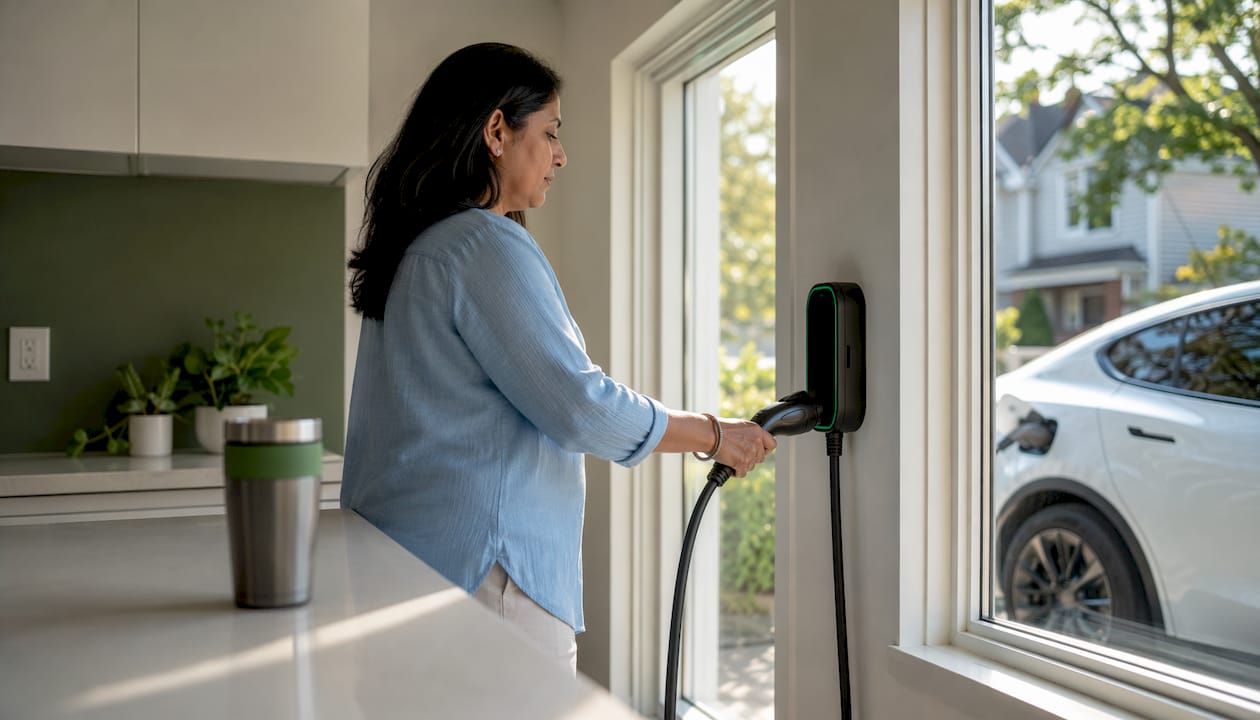
For many Toronto and GTA homeowners, a properly specified EV energy management system (EVEMS) or dynamic charge controller (DCC) is often the fastest, least disruptive way to add Level 2 charging without touching your service panel. Your immediate next step is to book a licensed electrician for a site assessment and load calculation before purchasing any equipment.
- EVEMS/DCC is the right starting point for homes with 100A or 200A service that have manageable existing loads.
- A panel or service upgrade becomes necessary when your service is 60A, your panel is full, or you’re planning multiple EVs plus major electrification projects.
- Ontario requires an ESA permit for every EV charger installation. A licensed electrician files it; you don’t.
- EV Install Pro Toronto handles site assessments, EVEMS/DCC installations, permit filing, and Ontario rebate applications in one visit.
Key figure: Eaton’s load management guidance confirms that load management avoids landscaping disruption, meter-side utility work, and the higher cost of a full service upgrade for many homes.
Table of Contents
- What does EV load management actually do?
- Is load management the right fit for your home?
- Load management vs. panel upgrade: costs and trade-offs
- What the installation process looks like in Ontario
- Condo and multi-unit buildings: what’s different
- How to choose the right installer
- Key takeaways
- An installer’s honest take on load management surprises
- EV Install Pro Toronto: local EVEMS installs, permits, and rebates handled
- Useful sources and further reading
What does EV load management actually do?
EV load management, also called an EVEMS (Electric Vehicle Energy Management System) or DCC (Dynamic Charge Controller), controls how much power your charger draws based on what the rest of your home is using at any given moment. The system treats your EV as the one flexible load in the house: when the oven, dryer, and heat pump are all running, it throttles the charger; when those loads drop off, it ramps charging back up automatically.
Static vs. dynamic: the practical difference
- Static load management sets a fixed power cap at installation. If your panel can spare 24A for the EV, the charger is capped at 24A permanently, even at 2 AM when nothing else is running. It’s simple and inexpensive, but it leaves speed on the table.
- Dynamic load management monitors whole-house current in real time and continuously recalculates available capacity. According to REEV’s explainer on load management, a dynamic system almost always delivers a better charging experience than a conservative static cap because it maximises speed whenever capacity is free.
A practical example: with a static cap, your charger might deliver 24A all night regardless of conditions. With a dynamic system, it might run at 16A while dinner is cooking, then climb to 32A by 10 PM once the kitchen is quiet.
Pro Tip: When comparing EVEMS products, check whether the system measures whole-house current at the service entrance or only monitors the EV circuit. Whole-house monitoring, as described in Eaton’s load management white paper, is what enables true real-time reallocation. Circuit-only monitoring is a weaker implementation.
Is load management the right fit for your home?
Work through these steps before calling an installer.
- Check your service size. Is your main breaker 100A, 200A, or something older like 60A? A 200A service almost always supports EVEMS. A 100A service usually can, depending on your other loads. A 60A service typically cannot.
- List your major electric loads. Electric range, electric dryer, heat pump, electric water heater, and hot tub all count. Add up their amperage. If you’re already near your service limit at peak times, load management has less room to work with.
- Estimate your nightly charging need. Most EV drivers need to restore a typical range overnight. A Level 2 charger at even a modest charging current can deliver a significant amount of range per hour of charging. That’s achievable on a managed circuit.
- Consider your plans for the next five years. Adding a second EV, converting to an electric heat pump, or installing solar all change the equation.
Red flags that point toward a panel or service upgrade instead:
- Breakers trip regularly under normal household load
- Your panel has no spare breaker slots
- You’re planning two or more EVs simultaneously
- Your service is 60A, or a heavily loaded 100A with all-electric HVAC. As the WattWallet homeowner guide notes, physical service limits exist that dynamic load management cannot overcome.
If none of those red flags apply, a managed Level 2 install is very likely your most cost-effective path. You keep your existing service, avoid utility involvement, and still get useful charging speeds every night.
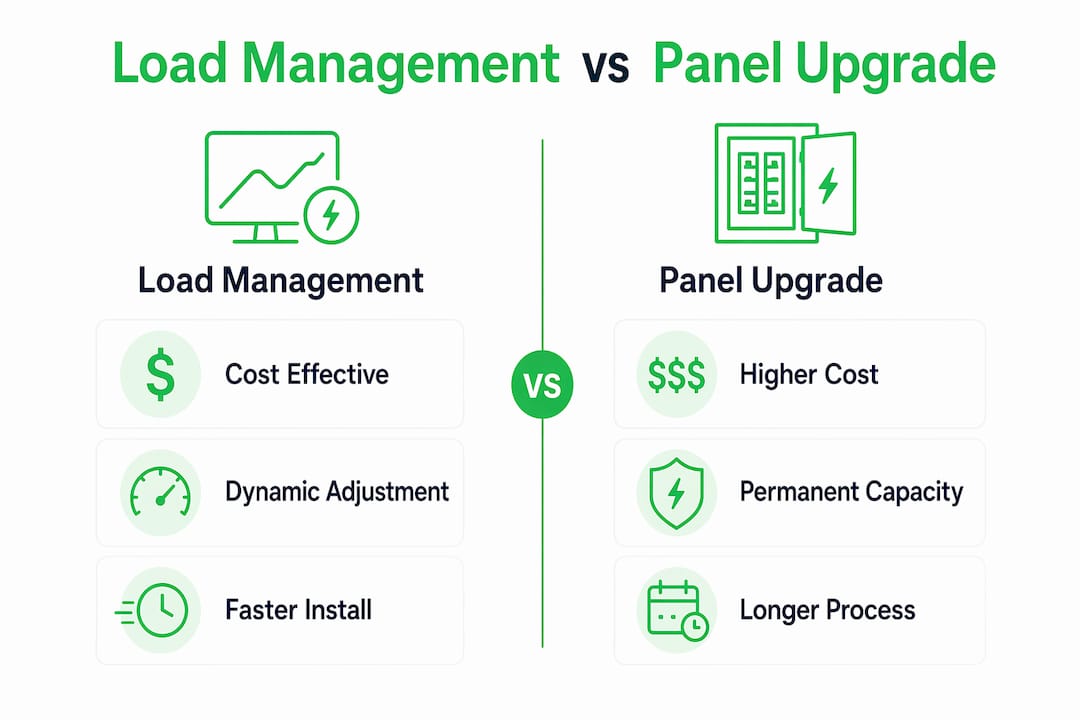
Load management vs. panel upgrade: costs and trade-offs
| Dimension | EVEMS/DCC load management | Panel/service upgrade |
|---|---|---|
| Best for | Homeowners, condos, multi-unit properties | Homes with 60A service, full panels, or 2+ EVs |
| Typical cost | $800 installed | — |
| Installation time | 2–4 hours, same day | 1–2 days; utility scheduling may add weeks |
| Permit & ESA | ESA permit required; filed by licensed electrician | ESA permit required; utility may need to disconnect |
| Charging speed | Level 2 at managed amperage (typically 16–32A) | Full Level 2 at 32A with no throttling |
| Simultaneous vehicles | 1–4 with DCC-12 style controller | Depends on new panel capacity |
| Ongoing management | Automatic; app monitoring available | None required after install |
For most Toronto homeowners with 100A or 200A service, EVEMS/DCC is the clear first choice. The cost difference alone is significant, and the installation is completed in a single visit with no utility coordination. A panel upgrade makes sense when you’re planning a full home electrification project anyway, or when your service is simply too small to support any meaningful managed charging.
What the installation process looks like in Ontario
A licensed installer follows a defined sequence. Knowing it helps you plan your schedule and avoid surprises.
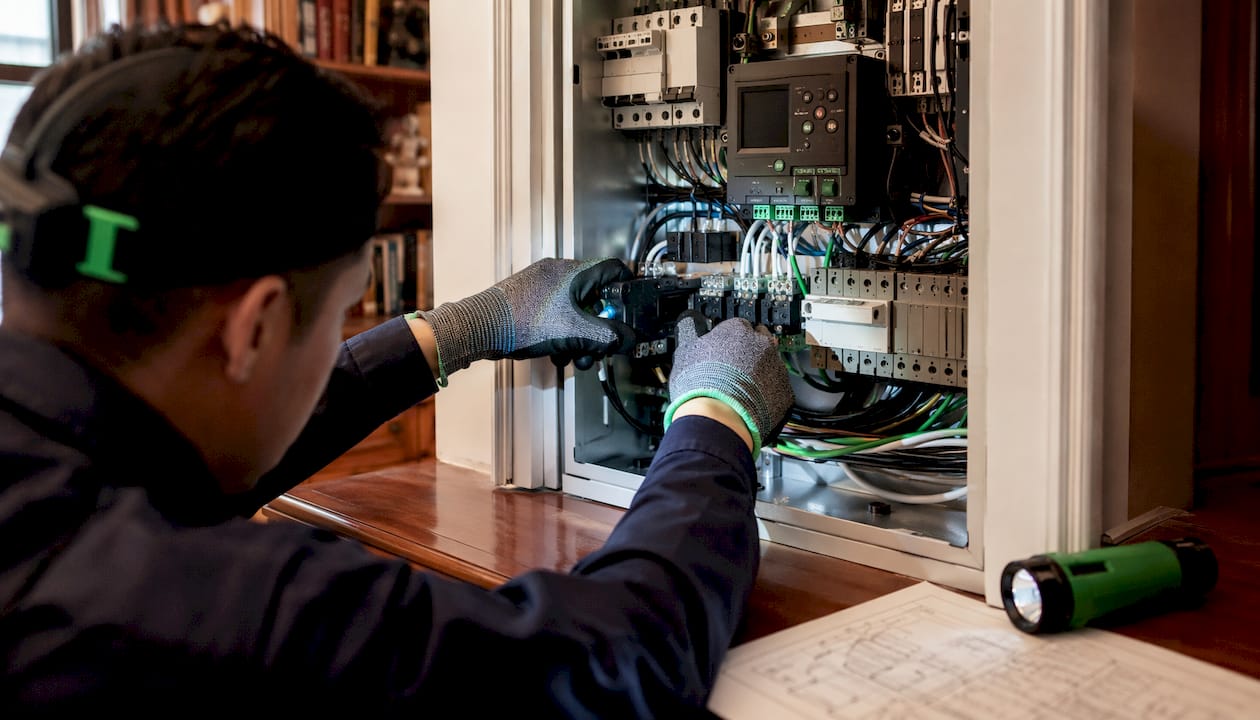
- Site assessment and load calculation. The electrician inspects your panel, measures your service size, reviews your existing loads, and calculates available capacity. This takes 30–60 minutes.
- Written quote. You receive a scope-specific quote covering equipment, labour, permit fees, and any required panel work.
- Permit filing. In Ontario, an ESA electrical permit is required before work begins. Your licensed electrician files it. You do not need to manage this step.
- Installation. For an EVEMS/DCC install, the electrician mounts the load controller, installs the current transformer at the service entrance, runs the circuit to the charger location, and connects the EVSE. Most residential installs are complete in 2–4 hours.
- Inspection and Certificate of Acceptance. The ESA inspects the work and issues a Certificate of Acceptance. This is your proof of code compliance and is required by most home insurers and EV rebate programmes.
What causes delays:
- Utility involvement (required for service upgrades, not typically for EVEMS installs)
- Condo board approval (see next section)
- Meter upgrades required by the utility
- Panels with hidden damage or mislabelled circuits discovered during the site visit
Condo and multi-unit buildings: what’s different
Load management is often not optional in condos. It’s the only practical way to add chargers without upgrading the building’s utility transformer, which is expensive and sometimes physically impossible given the building’s electrical room layout.
Key considerations for property managers:
- DCC/EVEMS is typically mandatory for multi-unit deployments. A controller like the DCC-12 allows multiple chargers to share a fixed power allocation without exceeding the building’s transformer limit.
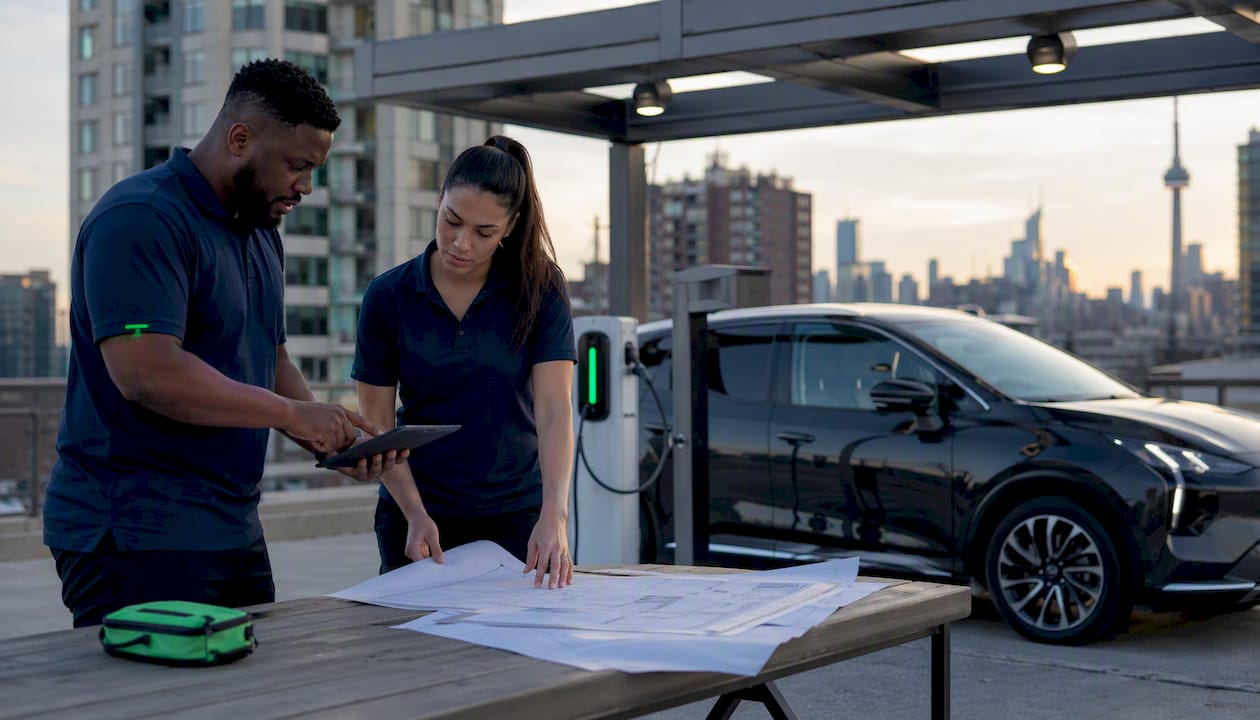
- Board approval is required. Your installer should supply a load study, an ESA compliance statement, and a written scope of work for the board package. Condo EV charger installations in Toronto follow a defined approval workflow.
- Metering and allocation. Buildings can configure priority charging (certain units or fleet vehicles charge first) or balanced charging (available power split equally). The gridX EV charging strategy overview notes that modern EVEMS prevent main breaker trips by applying exactly this kind of prioritisation logic.
- Transformer limits are a hard ceiling. Your installer must confirm the building’s available transformer capacity before specifying how many chargers can be added.
Pro Tip: Property managers should stage installations in phases rather than wiring every parking spot at once. Start with a DCC-12 or equivalent controller sized for your eventual target, then add chargers as demand grows. This avoids over-specifying hardware upfront and keeps board approval simpler.
How to choose the right installer
Not every electrician who offers EV charger installation has the experience to specify and commission an EVEMS correctly. Here’s what to verify.
Must-have credentials and proof points:
- ESA-licensed electrician (ask for their licence number)
- Demonstrated experience filing ESA permits and obtaining Certificates of Acceptance
- Liability insurance and warranty on both labour and equipment
- Transparent written quote with itemised scope
- Experience with condo DCC projects and board approval documentation
Questions to ask during a quote:
- How do you calculate available load capacity, and will you show me the calculation?
- Do you recommend static or dynamic load management for my service size, and why?
- Is the EVEMS/DCC equipment you’re specifying compatible with my panel and my EV’s onboard charger?
- Do you handle rebate filing, or is that my responsibility?
Red flags:
- Vague load calculations (“your panel looks fine”)
- Unwillingness to file permits or dismissing the ESA inspection step
- No written warranty or proof of insurance
- Pressure to skip the Certificate of Acceptance
When comparing two quotes, make sure the scope is identical. One quote may include the current transformer and load controller; another may list only the charger and circuit. Scope creep at invoice time is the most common complaint in this category.
Key takeaways
For most Toronto and GTA homeowners, a dynamic EVEMS or DCC controller is the fastest, most cost-effective route to safe Level 2 charging without a full service upgrade.
| Point | Details |
|---|---|
| Start with a load calculation | A licensed electrician’s site assessment tells you whether EVEMS or a panel upgrade is the right call. |
| Dynamic beats static | Dynamic load management maximises charging speed in real time; static caps leave capacity unused overnight. |
| EVEMS costs less upfront | Installed EVEMS generally costs less than a panel or service upgrade, which can vary widely depending on scope and location. |
| Permits are non-negotiable | Every Ontario EV charger install requires an ESA permit and Certificate of Acceptance; your electrician files both. |
| Evchargerinstallationtoronto handles it end-to-end | EV Install Pro Toronto provides ESA-licensed EVEMS/DCC installs, permit handling, and rebate support across the GTA. |
An installer’s honest take on load management surprises
Most homeowners arrive at a quote conversation with one question: “Do I need a panel upgrade?” The honest answer is that you usually don’t, but you need a real load calculation to be certain. What surprises people is how often the site assessment reveals something the homeowner didn’t know about: a panel with mislabelled circuits, a double-tapped breaker that’s been there for years, or a 100A service that’s already running closer to its limit than the homeowner realised because of a recently added heat pump.
Dynamic systems are the right choice for the vast majority of residential installs. The charging experience is noticeably better than a static cap, and the system handles the variability of real household life automatically. Where I’d push back on load management as the answer is when the panel itself is in poor condition or when the homeowner is genuinely planning two EVs and a heat pump within two years. In that case, doing the panel upgrade now and sizing it properly is cheaper than doing it twice.
One practical tip for a smoother install: clear access to your electrical panel before the electrician arrives, and if you’re in a condo, have your board approval documentation ready before booking. Waiting on a board decision after the electrician is scheduled is the single most common cause of delays on condo jobs.
EV Install Pro Toronto: local EVEMS installs, permits, and rebates handled
Skip the guesswork on whether your home needs a panel upgrade. Evchargerinstallationtoronto’s ESA-licensed electricians assess your service, specify the right EVEMS or DCC controller, and complete the installation, permits, and rebate paperwork in one visit. Pricing starts from $800, same-week bookings are available, and every install comes with a Certificate of Acceptance and full warranty coverage.
Rebates of up to $5,000 are available for qualifying Ontario homeowners, and Evchargerinstallationtoronto handles the application on your behalf. Use the EV charger cost calculator to get a quick local estimate, or visit the EVEMS installation page to book your site assessment today.
Useful sources and further reading
- Eaton EV charging load management white paper — Technical detail on dynamic, site-responsive load management hardware requirements. Best for installers and property managers specifying equipment.
- Eaton EV charger load management brochure (Canada) — Homeowner-friendly overview of when load management avoids a service upgrade. Good first read for any homeowner.
- REEV: static vs. dynamic load management — Clear explanation of the two approaches with practical examples. Useful for homeowners comparing product options.
- WattWallet homeowner guide to EV charger load management — Explains the homeowner benefit and the physical limits of load management. Recommended reading before your site assessment.
- DCC Electric: EVEMS and DCC-12 overview — Background on DCC-style controllers for multi-unit buildings. Relevant for property managers and condo boards.
- gridX EV charging strategies — Covers priority charging, balanced charging, time-of-use optimisation, and PV surplus strategies. Useful for property managers and homeowners with solar.
- Peak Load Management Alliance (PLMA) — Industry practitioner community for load management professionals. Reference for installers seeking continuing education and industry standards.
- ESA permit guide for Ontario EV charger installs — Practical explanation of Ontario permit requirements and what the Certificate of Acceptance covers. Recommended for homeowners before booking.
Recommended
- Panel Upgrade For Ev Charger in Toronto | Licensed ESA Electrician | EV Install Pro Toronto
- EVEMS vs Panel Upgrade Toronto: Which Do You Actually Need for EV Charging? (2025) | EV Install Pro Toronto
- Panel Upgrade For Ev Charger in Midtown Toronto | Licensed ESA Electrician | EV Install Pro Toronto
- Panel Upgrade For Ev Charger in Downtown Toronto | Licensed ESA Electrician | EV Install Pro Toronto
Get Your Free Installation Quote
Free assessment · ESA permit included · Same-week availability across the GTA