Outdoor EV charger installation in Toronto: 2026 cost guide
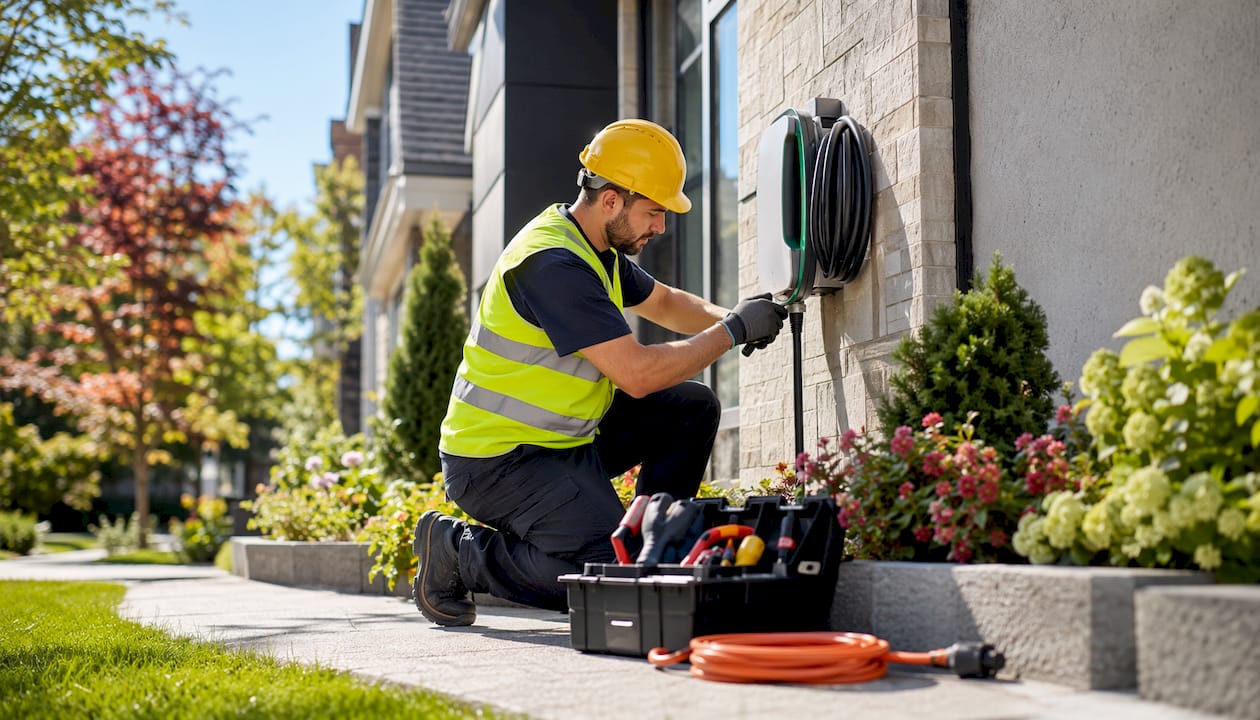
A straightforward outdoor Level 2 EV charger installation in Toronto typically covers hardware, labour, materials, and the mandatory ESA permit and inspection, with costs varying by scope. If your panel needs a 200A service upgrade, budget a significant additional cost depending on the project’s complexity. Every installation that adds a new 240V circuit requires an ESA permit and a final inspection by an ESA-certified inspector. Skipping that step puts your home insurance and resale value at risk.
The non-negotiables: Hire an ESA-licensed electrician, pull the ESA permit before work begins, and keep the inspection sticker and permit receipt. No permit means no legal protection if something goes wrong.
EV Install Pro (Evchargerinstallationtoronto) is the recommended local provider. Their ESA-licensed electricians handle permits, inspections, and rebate paperwork at no extra charge, with transparent pricing starting at a fixed rate and same-week booking available across the Greater Toronto Area.
Table of Contents
- Which Toronto installers should you consider?
- What does a residential outdoor Level 2 installation quote include?
- What drives the cost of your installation up or down?
- Realistic Toronto cost scenarios for your home
- Ontario rules: ESA permits, OESC requirements, and rebates
- Outdoor installation choices that hold up through Toronto winters
- How to choose a Toronto installer: questions to ask and red flags
- Key takeaways
- Why the permit-first approach matters more than most homeowners realise
- Get a quoted outdoor Level 2 install from EV Install Pro
- Authoritative sources and further reading
Which Toronto installers should you consider?
| Dimension | EV Install Pro (Evchargerinstallationtoronto) | Electric Vehicle Charging Station (generic category) |
|---|---|---|
| Typical total price | Starting at a fixed rate; complex jobs quoted on-site | starting from $1,200 |
| What price includes | Hardware, labour, materials, ESA permit, inspection, rebate handling | Varies; confirm line items in writing |
| Booking lead time | Same-week available | Typically 1–2 weeks |
| ESA-licensed electrician | Yes, on staff | Confirm before booking |
| Warranty on labour | Yes | Ask for written warranty |
| Outdoor/hardwired capability | Full hardwired outdoor installs, panel upgrades, EVEMS | Confirm outdoor rating capability |
| Rebate and permit support | Full handling included | Varies by contractor |
Why EV Install Pro stands out:
- 4.9-star rating from verified local customers
- End-to-end service: site assessment, permit pull, installation, ESA inspection, rebate application
- Handles 200A panel upgrades and EVEMS smart load management in-house
- No hidden fees; written, line-item quotes provided before any work begins
What does a residential outdoor Level 2 installation quote include?
A complete, honest quote covers every cost before you commit. Here is what each line item should represent:
- Hardware: Outdoor-rated Level 2 charger (NEMA 4 or equivalent), mounting bracket, and cable holster
- Electrical materials: Correctly sized breaker (a 48A charger requires a 60A breaker under the 125% continuous-load rule), appropriate AWG conductor, and outdoor-rated conduit (Schedule 40/80 PVC, LFMC, or RMC)
- Weatherproof fittings: Junction boxes, sealed penetrations, drip loops, and weatherproof covers for all outdoor junctions
- Labour: Site assessment, wire run, mounting, testing, and clean-up
- Permits and inspection: ESA permit fee and final inspection; a reputable installer pulls the permit and coordinates the inspector
- Written warranty: Labour warranty stated in the quote document
If a quote omits the permit fee or lists no conduit type, ask for clarification before signing.
What drives the cost of your installation up or down?
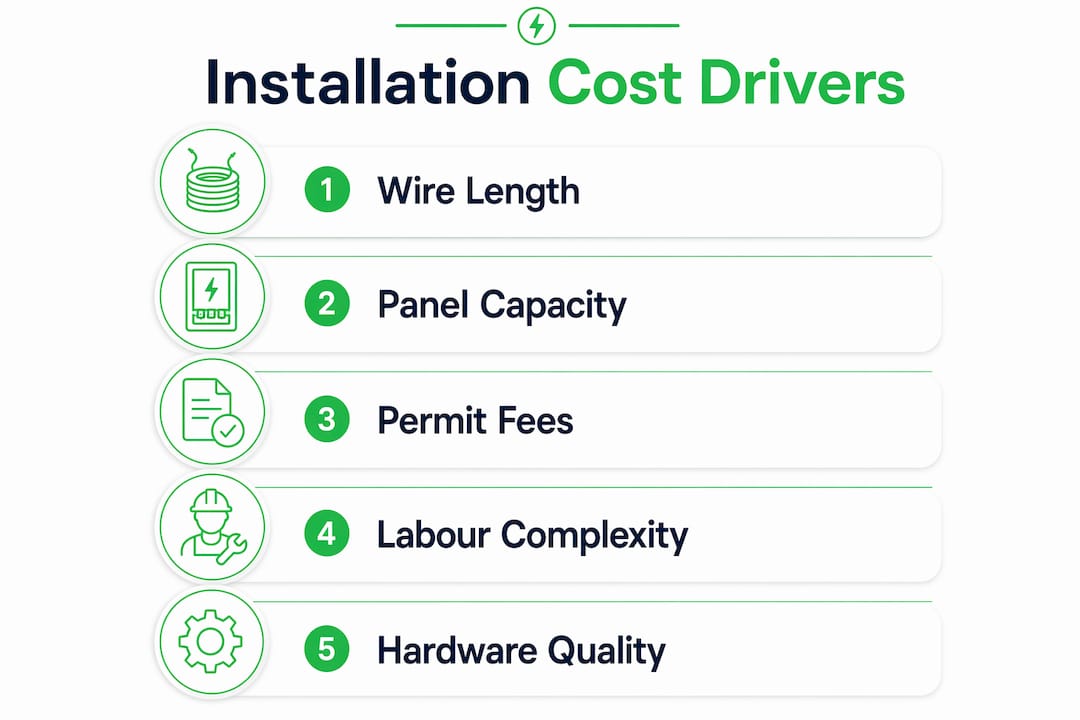
The wire run distance and routing complexity is the single largest variable. A short, direct run from a panel adjacent to your parking pad costs far less than more complex wiring routes like fishing wire through finished walls or trenching underground.
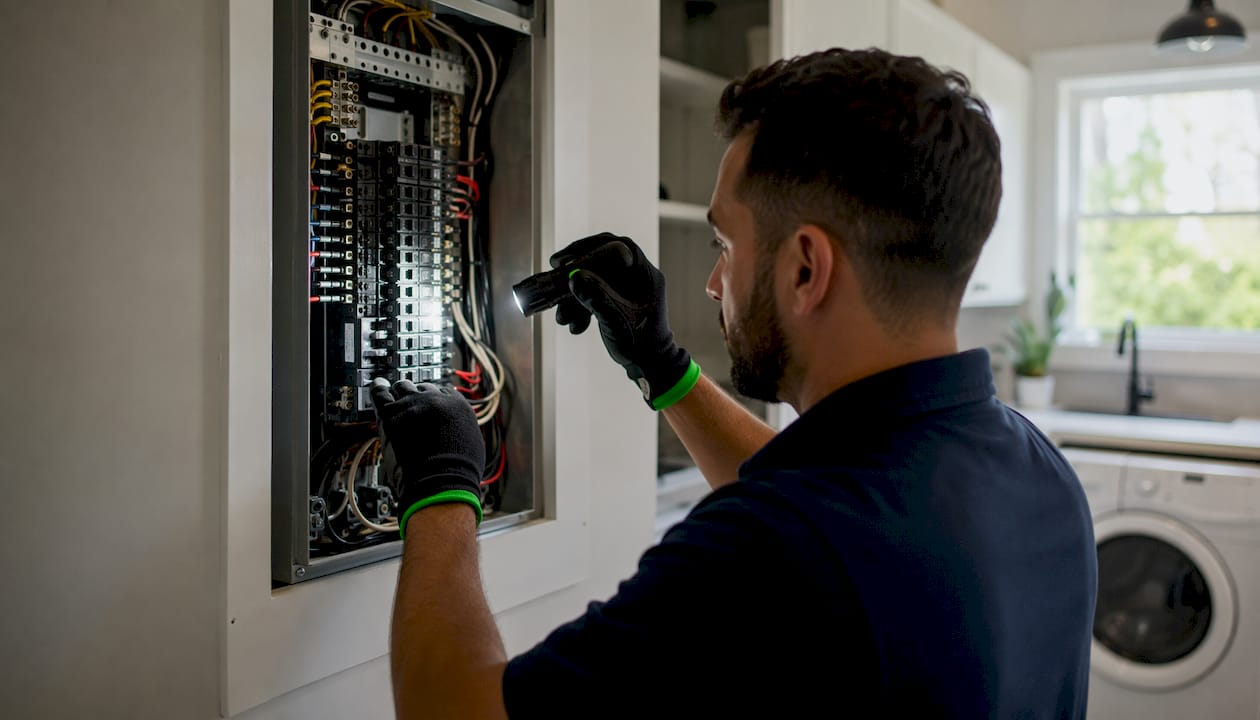
Panel capacity is the second major factor. Older Toronto homes with 100A service can struggle to accommodate a 48A charger alongside existing loads. A full 200A service upgrade adds a substantial cost to the job, depending on the scope and complexity. An alternative worth asking about: smart load management devices like the DCC-12 (EVEMS) can monitor household load and throttle the charger automatically, often eliminating the need for a full service upgrade at a fraction of the cost. You can learn more about EVEMS installation as a panel-upgrade alternative.
Pro Tip: Get an on-site assessment before accepting any quote. Measuring the actual run distance, checking panel layout, and identifying the mounting substrate (wood stud, masonry, concrete) prevents surprise change orders on installation day.
Other cost drivers include:
- Hardwired vs. NEMA 14-50 receptacle: Hardwired is preferred outdoors for durability; the price difference is usually $100–$200
- Mounting surface: Masonry and concrete require anchors and add labour time; detached structures need a subpanel or underground feed
- Permitting complexity: Utility involvement for large service changes can extend timelines
When you are budgeting multiple home trades at once, the same principle of getting itemised written quotes applies across contractors. A comparison of trade contractor quotes for HVAC work illustrates how scope and complexity drive cost variance in exactly the same way.
Realistic Toronto cost scenarios for your home
| Scenario | Hardware | Labour & materials | ESA permit | Panel upgrade | Typical total |
|---|---|---|---|---|---|
| A: Simple (short run, panel nearby) | — | — | $100–$200 | None | starting from $1,200 |
| B: Medium (30–50 ft run, some wall fishing) | — | — | $100–$200 | None | — |
Scenario A suits homes where the electrical panel sits adjacent to the parking pad. A hardwired run of under 20 feet with no finished-wall fishing keeps labour low.
Scenario B covers the most common Toronto situation: a semi-detached or detached home where the panel is on the opposite side of the garage, requiring 30–50 feet of conduit through a partially finished basement or along an exterior wall.
Scenario C applies to detached garages, long underground runs, or any home where the panel assessment reveals insufficient capacity. This is where EVEMS becomes a financially attractive option compared to a full service upgrade.
Ontario rules: ESA permits, OESC requirements, and rebates
Ontario law is clear. Any new 240V circuit in a residential property requires an ESA permit and a final inspection. This flows from the Ontario Electrical Safety Code (OESC), which governs all residential electrical work in the province.
What you must have on file after installation:
- ESA permit receipt (pulled by your electrician before work starts)
- Final inspection sticker or sign-off from the ESA-certified inspector
- Written, line-item quote from your installer
- Warranty documentation
Unpermitted work voids many home insurance policies and can complicate a sale. Buyers’ lawyers routinely ask for permit history on electrical upgrades.
On rebates: There is no current Ontario provincial residential rebate for EV charger installation. Federal ZEVIP funding targets commercial and multi-unit residential projects, not typical single-family homes. Check current Ontario rebate options and your local utility for any managed-charging incentives that may apply to your situation.
Also worth noting: combining GFCI protection at both the breaker and within the charger can cause nuisance tripping. Discuss your protection strategy with your electrician during planning.
Outdoor installation choices that hold up through Toronto winters
Toronto’s freeze-thaw cycles are hard on outdoor electrical equipment. Choosing the right ratings and conduit strategy from the start prevents failures in year two or three.
- NEMA rating: NEMA 4 is the minimum for exposed driveway or carport installations. It protects against windblown rain, dust, and hose-directed water. The rating must apply to the charger enclosure AND the entire feed path.
- Conduit: Schedule 40 or 80 PVC suits most outdoor runs; LFMC (liquid-tight flexible metal conduit) handles tight bends near the charger; RMC (rigid metal conduit) is used where physical protection is critical.
- Penetrations and drip loops: All wall penetrations need sealed bushings and exterior-grade sealant. Drip loops on cable runs prevent water from tracking into the enclosure.
- Hardwired vs. plug-in: Hardwired installations are more durable outdoors because they eliminate the weather-exposed receptacle interface. Plug-in setups add a gasket, plug blades, and an in-use cover as potential failure points in cold, wet conditions.
- Mounting height: Most Level 2 units have 20–25 ft cables; mounting 48–54 inches above the parking surface keeps the connector reachable and off the ground.
Pro Tip: Mount above the expected snow line and position the cable holster so it cannot become an ice shelf. A connector frozen into a holster in January is a common and entirely avoidable service call.
How to choose a Toronto installer: questions to ask and red flags
Essential credentials to confirm:
- ESA-licensed electrician on staff (ask for their ESA licence number)
- Liability insurance and WSIB coverage
- Local references or verifiable reviews
- Experience with outdoor hardwired installs specifically
Questions to ask on the first call:
- Do you pull the ESA permit, or does the homeowner?
- Who schedules and attends the final ESA inspection?
- Does your quote include all conduit, fittings, and weatherproof boxes?
- How do you handle a panel that is near capacity?
- What is your labour warranty, and is it in writing?
Red flags that should stop you from signing:
- A quote with no line items, just a single total number
- Recommending an outdoor plug-in install without specifying weatherproof enclosures and conduit
- No mention of an ESA permit or inspection in the scope of work
- Refusing to provide a written warranty on labour
A good written quote names the charger model or a hardware allowance, states the wire gauge and conduit type, specifies the breaker size, lists the permit fee separately, and gives an expected completion timeline.
Key takeaways
A properly permitted outdoor Level 2 EV charger installation in Toronto typically requires an ESA permit and final inspection and is best installed hardwired outdoors for durability.
| Point | Details |
|---|---|
| Toronto cost range | Straightforward installs run $1,200–$2,500; panel upgrades add $1,500–$4,500 or more depending on scope. |
| ESA permit is mandatory | Any new 240V circuit requires an ESA permit and final inspection under Ontario law. |
| Hardwire outdoors | Hardwired installs eliminate weather-exposed receptacle interfaces and last longer in Toronto’s climate. |
| Check panel capacity early | A 48A charger needs a 60A breaker; older 100A panels may require an upgrade or EVEMS device. |
| Evchargerinstallationtoronto | EV Install Pro handles ESA permits, inspections, rebate applications, and panel upgrades with same-week booking from $800. |
Why the permit-first approach matters more than most homeowners realise
Most of the calls that go sideways start the same way: a homeowner found someone cheaper who skipped the permit. The work looks fine for a year. Then there is an insurance claim, a home sale, or an ESA audit, and the unpermitted circuit becomes a very expensive problem to fix retroactively.
The ESA permit process exists precisely because a 240V outdoor circuit in a Canadian climate carries real risk if installed incorrectly. Freeze-thaw cycling stresses conduit joints. Moisture finds its way into improperly sealed penetrations. A breaker sized without the 125% continuous-load rule in mind can overheat over time. These are not theoretical risks; they are the failure modes that the OESC and ESA inspection process are designed to catch before they cause harm.
The installers worth hiring are the ones who treat the permit as a baseline, not a selling point. When a contractor mentions the permit in the first sentence of their quote, that is a signal they understand the work. When they do not mention it at all, that is a signal to keep looking.
Get a quoted outdoor Level 2 install from EV Install Pro
Evchargerinstallationtoronto gives Toronto homeowners a clear, fixed-price path to a compliant outdoor charger. Starting from $1,200, every job includes a written line-item quote, ESA permit handling, a licensed electrician on-site, final inspection coordination, and a labour warranty. Same-week booking is available across the GTA.
Use the free cost calculator to get an instant estimate based on your home’s setup. If your panel needs attention first, Evchargerinstallationtoronto handles panel upgrades for EV chargers and EVEMS installations in the same booking. No separate contractors, no coordination headaches.
Authoritative sources and further reading
- Electrical Safety Authority (ESA): Ontario’s primary authority on permits, inspections, and the OESC. Confirm permit requirements and find a licensed electrician through their contractor search tool.
- Natural Resources Canada — EV charger installation: Federal guidance on home charging options, Level 2 installation considerations, and links to current incentive programmes.
- Alternative Fuels Data Center — charging at home: U.S.-based resource (note: American context) confirming that outdoor Level 2 installs are safe when equipment and wiring are correctly rated and installed per code.
- TPSON Power — outdoor EV charger weatherproofing guide: Detailed technical reference on NEMA/IP ratings, conduit strategy, and cable management for outdoor installations.
Recommended
Get Your Free Installation Quote
Free assessment · ESA permit included · Same-week availability across the GTA