Condo EV charger approval: what owners and boards need to know
Condo owners in Canada can get approval to install an EV charger, and the process is more straightforward than most boards assume. There are two routes: an owner-initiated application, where you request permission to install a charger at your own expense, or a corporation-initiated project, where the condo corporation drives the rollout and the costs flow through common expenses. The route you take determines who pays, who pulls permits, and whether a vote will be required.
Two approval routes at a glance:
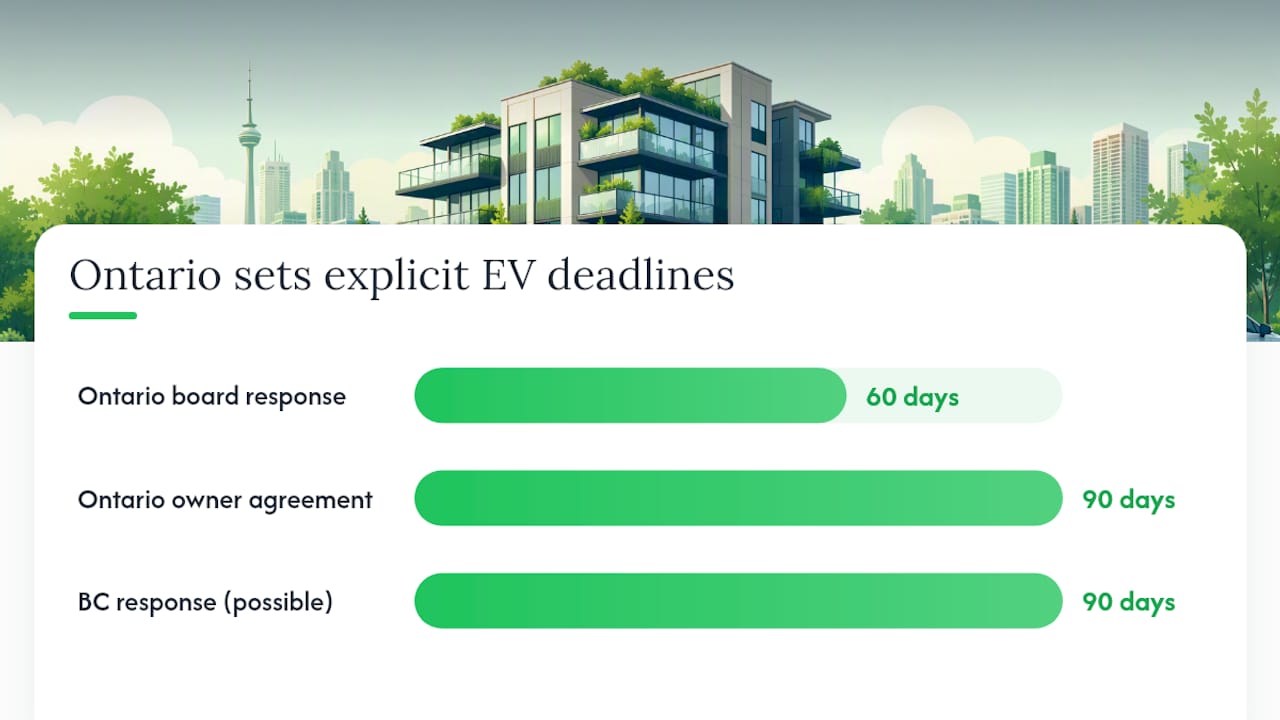
- Owner-initiated: You apply to the board, cover all costs, arrange a licensed contractor, and enter a formal EV agreement with the corporation. The board typically has 60 days to respond in Ontario.
- Corporation-initiated: The board proposes the project as a building-wide upgrade. Costs become common expenses, and the corporation manages procurement and permits.
Timeline callout: In Ontario, boards have 60 days to respond to an owner application under the CAO guide: Electric vehicle charging systems. Once approved, owners typically have 90 days to enter a formal EV agreement with the corporation.
Key takeaways
Condo owners in Canada can get EV charger approval through either an owner-initiated application or a corporation-initiated project, with 60-day board response timelines in Ontario and a 90-day window to enter a formal EV agreement after approval.
| Point | Details |
|---|---|
| Two approval routes | Owner-initiated (you pay, you apply) and corporation-initiated (board drives, costs are common expenses) follow different rules and timelines. |
| Board response timeline | In Ontario, boards have a required response period to an owner application; the owner then has a prescribed timeframe to enter a written EV agreement. |
| Licensed contractor and permits required | All installations must be completed by an ESA-licensed contractor with a permit and inspection; unpermitted work can void insurance. |
| Rebate pre-approval is critical | Most provincial and federal rebate programmes require pre-approval before you purchase equipment or begin installation. |
| Evchargerinstallationtoronto | Provides ESA-licensed installation, permit handling, EVEMS load management, and rebate support across the Greater Toronto Area. |
Table of Contents
- 1. Who has decision authority and what triggers each approval route
- 2. Step-by-step owner application: what to submit and what the board must do
- 3. When a co-owner vote is triggered, notice rules and voting thresholds
- 4. What the EV agreement covers and clauses boards commonly require
- 5. Technical rules, permits and the risks of non-compliant installations
- 6. Typical costs, who pays under each route, and rebate opportunities
- 7. Province-by-province rules that materially change the approval process
- 8. Next steps if the board rejects your application
- 9. Installer-tested tactics that materially improve approval odds
- 10. A concise checklist owners can use to prepare and submit an application
- 11. Why pursuing condo EV charging approval is worth doing now
- Condo EV charger installation made straightforward with Evchargerinstallationtoronto
- Sources
1. Who has decision authority and what triggers each approval route
The legal distinction between corporation-initiated and owner-initiated projects is not just administrative. It determines who bears the cost, who is liable if something goes wrong, and whether the project requires a vote.
Owner-initiated means you, as a unit owner, are proposing a change to a common element (your parking stall’s electrical supply) for your own benefit. You pay for the installation, the permit, and ongoing maintenance. The corporation’s role is to review, approve, and enter a written agreement.
Corporation-initiated means the board decides to install charging infrastructure as a building improvement. This typically happens when:
- Multiple owners have requested chargers and a building-wide solution is more cost-effective
- The project involves shared electrical infrastructure (a new sub-panel, conduit runs, or a metering system)
- The board wants to adopt a Charging-as-a-Service model or a managed billing platform
- A developer or property manager is future-proofing a new or recently converted building
The cost implications are significant. Under a corporation-initiated model, expenses are treated as common expenses and may be funded through the reserve fund, a special levy, or a service contract. Under an owner-initiated model, the owner pays everything, including any panel upgrade or sub-metering equipment required for their stall.
Provincial statutes set the specific thresholds. In Ontario, the Condominium Act and O. Reg. 48/01 govern the process. In British Columbia, the Strata Property Act (as amended by Bill 22) applies. Québec operates under the Civil Code of Québec, with distinctions based on whether the parking stall is a private portion or a common portion.
2. Step-by-step owner application: what to submit and what the board must do
A complete application reduces the chance of delays. Boards are entitled to reject incomplete submissions, which restarts the clock. According to Clean Energy Canada’s condo EV guide, a thorough application typically includes:
What to include in your application:
- Your name, unit number, and parking stall number
- A description of the proposed EV charger (make, model, Level 2 specifications, amperage draw)
- A proposed mounting location and a simple site plan or photograph
- The electrical scope of work, including wiring route and any sub-panel or circuit requirements
- The name and licence number of your chosen electrical contractor
- Confirmation that an ESA permit (or equivalent provincial permit) will be obtained
- A sub-metering or dedicated circuit proposal so your electricity use is billed separately from common areas
- Evidence of your homeowner’s insurance and a statement that you will maintain the charger
What the board must do:
- Confirm the application is complete (boards may request missing items once)
- Respond in writing within the required window — 60 days in Ontario under the CAO process
- If approving, propose an EV agreement within 90 days of approval
- If rejecting, provide written reasons
If the board does not respond within the required period, some provincial rules treat the application as deemed approved. Do not rely on a verbal nod from a property manager. Ontario’s Condominium Act requires a formal written agreement for changes to common elements, and failing to obtain it can leave you liable for removal costs later.
The CAO guide provides response templates boards can use, which also gives owners a clear picture of what a compliant response looks like.
Pro Tip: Submit your application by registered mail or email with read receipt. A documented delivery date protects you if a dispute arises over whether the 60-day clock has started.
3. When a co-owner vote is triggered, notice rules and voting thresholds
Not every EV charger installation requires a vote of all owners, but some do. Understanding the thresholds prevents surprises.
If it does, the board must give 60 days’ notice and owners can requisition a meeting. Owner-initiated installations generally do not trigger a vote, but the board must still approve the EV agreement.
British Columbia: Bill 22 amendments to the Strata Property Act lowered the threshold for many EV-related decisions to a simple majority vote of the strata council, rather than requiring a three-quarters vote of all owners. This makes it easier for councils to approve owner requests without a full general meeting.
Québec: The Civil Code distinguishes between changes to private portions and changes to common portions. If your parking stall is a private portion, you have more latitude. If it is a common portion (which is common in older Québec condos), any modification typically requires co-owner approval, and the voting threshold depends on the nature of the change.
Key thresholds to know:
- Ontario: A cost threshold of the annual budget triggers owner notice and requisition rights for corporation-initiated projects
- Ontario: Special levies for reserve fund spending often require a super-majority owner vote
- B.C.: Many EV decisions now pass by majority strata council vote under Bill 22
- Québec: Changes to common portions require co-owner approval; thresholds vary by type of change
Provincial rules are actively evolving. The Plug’n Drive condo charging resource tracks recent amendments and is worth checking for the latest threshold updates in your province.
4. What the EV agreement covers and clauses boards commonly require
Once the board approves your application, the next step is a written EV agreement. This is not optional. The agreement protects both you and the corporation by defining responsibilities before anything is installed.
Standard clauses in an EV agreement:
- Installation responsibility: You hire and pay the licensed contractor; the corporation approves the scope
- Maintenance and repair: You are responsible for maintaining the charger and associated wiring
- Insurance: You must maintain liability insurance covering the charger and any damage it causes
- Access: The corporation retains the right to access the charger for building maintenance or emergency work
- Restoration: If you sell your unit or the charger is removed, you restore the electrical infrastructure to its original condition (or the new owner assumes the agreement)
- Ownership on resale: The agreement should specify whether the charger transfers with the unit or is removed
- Billing and sub-metering: How your electricity consumption is measured and billed separately from common area costs
The 90-day window to enter the agreement after approval is standard in Ontario. Missing that window can require you to restart the application process.
Why registration on title matters: For owner-initiated installations, the EV agreement should be registered on title. This means a future buyer of your unit is bound by the same obligations and benefits. Without registration, a new owner could argue the agreement does not apply to them, leaving the corporation in a difficult position.
The CAO guide includes sample agreement language that boards and owners can adapt. Using a template reduces negotiation time and ensures nothing critical is omitted.
5. Technical rules, permits and the risks of non-compliant installations
Every EV charger installation in a condo must be completed by a licensed electrical contractor. In Ontario, that means an ESA-licensed contractor who pulls an electrical permit and arranges an inspection. Other provinces have equivalent requirements through their own electrical safety bodies (Technical Safety BC, Régie du bâtiment du Québec, and so on).
What the technical process involves:
- A load calculation to confirm the building’s electrical service can support the new circuit
- An electrical permit pulled by the licensed contractor before work begins
- Installation of a dedicated circuit (typically 240V/40A for a Level 2 charger)
- A sub-meter or dedicated circuit breaker so your consumption is billed separately
- A post-installation inspection by the electrical safety authority
- Documentation provided to the board confirming permit and inspection completion
Skipping any of these steps carries real consequences. Unpermitted work can void your homeowner’s insurance. It can also force removal at your expense if the corporation or a future buyer discovers the non-compliance. The NRCan MURB guide outlines when an Electrical Planning Report (EPR) is appropriate, particularly when multiple units are requesting chargers simultaneously or when the building’s existing service capacity is uncertain.
An EPR is not always required for a single-stall owner-initiated install, but it becomes important when the building is planning for five or more chargers, or when the electrical service is already near capacity. Smart load management, specifically an EV Energy Management System (EVEMS), can often avoid a full service upgrade by distributing available capacity across multiple chargers dynamically. For condo buildings in Toronto, EVEMS installation is frequently the most cost-effective path when several owners want chargers at the same time.
Pro Tip: Include contractor-signed schematics and a preliminary load calculation in your board application. Boards are far more likely to approve quickly when they can see that a licensed professional has already assessed the electrical impact.
6. Typical costs, who pays under each route, and rebate opportunities
Cost allocation is one of the most common points of confusion in condo EV charger approvals. The rule is straightforward: under an owner-initiated installation, you pay for everything. Under a corporation-initiated project, costs flow through common expenses.
Owner-initiated costs typically include:
- Electrical contractor fees for installation and permit
- Cost of the Level 2 charger unit itself
- Any dedicated conduit run from the electrical room to your stall
- Sub-metering equipment
- Any panel upgrade if your stall’s circuit capacity is insufficient (see panel upgrade guidance for Ontario)
Corporation-initiated costs are shared across all unit owners through common expenses, a special levy, or a reserve fund draw (subject to the voting thresholds described above).
Rebate and funding opportunities materially change the financial picture. Several programmes are available to condo owners and corporations in Canada:
- Ontario rebate programmes cover both residential and multi-unit installations; check current eligibility before purchasing equipment
- York Region-specific rebates apply to owners in Markham, Vaughan, and Richmond Hill
- Federal ZEV incentives through Transport Canada’s zero-emission vehicle programme provide additional support for qualifying purchases
- The PluginBC guide notes that rebate pre-approval is commonly required before purchases or installation begins, and that some programme rules changed for multifamily applicants
Rebate pre-approval is critical. Most programmes require you to apply before you buy the charger or begin installation. Presenting available rebates to your board as part of the application is also a persuasion tool: a project that costs the corporation less (or nothing) is easier to approve.
Boards considering a building-wide rollout have additional funding models available: a special levy, a Charging-as-a-Service contract with a third-party provider, or an owner-pay-for-service model where each participating owner pays a monthly fee that covers infrastructure amortisation. Each model has different implications for reserve fund contributions and common expense declarations.
7. Province-by-province rules that materially change the approval process
The approval process for electric vehicle charging in condos varies enough between provinces that following the wrong set of rules can delay or derail your application.
Ontario
The Condominium Act and O. Reg. 48/01 govern the process. Boards have 60 days to respond to an owner application. Once approved, the owner has 90 days to enter a written EV agreement. The Condominium Authority of Ontario (CAO) publishes application and response templates that both owners and boards can use directly. The CAO guide is the primary reference for Ontario owners.
British Columbia
The Strata Property Act, as amended by Bill 22, governs strata corporations. Key changes include:
- Many EV-related decisions now require only a majority strata council vote rather than a three-quarters owner vote
- Strata corporations may be required to commission an Electrical Planning Report before approving multiple charger requests
- Owner proposals may have a 90-day response window in some cases
- BC Hydro’s installation guide and PluginBC provide practical step-by-step guidance for B.C. strata owners
Québec
The Civil Code of Québec applies. The key distinction is whether your parking stall is classified as a private portion or a common portion:
- Private portion: you have more latitude to install with board notification rather than full co-owner approval
- Common portion: any modification requires co-owner approval, with voting thresholds that depend on the nature of the change
- Registration on title is particularly important in Québec to bind future owners
For a current summary of EV-ready bylaws and provincial rule updates across Canada, the Electric Autonomy bylaw tracker is a useful reference.
Pro Tip: Before submitting your application, confirm with your property manager whether your parking stall is classified as a private portion, an exclusive-use common element, or a general common element. That classification determines your rights and the applicable approval threshold.
8. Next steps if the board rejects your application
A rejection is not the end of the process. Most rejections are based on incomplete information, concerns about electrical capacity, or uncertainty about maintenance and insurance. All of these are addressable.
Immediate steps after a rejection:
- Request written reasons if the board has not provided them (you are entitled to this in most provinces)
- Review the reasons carefully; many objections are technical, not policy-based
- Commission an electrical planning or load study from a licensed contractor to address capacity concerns
- Propose mitigations: a different stall location, an EVEMS to manage load without a service upgrade, or a shared charging station model
- Revise and resubmit with the additional documentation
Formal options if the board refuses to engage:
- Requisition a meeting: If enough owners support EV charging (typically 15% of owners in Ontario), you can requisition a special general meeting to put the question to a vote.
- Mediation: The Condominium Authority Tribunal (CAT) in Ontario handles disputes about EV charger applications. B.C. has the Civil Resolution Tribunal. Québec has its own administrative processes.
- Arbitration: Some condo declarations require arbitration before litigation; check your declaration.
- Legal advice: If the board is refusing an application that meets all statutory requirements, a condo lawyer can advise on your options.
Preparing an owner-led case for a vote:
- Prepare a concise technical appendix: load study, contractor quote, permit plan, and sub-metering proposal.
- Frame the cost/benefit clearly: include available rebates, long-term property value considerations, and the cost of inaction.
- Gather precedent examples from comparable buildings in your city that have approved similar installations.
- Present the project as a building-wide opportunity, not a single-owner request, to reduce the board’s perception of risk.
9. Installer-tested tactics that materially improve approval odds
Owners who approach the board with a complete, professionally prepared package get approvals faster. This is consistent across Ontario, B.C., and Québec.
What to include in your initial submission:
- A contractor-signed site assessment confirming electrical capacity and proposed scope
- A clear sub-metering method (dedicated circuit breaker or smart sub-meter) so billing is unambiguous
- A maintenance plan: who services the charger, what happens if it fails, and who pays
- Proof of insurance coverage for the charger and associated wiring
- A permit-ready quote from your licensed contractor
The future-proofing argument works. According to PluginBC’s multifamily guide, planning for broad building electrification reduces long-term per-stall costs compared to fragmented, one-off retrofits. When you present your single-stall request alongside a scalable plan (conduit rough-in for future stalls, EVEMS-ready wiring), boards see a managed project rather than an ad hoc request. That framing reduces perceived risk to the corporation.
Load management is often the deciding factor in a board’s technical objection. A building that appears to be near electrical capacity can often accommodate multiple Level 2 chargers with an EVEMS, which dynamically allocates available amperage across active chargers. This avoids the cost and disruption of a full service upgrade. Presenting this option, with a contractor-validated estimate, directly addresses the most common board objection.
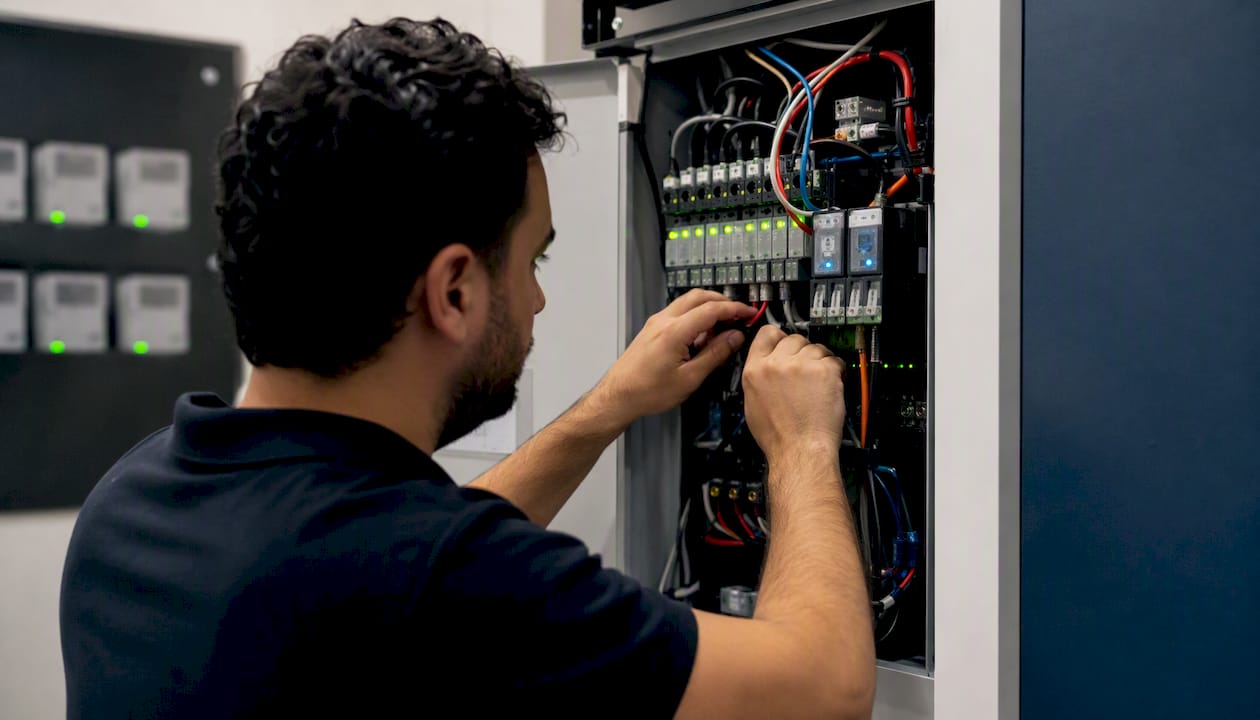
Pro Tip: Ask your contractor to provide a permit-ready quote and signed schematics before you submit to the board. Boards that see a complete permit package approve faster because they know the project will pass inspection.
A validated EPR and signed contractor schematics are persuasive because they reduce the board’s uncertainty about service impacts and long-term costs, as noted in the PluginBC guide. Boards are not electrical engineers; they approve projects they feel confident about.
10. A concise checklist owners can use to prepare and submit an application
Use this checklist from pre-application to post-installation handover.
- Commission a site assessment from a licensed electrical contractor to confirm capacity and identify the best wiring route to your stall.
- Choose a licensed contractor who is ESA-licensed (Ontario) or holds the equivalent provincial licence, and who has experience with condo installations and permit handling.
- Draft your application packet including all items listed in Section 2: contact info, charger spec, site plan, electrical scope, contractor details, permit plan, sub-metering proposal, and insurance confirmation.
- Apply for rebate pre-approvals before purchasing equipment. Check Ontario rebate programmes and federal ZEV incentives; most require pre-approval before installation begins.
- Submit to the board by a documented method (registered mail or email with read receipt) and note the date the 60-day (or applicable provincial) clock starts.
- Follow up on timelines. If you have not received a written response within the required window, send a written follow-up and document it.
- Enter the EV agreement within 90 days of approval. Review all clauses, confirm registration on title where required, and keep a signed copy.
- Arrange permits and inspections through your contractor before any work begins. Never allow installation to proceed without a permit in place.
- Complete installation and obtain inspection certificate. Provide a copy of the permit and inspection certificate to the board as confirmation of compliant installation.
Keep the following documents permanently:
- Signed EV agreement (registered copy if applicable)
- Electrical permit and inspection certificate
- Contractor warranty documentation
- Proof of insurance coverage for the charger
- Sub-metering or billing arrangement confirmation
If any step is unclear, an ESA-licensed electrician can walk you through the permit and inspection requirements specific to your building.
11. Why pursuing condo EV charging approval is worth doing now
The legal and technical steps in this guide can feel like a lot of work for a single parking stall. But the broader context makes the effort worthwhile, and the window to act cost-effectively is narrowing.
Condos that enable EV charging are more desirable to buyers and renters who drive electric vehicles, a segment that is growing steadily across Canada. A building with approved, permitted chargers commands a practical advantage over one that has not addressed the question. That advantage compounds as EV adoption increases.
The cost argument is equally clear. Buildings that commission an EPR and rough-in conduit for future stalls now spend significantly less per stall than those that retrofit one charger at a time. Every one-off installation that bypasses shared infrastructure planning adds cost to the next request. Boards that approve a scalable plan today protect the reserve fund from larger, more disruptive upgrades later.
Framing the project as a building-value enhancement and a rebate-capture opportunity is not spin. It is accurate. Available rebates reduce the net cost to the owner or the corporation, and presenting that math clearly is one of the most effective ways to move a hesitant board. The combination of a complete technical package, a licensed contractor’s signed documentation, and a clear rebate summary addresses the three questions boards ask most often: Is it safe? Is it legal? What does it cost us?
Condo EV charger installation made straightforward with Evchargerinstallationtoronto
Getting board approval is only half the process. The installation itself needs to be permit-complete, ESA-inspected, and backed by documentation the board can file. That is exactly what Evchargerinstallationtoronto delivers across the Greater Toronto Area.
Evchargerinstallationtoronto’s team of ESA-licensed electricians handles the full scope: site assessment, permit application, Level 2 charger installation, smart load management (EVEMS) to avoid costly panel upgrades, and rebate application support. Every installation comes with a completed permit and inspection certificate, which is exactly what condo boards require before authorising ongoing use. Pricing starts from $800, same-week bookings are available, and the team carries a 4.9 customer rating. Use the free cost calculator to get an itemised estimate for your building before your next board meeting.
Sources
The following official documents and guides substantiate the steps and timelines in this article. Confirm current rebate programme details directly with each authority before purchasing equipment, as programme rules can change.
Primary statutory and regulatory references:
- Find a licensed electrical contractor — ESA
- Guide to electric vehicle charging in multi-unit residential buildings — NRCan
- Implementing EV charging infrastructure in your multifamily building — PluginBC
- Zero-emission vehicles overview — Transport Canada
Provincial and practical guides:
This article is general information, not a substitute for advice from a qualified lawyer. Consult a qualified legal professional about your own circumstances before acting on anything here.
Recommended
- EV Charger Installation in a Toronto Condo or Apartment: The Complete 2025 Guide | EV Install Pro Toronto
- Tesla charger condo: Toronto owners’ guide | EV Install Pro Toronto
- Condo & Apartment EV Charger Installation Toronto | Board Approval Included | EV Install Pro Toronto
- EV Charger Installation Process & Timeline in Toronto: What to Expect (2026) | EV Install Pro Toronto
Get Your Free Installation Quote
Free assessment · ESA permit included · Same-week availability across the GTA