Getting a condo EV charger permit approved in Toronto
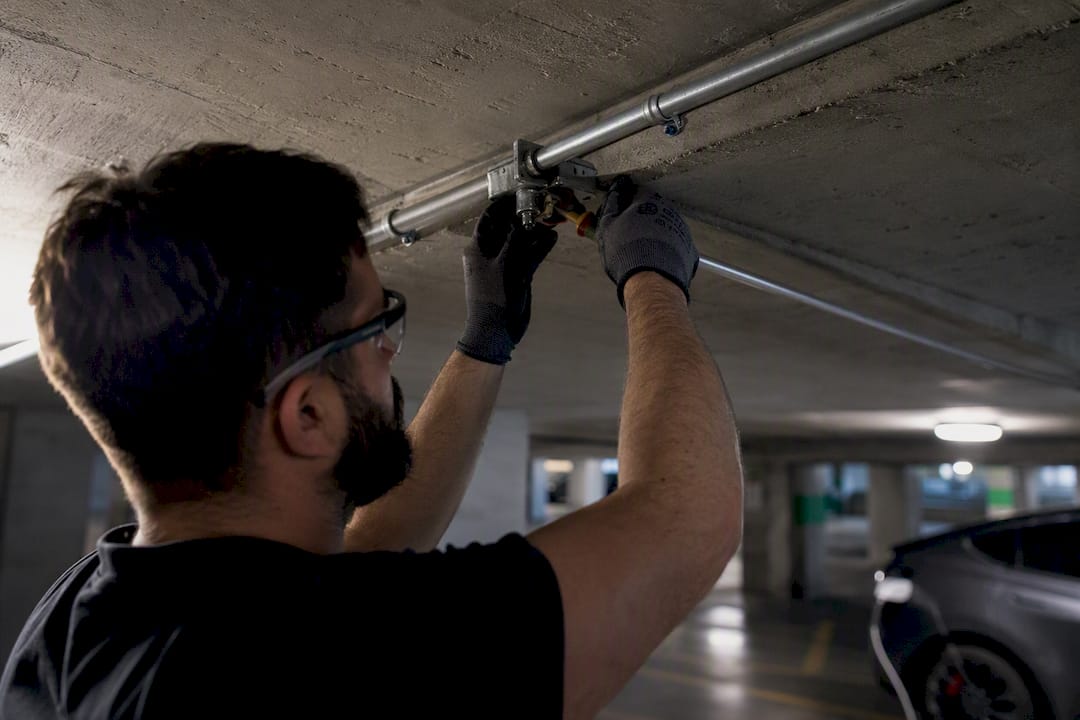
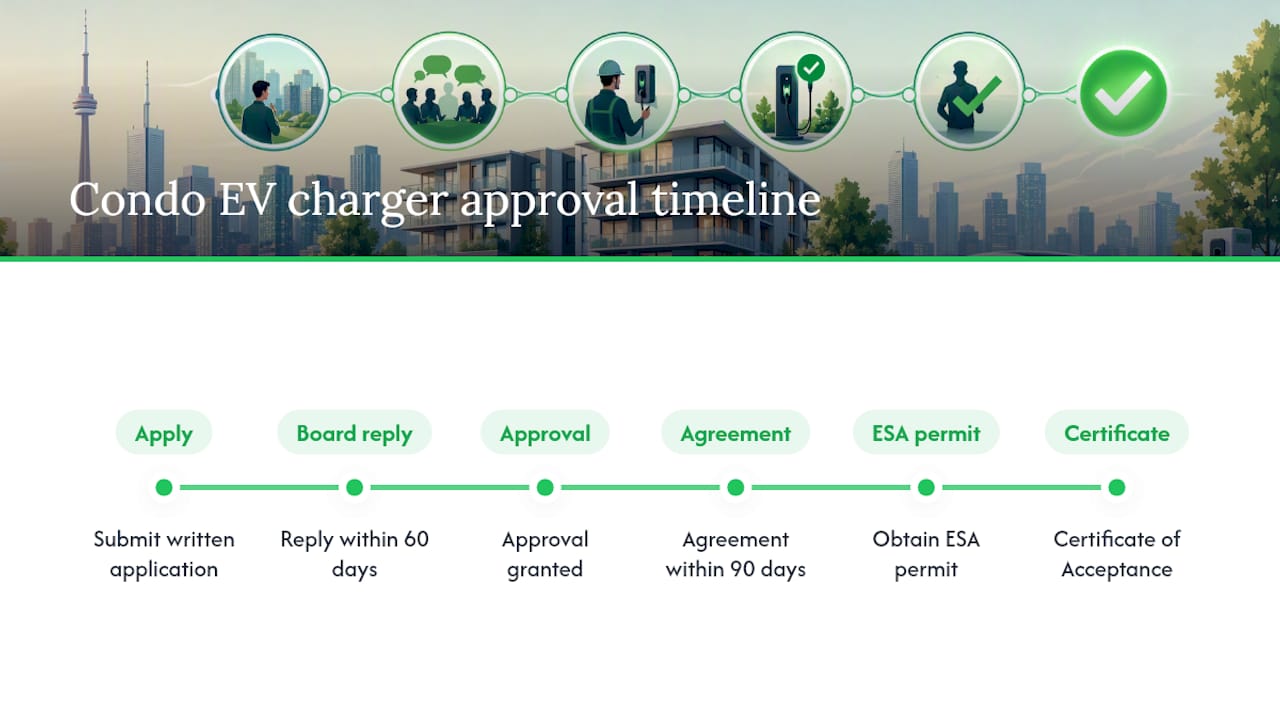
Yes, Toronto condo owners need both condo corporation approval and an Electrical Safety Authority (ESA) permit before installing a permanent, hardwired EV charger. There’s no way around either step. The Condominium Act process gives your board 60 days to respond to a written request, and separately, any 240‑volt installation must be completed by a Licensed Electrical Contractor (LEC) who files the ESA permit and closes the job with a Certificate of Acceptance.
Two legal touchpoints govern everything that follows:
- Condo governance: a formal written application, a 60‑day board response window, and typically a signed agreement within 90 days.
- Electrical compliance: an ESA permit pulled by an LEC, followed by inspection and a Certificate of Acceptance.
Your next move: book a site assessment with a licensed contractor and use their report as the technical backbone of your written request to the board.
Key Takeaways
Getting a condo EV charger approved in Toronto requires both a formal condo‑board application under the Condominium Act and an ESA permit filed by a Licensed Electrical Contractor.
| Point | Details |
|---|---|
| Two approvals, not one | You need condo corporation sign‑off under the Condominium Act and a separate ESA permit filed by an LEC. |
| Know the timelines | Boards have 60 days to respond; agreements are typically finalized within 90 days. |
| Lead with a load assessment | A professional capacity check attached to your first request speeds up board review. |
| Consider load management first | EVEMS or dynamic load sharing can avoid a costly panel upgrade in many older buildings. |
| Rebates change the math | Programs like NRCan’s ZEVIP have covered up to roughly half of eligible costs for multi‑unit projects. |
| Evchargerinstallationtoronto handles the full chain | ESA‑licensed electricians manage the assessment, permit filing, inspection, and rebate paperwork in one package. |
Table of Contents
- Why a condo EV charger permit process differs from a house
- How do you get condo board approval for an EV charger in Ontario?
- Do you need an ESA permit for a condo EV charger?
- What technical checks does a condo EV install require?
- How much does a condo EV charger installation cost in Toronto?
- What funding and rebates apply to condo EV charger projects?
- What should you include in your written request to the board?
- What happens during and after installation?
- How EV Install Pro handles condo permits and approvals in Toronto
- Frequently asked questions
- Sources
Why a condo EV charger permit process differs from a house
Installing a charger in a detached home is mostly a conversation between you, your electrician, and your electrical panel. A condo adds two more parties: the corporation that governs common elements, and the ESA, which treats the parking garage’s electrical infrastructure the same way it treats any shared building system.
Three things make condo installs genuinely harder than home installs:
- Shared capacity. Your parking stall usually draws off a common electrical service, not your unit’s own panel, so the board has a legitimate stake in how much load you’re adding.
- Formal governance. A private homeowner just calls an electrician. A condo owner submits a written request, waits through a statutory review period, and often signs a formal agreement covering insurance and metering.
- Mandatory licensing. DIY hardwired 240‑volt work is not legal in Ontario condos (or houses, for that matter). Only an LEC can pull the permit.
Pro Tip: Attach a professional load assessment to your very first letter to the board. Boards that see hard numbers up front approve requests faster than boards left to guess at electrical risk.
How do you get condo board approval for an EV charger in Ontario?
Ontario’s Condominium Act and the Condominium Authority of Ontario (CAO) lay out a defined process, not a vague “ask nicely and hope” system. Here’s the sequence:
- Submit a written application to the condo corporation describing the proposed charger, its location, and the electrician doing the work.
- Attach supporting documents: electrical drawings, a licensed contractor’s cost estimate and scope of work, a load assessment, proof of insurance, and a proposed approach to metering or cost recovery.
- Wait through the response window. The board has 60 days to respond under Ontario Regulation 48/01.
- Finalize a written agreement, typically within 90 days of approval, covering liability, insurance, and billing.
- Watch for a requisitioned meeting or vote if the board decides the request affects common elements broadly enough to need one.
Documents worth having ready before you send anything:
- Contractor licence number and ESA registry listing
- Load calculation or capacity assessment
- Certificate of insurance naming the corporation where required
- A one‑page cost and billing summary
Send your application by a method that creates a paper trail, registered mail or a dated email to the property manager and board. If the 60 days pass with no response, you have grounds to escalate, and Ontario’s updated framework was specifically designed to make indefinite stonewalling harder than it used to be.
Do you need an ESA permit for a condo EV charger?
Yes, unconditionally, if the charger is hardwired or runs on a 240‑volt circuit. The ESA requires a Licensed Electrical Contractor to file the permit, perform the installation, and request final inspection. There is no owner‑installed pathway for this kind of work in a multi‑unit building.
Here’s what that looks like in practice:
- Your LEC files an ESA Notification of Work before starting.
- The ESA schedules an inspection, either during rough‑in or after the job is finished, depending on scope.
- Once the inspector signs off, the contractor receives a Certificate of Acceptance, the document that proves the installation meets Ontario’s electrical code.
The Certificate of Acceptance isn’t paperwork for its own sake. It’s the record your condo corporation, your insurer, and any future buyer of your unit will ask for if a question ever comes up about that circuit.
Common rework triggers include undersized conductors for the run length, missing grounding details, and panels without documented spare capacity. A contractor who has done several condo installs in your building type usually knows which of these tend to surface in Toronto’s older garages.
What technical checks does a condo EV install require?
Every legitimate condo EV project starts with a load calculation, an assessment of how much spare capacity the building’s electrical service actually has before your charger gets added to it. A qualified contractor or electrical engineer needs to verify this before anyone talks hardware.
From there, the technical options generally split three ways:
- Dedicated subpanel fed from the building’s electrical room, often the simplest fix when spare capacity exists.
- Main service upgrade to 200 amps, needed when the building is already near its limit. This is the most expensive route and the one boards resist most.
- Smart load management systems (EVEMS, dynamic load sharing, DCC‑12‑style controllers) that let multiple chargers share existing capacity by throttling output when demand peaks.
That third option matters more than most owners realize. A well‑configured load management system can let a building add several chargers on existing capacity instead of forcing a costly service upgrade, particularly in older Toronto towers with limited electrical room space.
Pro Tip: Propose a load management option in your very first submission, even if you’re only asking for one stall. Boards worry about the tenth request, not the first, and showing you’ve thought about scalability changes how your application reads.
How much does a condo EV charger installation cost in Toronto?
Budget realistically before you submit anything. A typical Level 2 installation in a condo, hardware, labour, and minor infrastructure work, runs roughly $2,000 to $5,000 CAD per stall before any rebates.
- Straightforward dedicated‑circuit installs land at the lower end of that range.
- Panel upgrades or load management systems push costs higher, sometimes by several thousand dollars depending on garage layout and cable run length.
- Timeline: board review (up to 60 days), site assessment and engineering (one to three weeks), permit and inspection (one to two weeks), then installation itself, often completed in a single day once approved.
Who pays what varies by building. Some corporations bill the requesting owner for everything; others split infrastructure upgrades across all owners if the work benefits future EV adopters too.
What funding and rebates apply to condo EV charger projects?
Federal and provincial money changes the math on a condo project meaningfully. Natural Resources Canada’s Zero Emission Vehicle Infrastructure Program (ZEVIP) has supported multi‑unit residential charging projects, with past intake rounds covering up to roughly half of eligible costs in some cases.
- NRCan ZEVIP targets multi‑unit buildings specifically, not single homes, making it directly relevant to condo corporations planning shared infrastructure.
- Provincial and municipal top‑ups sometimes layer on top of federal funding, though most require pre‑approval before you buy equipment, not after.
- Present the numbers in your board package. A request that shows the building’s net cost after rebates reads very differently than one that only shows sticker price.
What should you include in your written request to the board?
Your application is stronger when it reads like a completed project proposal, not a request for permission to start thinking about one.
- Contractor’s name, ESA licence number, and scope of work
- Load assessment or calculation showing available capacity
- Equipment specifications (make, model, amperage)
- Cost estimate with a proposed metering or billing method
- Certificate of insurance and any indemnity language the board’s property manager typically requires
One structural choice matters more than owners expect: offering staged options. Present a Level 1 outlet, a Level 2 hardwired charger, and a shared‑charger configuration as tiers, with a recommendation for a phased rollout. Boards that see a lower‑cost first phase approve faster than boards asked to commit to the most expensive option immediately, and a building‑wide electrical planning report can avoid repeat engineering costs if more owners follow your lead.
What happens during and after installation?
Once approved, the physical work moves fast compared to the approval process itself.
- The contractor schedules garage access, typically working around resident parking with minimal disruption to a single stall or a short section of aisle.
- Cable routing and pedestal or wall‑mount work usually take a few hours to a full day.
- The ESA conducts final inspection, checking grounding, conductor sizing, and panel labelling before issuing the Certificate of Acceptance.
Delays at this stage usually trace back to incomplete documentation from earlier in the process, not the physical work itself. After inspection, ongoing use, billing method, remote monitoring, maintenance responsibility, typically gets locked into the written agreement signed with the corporation.
How a certified installer manages permits, approvals, and rebates
A certified installer coordinates the whole chain: site assessment, load calculation, ESA permit filing, inspection scheduling, and Certificate of Acceptance handling.
- Prepares the technical documents your board will actually ask for
- Files rebate paperwork alongside the permit application
- Hands owners a completed package, not a stack of loose invoices, ready for board submission
Publisher perspective: what actually derails condo EV applications
The applications that stall almost never fail because boards are hostile to EVs. They fail because the paperwork is thin: no load assessment, no insurance proof, a vague one‑line billing proposal. Include a licensed contractor’s full scope of work and a proposed load management option from the start, and most of the friction disappears before a meeting ever gets called.
How EV Install Pro handles condo permits and approvals in Toronto
Evchargerinstallationtoronto is the practical alternative to piecing together your own contractor, engineer, and paperwork separately for a condo EV project in Toronto. One team handles the load assessment, files the ESA permit, coordinates inspection, and manages your rebate application, so your board package arrives complete instead of half‑finished.
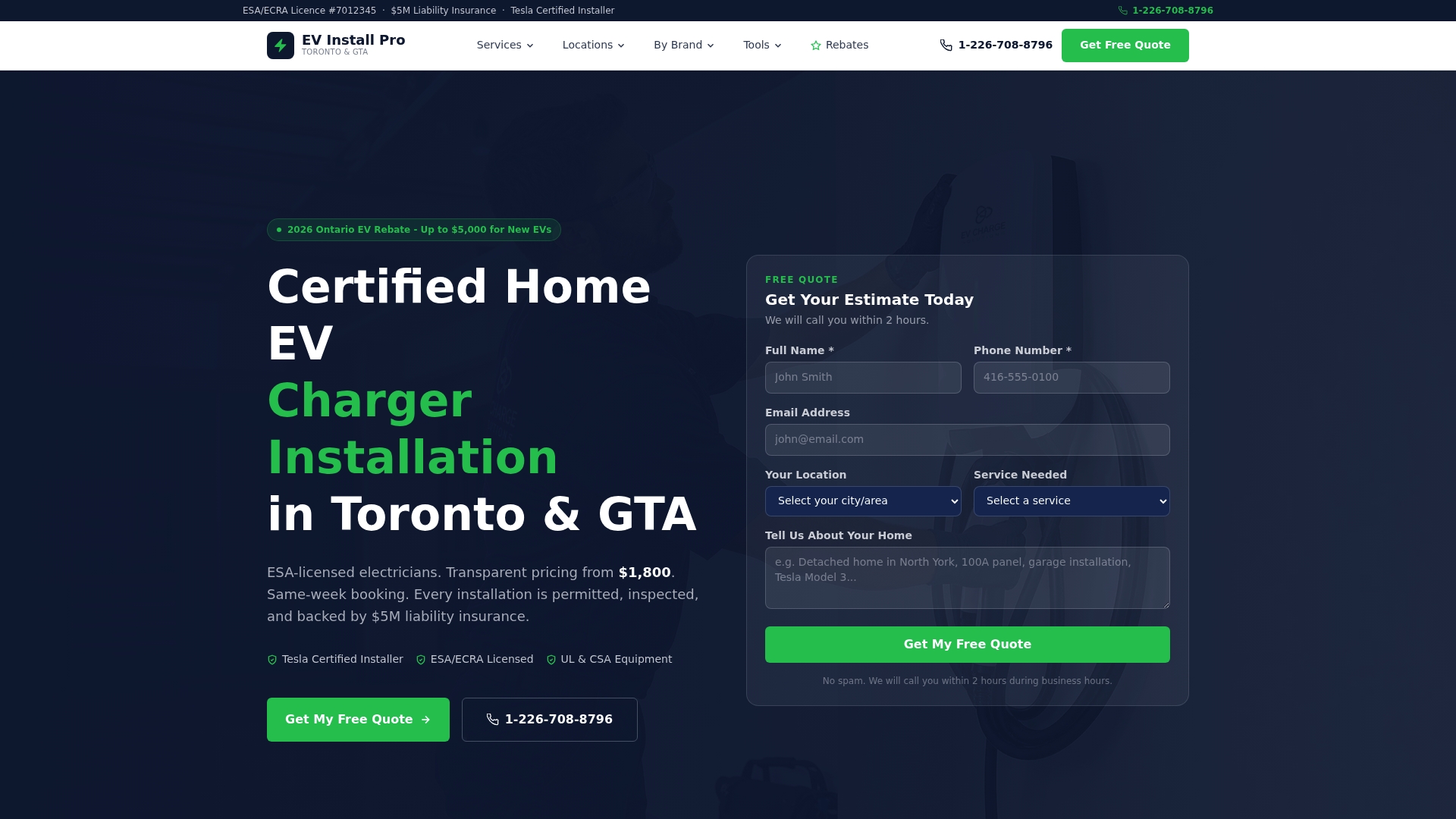
That matters most at the board stage: a submission built on a licensed contractor’s documentation gets reviewed faster than one assembled piecemeal by an owner. Evchargerinstallationtoronto’s ESA‑licensed electricians handle panel upgrades and smart load management installs across the Greater Toronto Area, with same‑week booking where scheduling allows and no separate charge for permit and inspection handling. If you’re ready to see what your specific stall and building setup would cost, run the numbers through the free installation cost calculator and book a site assessment from there.
Frequently asked questions
Can I install an EV charger at a condominium in Toronto? Yes, but a permanent 240‑volt charger needs condo corporation approval and an ESA permit filed by a Licensed Electrical Contractor. You cannot legally do the hardwired work yourself.
Do I need a permit to install an EV charger in Ontario? Any hardwired or 240‑volt installation requires an ESA permit and a Certificate of Acceptance issued after inspection, regardless of whether you live in a condo or a house.
How long does condo board approval take? Under Ontario’s Condominium Act framework, the board has 60 days to respond to a formal written application, with a written agreement typically finalized within 90 days of approval.
How do I charge an EV if I live in a condo without an assigned charger yet? Many owners start with a Level 1 outlet at their stall while pursuing board approval for a hardwired Level 2 charger, then upgrade once the permit and installation are complete.
What if my condo board denies or ignores my request? Ontario’s regulatory framework requires a response within the statutory window; unresolved delays can be escalated, and a stronger technical submission with a load assessment and insurance details often prevents denial in the first place.
This article is general information, not a substitute for advice from a qualified lawyer. Consult a qualified legal professional about your own circumstances before acting on anything here.
Sources
- Condominium Authority of Ontario — how can EV charging be installed in condos?
- ACMO – Condominium Act process for EV charging (article)
- ESA — find a licensed electrical contractor
Recommended
- EV Charger Installation in a Toronto Condo or Apartment: The Complete 2025 Guide | EV Install Pro Toronto
- Condo & Apartment EV Charger Installation Toronto | Board Approval Included | EV Install Pro Toronto
- Tesla charger condo: Toronto owners’ guide | EV Install Pro Toronto
- EV Charger Installation Process & Timeline in Toronto: What to Expect (2026) | EV Install Pro Toronto
Get Your Free Installation Quote
Free assessment · ESA permit included · Same-week availability across the GTA