Dryer outlet EV charging: safe options for Canadian homeowners

Yes, you can use a 240V dryer outlet to charge your EV in Canada — but the outlet type, wiring condition, and how you configure your charging current all determine whether it is safe and code-compliant. A grounded NEMA 14-30 or NEMA 14-50 outlet is a workable starting point. An older, ungrounded NEMA 10-30 is not, unless a licensed electrician upgrades it first. Before you plug in anything, a quick inspection by an ESA-licensed electrician is the single most important step the Canadian Electrical Code and local authorities having jurisdiction (AHJ) expect you to take.
Quick verdict at a glance:
- Acceptable temporary option: NEMA 14-30 or NEMA 14-50 outlet with a certified smart splitter or manufacturer-approved adapter, current set to 24A maximum on a 30A circuit
- Best permanent option: Dedicated NEMA 14-50 or 40–48A hardwired circuit installed by an ESA-licensed electrician with permit
- Immediate no-go: NEMA 10-30 (3-prong, ungrounded) with a jumper adapter or improvised grounding hack — stop and call an electrician first
- Who to call in the GTA: Evchargerinstallationtoronto (EV Install Pro), ESA-licensed, same-week booking available
Table of Contents
- Run this safety check before you plug in your EV
- What your dryer outlet type means for EV charging
- How fast will a dryer outlet actually charge your EV?
- How to connect your EV safely to a dryer outlet
- Canadian Electrical Code and permit requirements you need to know
- Red flags and common mistakes that require a professional
- What a licensed electrician will inspect and what to ask them
- Realistic Canadian costs and timelines
- How EV Install Pro handles a dryer-outlet or Level 2 installation
- Key takeaways
- The case for getting the wiring right the first time
- Get a code-compliant EV charger installation from Evchargerinstallationtoronto
- Useful sources
Run this safety check before you plug in your EV
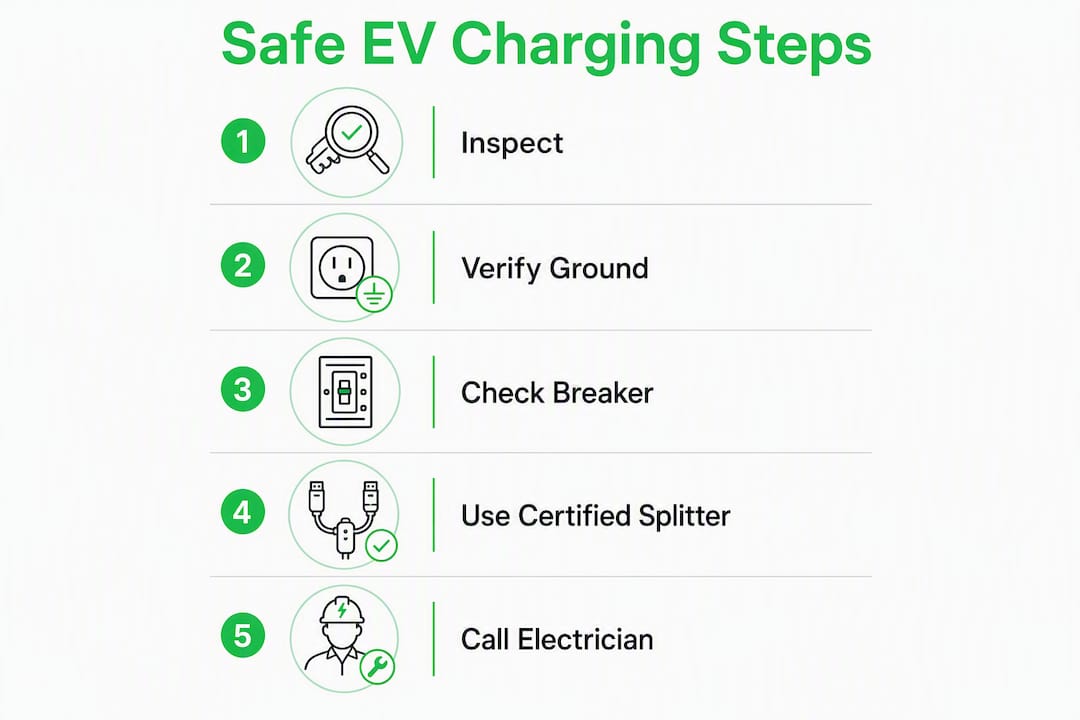
A licensed electrician should verify your receptacle, wiring, and panel capacity before you use any dryer outlet for EV charging. That said, you can do a quick visual triage yourself to know whether to proceed or stop immediately.
Check these items first:
- Count the prongs on your dryer outlet: 3-prong means NEMA 10-30 (ungrounded, stop here); 4-prong means NEMA 14-30 or 14-50 (proceed with caution)
- Confirm the breaker amperage on your panel — look for a double-pole breaker labelled 30A or 50A
- Inspect the receptacle face for scorch marks, discolouration, or a loose, wobbly fit
- Verify your portable EVSE or Level 2 charger supports the exact NEMA type you have
- Confirm the cable reaches the outlet without any extension cord
Red flags that mean stop immediately:
- Any scorch marks or burning smell near the outlet
- Breaker that has tripped recently without explanation
- Aluminium wiring anywhere in the circuit (look for “AL” stamped on the wire jacket)
- Unknown panel capacity or a panel that is already near its load limit
- Outlet that feels warm to the touch after the dryer runs
Pro Tip: Unplug the dryer and test whether your EVSE plug seats firmly in the receptacle before committing to a charging session. A loose fit is a thermal failure waiting to happen — do not improvise with jumper wires or temporary grounding hacks.
What your dryer outlet type means for EV charging
Not all 240V outlets are equal. The NEMA designation tells you the voltage, amperage, and — critically — whether a dedicated equipment ground is present. NEMA connectors follow standards set by the National Electrical Manufacturers Association and are used across North America, including Canada.
| NEMA Type | Volts | Typical Breaker | Safe Continuous Charge | Dedicated Ground? |
|---|---|---|---|---|
| 10-30 | 240V | 30A | Not recommended | No |
| 14-30 | 240V | 30A | 24A | Yes |
| 14-50 | 240V | 50A | 40A | Yes |
| 6-50 | 240V | 50A | 40A | Yes (no neutral) |
Older NEMA 10-30 outlets lack a dedicated equipment ground, which is why modern code requires 4-prong grounded outlets for new installations. Without a proper ground, a fault condition can energize your vehicle’s chassis — a serious shock hazard. The NEMA 14-50 is the preferred modern standard for Level 2 plug-in EV charging because it includes both a dedicated ground and higher amperage capacity.
Practical takeaways:
- NEMA 14-30: usable for temporary charging with a certified smart splitter; limited to a safe continuous current
- NEMA 14-50: a preferred plug-in option for a permanent home setup; supports a high continuous current
- NEMA 6-50: workable for EV charging but has no neutral wire — confirm your EVSE supports it
- NEMA 10-30: requires an electrician upgrade before any EV use; do not use adapters to work around the missing ground
The continuous-load rule is the other key constraint. The Canadian Electrical Code treats EV charging as a continuous load, meaning your charger can draw no more than 80% of the circuit’s rated amperage for extended periods.
How fast will a dryer outlet actually charge your EV?
The math is straightforward. Multiply the continuous amps by 240 volts to get kilowatts, then factor in your vehicle’s onboard charger efficiency to estimate range added per hour.
A 30A dryer circuit limited by the continuous-load rule delivers a maximum reduced current for safety, which results in moderate charging power. For most EVs, this allows for a reasonable amount of range added per hour of charging.
Charging speed comparison by circuit:
- 30A dryer circuit (NEMA 14-30): lower continuous current → moderate charging power → moderate range increase
- 50A dedicated circuit (NEMA 14-50): higher continuous current → higher charging power → higher range increase
- 40A dedicated circuit: intermediate continuous current and charging power
- 48A dedicated circuit: somewhat higher continuous current and charging power
For many Canadian homeowners with typical daily driving distances, a 30A dryer circuit can fully replenish overnight. The limitation shows up if you drive heavily and need a faster top-up, or if you share the circuit with the dryer and cannot guarantee uninterrupted charging time.
The 80% rule also has a wiring implication. A 30A dryer circuit typically uses 10 AWG wire. Running that circuit at its continuous limit (24A) for hours generates heat at every connection point — the receptacle, the plug, and the wire terminations. This is why staying at or below 24A on a 30A circuit is not just a code requirement; it is a thermal safety measure.
How to connect your EV safely to a dryer outlet
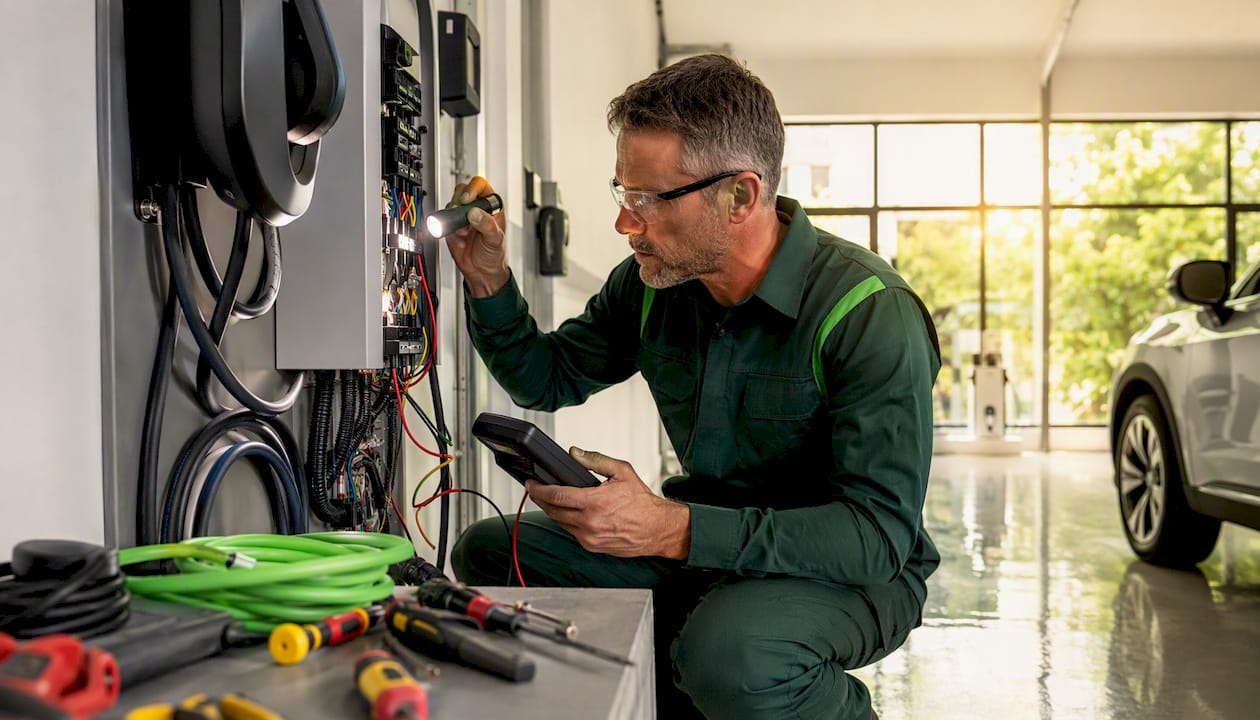
There are two realistic paths: a certified smart splitter for temporary sharing, or a permanent dedicated circuit. Manual plug swapping — unplugging the dryer and plugging in the EVSE by hand each time — is technically possible but relies entirely on human behaviour. Hardware-enforced load management is the only reliable way to share a 240V circuit safely; manual swapping is error-prone and leaves the circuit unprotected if both loads run simultaneously.
Safe temporary setup with a certified smart splitter
- Confirm your outlet is a grounded NEMA 14-30 or 14-50 (4-prong)
- Purchase a smart splitter that is CSA-certified or UL-listed and rated for your outlet type
- Plug the splitter into the dryer outlet — do not use an extension cord between the wall and the splitter
- Connect your portable EVSE to the splitter’s EV port using a manufacturer-approved adapter if needed
- Set your vehicle or EVSE charging current to 24A maximum (on a 30A circuit) or 40A maximum (on a 50A circuit)
- Route the EVSE cable safely — no pinching under doors, no coiling on a hot surface
Why cheap adapters are dangerous: Uncertified adapters can mask a circuit’s amp limit, allowing the EV to draw more current than the wiring can safely handle. Thermal failure at the receptacle is the result. Only use adapters from your EVSE manufacturer or a certified third party.
What to avoid entirely:
- Extension cords between the wall outlet and your EVSE
- Plug splitters that do not actively manage load
- Cheap, uncertified NEMA adapters from generic online retailers
- Any wiring modification you perform yourself without a permit
Pro Tip: If your home has a NEMA 10-30 outlet, an electrician can often upgrade it to a grounded 14-30 by connecting an existing ground wire that was never terminated in the wall box — a quick, affordable fix that avoids a full rewire.
The permanent dedicated circuit
A dedicated 40A or 50A circuit with a NEMA 14-50 outlet, installed by a licensed electrician with a permit, is the cleanest long-term solution. It eliminates load-sharing concerns, supports faster charging, and satisfies the Canadian Electrical Code requirements for a permanent EV charging installation. For homeowners weighing a dedicated pedestal-mount setup, this is also the foundation that makes a hardwired Level 2 charger possible.
Canadian Electrical Code and permit requirements you need to know
EV charging is classified as a continuous load under the Canadian Electrical Code (CEC), which means the circuit must be sized at 125% of the maximum charging current. That is the mathematical equivalent of the 80% rule: if you want 32A of continuous charging, the circuit must be rated for at least 40A.
Permit and inspection requirements vary by province and municipality. In Ontario, the Electrical Safety Authority (ESA) oversees electrical work, and a permit is typically required for any new circuit, outlet change, or panel modification. You can check the ESA permit process for EV charger installations to understand what applies to your specific situation.
When a permit is typically required in Ontario:
- Installing a new dedicated circuit for EV charging
- Upgrading an existing outlet from NEMA 10-30 to 14-30 or 14-50
- Adding a sub-panel or upgrading the main service panel
- Any electrical work in a multi-unit building’s common areas
What to expect from the permit process:
- Your electrician files the permit application with the ESA before work begins
- An ESA inspector reviews the completed work (often within a few days of filing)
- You receive a Certificate of Inspection confirming the work is code-compliant
Skipping the permit is not just a code violation — it can void your home insurance and create liability if a fire or fault occurs. A licensed electrician handles the permit filing as part of the job.
Red flags and common mistakes that require a professional
Some situations make dryer outlet EV charging unsafe regardless of the outlet type. Recognising these early saves you from a costly or dangerous outcome.
Stop and call an electrician if you notice any of these:
- You have a NEMA 10-30 outlet and are considering a jumper adapter to fake a ground connection
- The receptacle feels warm or hot after a charging session
- The breaker trips during or after charging
- The plug fits loosely or sags in the outlet under the weight of the EVSE cable
- You can see scorch marks, melted plastic, or discolouration around the outlet face
- Your home has aluminium branch-circuit wiring (common in Canadian homes built in the 1960s and 1970s)
- You are considering routing the EVSE cable through a window or door with an extension cord
Manufacturer guidance and safety bodies consistently advise against extension cords, conversion plugs, and improvised wiring for EV charging. The failure mode is thermal: a poor connection builds resistance, resistance builds heat, and heat eventually causes a fire or melts the receptacle.
The absence of a proper ground is a separate hazard. Without it, a wiring fault inside the vehicle or charger can put voltage on the car’s metal body. You would not know until you touched it.

Pro Tip: If you feel any tingling sensation when touching the EVSE connector or your vehicle’s charge port, stop charging immediately, unplug at the wall, and call an ESA-licensed electrician. That tingling is an electrical shock hazard, not a minor inconvenience.
What a licensed electrician will inspect and what to ask them
Knowing what an electrician checks — and what questions to ask — helps you get a clear, actionable recommendation from the visit rather than a vague “it depends.”
What the electrician will inspect
- Breaker rating and wire gauge: Confirm the breaker matches the wire (a 30A breaker requires 10 AWG minimum; a 50A breaker requires 6 AWG)
- Panel spare capacity: Check whether the main panel has room for a new double-pole breaker without exceeding its rated load
- Ground continuity: Test whether the ground wire is properly terminated at the outlet and the panel
- Receptacle condition: Inspect for heat damage, loose terminals, and fit quality
- Load calculation: Add the EV charging load to the home’s existing electrical demand to confirm the service can support it
A failed load calculation after adding an EV charger can require a service panel upgrade. This is one of the most common surprises homeowners encounter, particularly in older GTA homes with 100A service. Knowing this upfront lets you budget and plan accordingly. For a detailed breakdown of when an upgrade is triggered, the guide on panel upgrades for EV chargers in Ontario covers the specifics.
Questions to ask your electrician before booking:
- Are you ESA-licensed and will you pull the permit?
- Will you perform a full load calculation before recommending a circuit size?
- What is the outcome if my panel cannot support the new circuit?
- How long will the installation take, and what is the timeline for the ESA inspection?
- What is the written estimate, and does it include permit fees?
For guidance on what to expect from a qualified installer, the ESA-licensed electrician overview is a useful reference before you book.
Realistic Canadian costs and timelines
Costs vary based on your starting point — whether you are sharing an existing dryer outlet or installing a brand-new dedicated circuit.
| Solution | Estimated Cost (CAD) | Typical Timeline |
|---|---|---|
| Certified smart splitter + portable EVSE | — | Same day (purchase and plug in) |
| Electrician-installed NEMA 14-50 outlet | — | 1–3 business days |
| Dedicated 40–48A circuit with permit | — | 3–5 business days |
| — | — | 1–3 weeks |
These are typical ranges for the Greater Toronto Area. Your actual cost depends on panel location, wiring distance, and whether a panel upgrade is needed.
Rebates can significantly change the effective cost of a permanent install. Ontario homeowners may be eligible for rebates that offset installation costs. Evchargerinstallationtoronto handles the full rebate application as part of the installation, with available Ontario EV charger rebates potentially covering a meaningful portion of the project cost.
Key cost considerations:
- A smart splitter is the lowest upfront cost but does not add charging speed or future-proof your setup
- A dedicated NEMA 14-50 circuit is the best value for most homeowners — faster charging, code-compliant, and rebate-eligible
- Panel upgrades add cost and time but are sometimes unavoidable in older homes; smart load management (EVEMS) can sometimes eliminate the need for one
How EV Install Pro handles a dryer-outlet or Level 2 installation
A typical Evchargerinstallationtoronto job starts with an electrician inspection, not a sales pitch. The ESA-licensed technician assesses your existing outlet, runs a load calculation, and gives you a written recommendation — whether that is a certified splitter setup, an outlet upgrade, or a full dedicated circuit.
What the process looks like:
- Electrician arrives, inspects the dryer outlet, panel, and wiring
- Load calculation confirms whether the existing service supports the new circuit
- Written quote provided on-site, with permit handling included at no extra charge
- Installation completed the same day in most standard cases
- ESA inspection arranged and managed by Evchargerinstallationtoronto
Trust signals and proof points:
- ESA-licensed electricians on every job
- Transparent pricing starting from $1,800 for a complete installation
- Rebate support worth up to $5,000 for qualifying homeowners
- 4.9-star customer rating across completed GTA installations
- Permits and inspections managed end-to-end — no extra fees
Pro Tip: Ask specifically about smart load management (EVEMS) if your panel is near capacity. Evchargerinstallationtoronto installs EVEMS systems in Toronto that let you add EV charging without a panel upgrade — a significant cost saving for many older GTA homes.
Key takeaways
A grounded 4-prong outlet, the 80% continuous-load rule, and an ESA-licensed electrician’s inspection are the three non-negotiable conditions for safe dryer outlet EV charging in Canada.
| Point | Details |
|---|---|
| Outlet type determines safety | Only grounded NEMA 14-30 or 14-50 outlets are suitable; NEMA 10-30 requires an electrician upgrade first. |
| 80% rule limits charging speed | A 30A circuit delivers a maximum of 24A continuous charge, roughly 5.7 kW and ~30–40 km of range per hour. |
| Smart splitters beat manual swapping | Hardware-enforced load management is the only reliable way to share a dryer circuit safely with an EV. |
| Permits protect you | In Ontario, new circuits and outlet upgrades require an ESA permit; skipping it can void home insurance. |
| Evchargerinstallationtoronto | ESA-licensed installation from $1,800, with permits, rebate handling, and same-week booking across the GTA. |
The case for getting the wiring right the first time
There is a version of this conversation that ends with a homeowner plugging a portable EVSE into a 30-year-old dryer outlet, setting the current to 24A, and charging without incident for months. That happens. The problem is that the homeowner has no way of knowing whether the receptacle terminals are tight, whether the neutral is degraded, or whether the panel’s load calculation actually supports the added draw — without an inspection.
What I see repeatedly in the field is that the outlet looks fine on the outside. The breaker has never tripped. The dryer works. But when you pull the receptacle out of the wall, the terminals are loose, the wire insulation is brittle, or there is evidence of heat cycling that has been building for years. None of that is visible from the front of the outlet.
The smart splitter question is similar. The hardware itself is well-engineered. The risk is the outlet it plugs into, not the splitter. A certified splitter on a degraded receptacle is still a degraded receptacle.
The CEC and ESA guidance exists precisely because these failure modes are invisible until they are not. Following that guidance is not bureaucratic caution — it is the difference between a charging setup that works safely for a decade and one that causes a house fire at 2 AM. For homeowners who want to use their dryer outlet as a bridge while planning a permanent install, that is a reasonable approach. Just make sure the bridge has been inspected first.
Get a code-compliant EV charger installation from Evchargerinstallationtoronto
Sorting out your dryer outlet situation on your own takes time, and the stakes are real. Evchargerinstallationtoronto gives GTA homeowners a faster, safer path: an ESA-licensed electrician inspects your setup, runs the load calculation, and installs a code-compliant Level 2 circuit — permits included, no surprises on the invoice.
Pricing starts from $1,800 for a complete installation, and the team handles rebate applications worth up to $5,000 so you are not leaving money on the table. Same-week bookings are available across the Greater Toronto Area.
Use the free cost calculator to get an instant estimate for your home, or visit evchargerinstallationtoronto.ca to book your inspection.
Useful sources
- What Is A NEMA Connector? A Guide To Outlet Types For EV Charging And Home Use — DUEVOLT
- Understanding NEMA 10-30 to 14-50 adapter ground connection — NeoCharge Help
- Discussion: switching old NEMA 10-30 receptacle to NEMA 14-50 — DIY Stack Exchange
- ESA Permit for EV Charger Installation Ontario — Evchargerinstallationtoronto
- Ontario EV Charger Rebates 2026 — Evchargerinstallationtoronto
Recommended
Get Your Free Installation Quote
Free assessment · ESA permit included · Same-week availability across the GTA