NeoCharge vs SplitVolt: which is right for GTA homeowners?
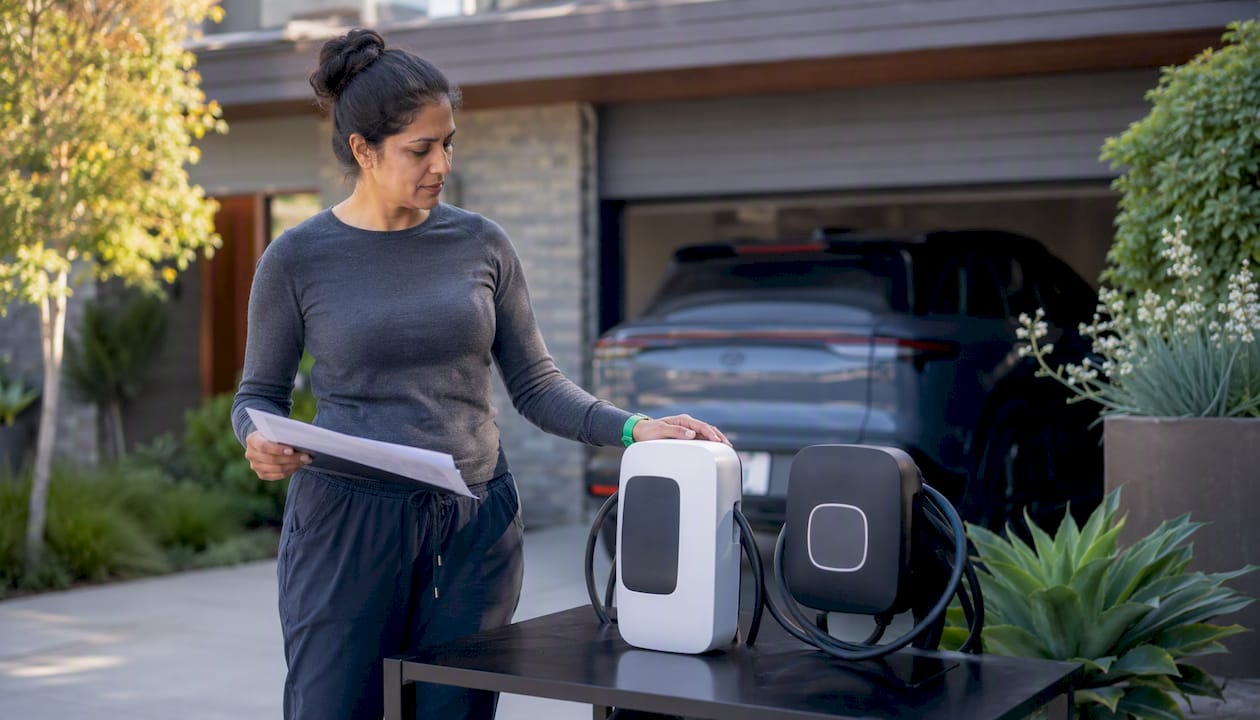
For most GTA homeowners, a licensed, hardwired Level 2 installation is the right choice. It is safer, code-compliant, faster to charge, and the only option that qualifies for Ontario rebates. Smart splitters like NeoCharge and SplitVolt serve a narrower purpose: they work reasonably well as a temporary fix when you rent, face a maxed-out panel, or need a short-term solution while you plan a proper install.
Here is when each option makes sense at a glance:
- Licensed Level 2 install: permanent home, nightly charging, two EVs, or any situation where you want rebate eligibility and ESA compliance
- NeoCharge or SplitVolt splitter: renter without wiring permission, panel at capacity with no upgrade budget yet, or very low nightly mileage
- Panel upgrade first, then hardwired install: older GTA homes with 100A service that need capacity before adding a dedicated circuit
“Smart splitters are an innovative workaround for constrained scenarios, but industry professionals emphasise they are not a substitute for a dedicated, code-compliant circuit. ESA-licensed electricians will recommend a dedicated circuit whenever the panel allows it.”
Evchargerinstallationtoronto (operating as EV Install Pro) is the local, ESA-licensed installer serving the Greater Toronto Area. Pricing starts from $800, with same-week booking and full permit and rebate handling included.
Table of Contents
- How do NeoCharge, SplitVolt and a dedicated Level 2 install compare?
- How do smart splitters actually work compared to a hardwired charger?
- When does a smart splitter make sense, and when should you avoid it?
- What does a Level 2 install cost in the GTA, and what rebates apply?
- What does an ESA-licensed electrician check during a Level 2 install?
- How to decide: NeoCharge, SplitVolt or a licensed installation?
- EV Install Pro: ESA-licensed installation for GTA homeowners
- Key takeaways
- What installers actually see on the job
- Useful sources for further reading
How do NeoCharge, SplitVolt and a dedicated Level 2 install compare?
The table below covers the eight dimensions that actually change a homeowner’s decision.

| Dimension | NeoCharge | SplitVolt | Dedicated Level 2 Install |
|---|---|---|---|
| Best for | Renters, low-mileage drivers, temporary use | Same as NeoCharge; also suits NEMA 14-50 setups | Permanent homeowners, daily charging, two EVs |
| Cost | Device — | Device — | Starts at $800 installed (GTA) |
| Installation complexity | Plug-and-play; no electrician required | Plug-and-play; no electrician required | Hardwired by ESA-licensed electrician; permit required |
| Certifications & compliance | Consumer electronics certification; not ESA-permitted | Consumer electronics certification; not ESA-permitted | ESA-permitted, CSA-compliant, inspection on file |
| Load-balancing method | Active sensing; automatic switching | Active sensing; max ~24A on 30A circuit | Dedicated circuit; full rated amperage available |
| App / connectivity | App complaints reported; some users treat it as a dumb switch | Digital display; similar app reliability concerns | No app dependency; EVSE app is separate |
| Warranty & reliability | Limited consumer warranty; app may be unsupported | Limited consumer warranty | Workmanship warranty from licensed installer |
| Rebate eligibility | Not eligible | Not eligible | Eligible for Ontario and federal incentives |
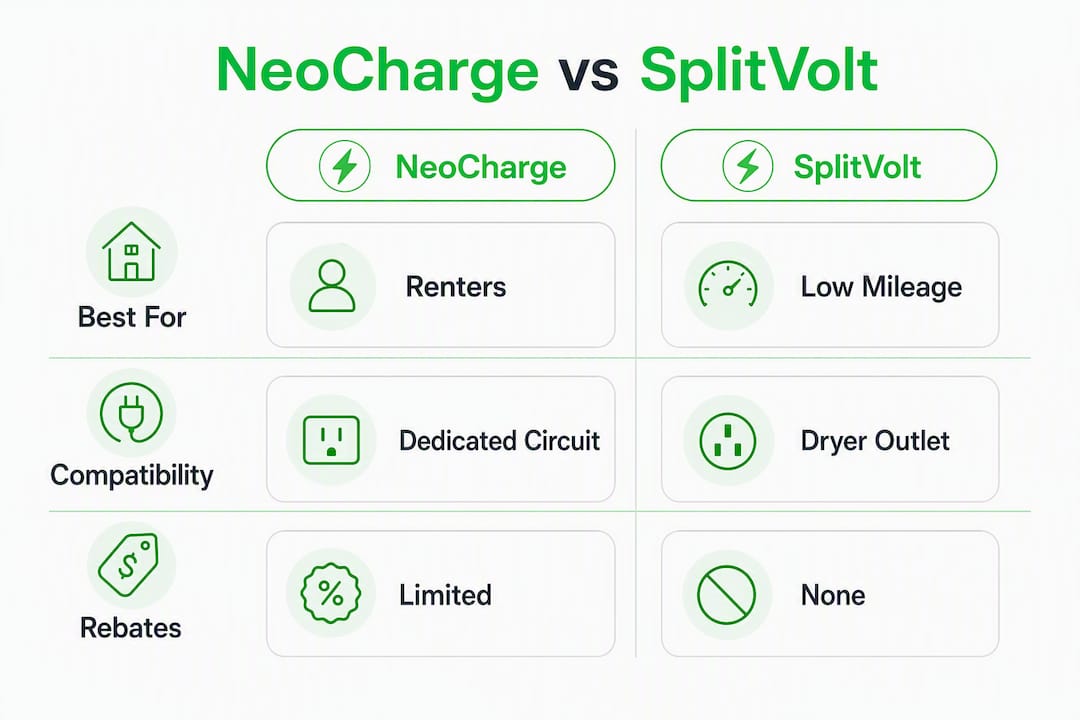
Pro Tip: When scanning this table, prioritise the certifications and rebate rows first. A device that saves $1,000 upfront but disqualifies you from a $500–$1,500 rebate and leaves no ESA inspection on file is rarely the better deal for a homeowner who plans to stay.
How do smart splitters actually work compared to a hardwired charger?
A smart splitter sits between your existing 240V dryer outlet and two loads: your dryer and your EV charger. It senses which appliance is drawing power and automatically switches current between them so both never run at full draw simultaneously. A hardwired Level 2 charger, by contrast, connects directly to a dedicated breaker in your panel and draws its full rated amperage whenever your EV is plugged in.
Key differences in practice:
- Maximum amperage: Most consumer splitter models cap at 24A on a typical 30A/240V dryer circuit, which limits charging speed compared to a dedicated 40A or 50A circuit
- Sensing and interlock: the splitter monitors current draw and switches the active load; if both appliances signal simultaneously, the EV charger is typically deprioritised
- Circuit path: panel → main breaker → 240V dryer breaker → dryer receptacle → splitter → EVSE or dryer
- EVSE compatibility risk: some EV charger models run startup checks or low-power modes that cause automated splitters to cycle power repeatedly or throw error states
A dedicated Level 2 install removes all of that complexity. The circuit is sized for continuous EV charging, the breaker is rated correctly, and there is no shared load to manage.
When does a smart splitter make sense, and when should you avoid it?
Reasons to consider a splitter
- No wiring permission (renter or condo without board approval)
- Panel is genuinely at capacity and a panel upgrade is not yet in budget
- Very low nightly mileage where slower charging is acceptable
- Short-term need while planning a permanent install
Electrek’s hands-on NeoCharge review described it as a practical lower-cost alternative for exactly these constrained situations, noting it eliminated the inconvenience of swapping plugs manually.
Reasons to avoid a splitter
- You own your home and plan to stay more than a year
- You charge nightly or drive more than 60–80 km daily
- You want rebate eligibility
- Your dryer outlet is an older NEMA 10-30 without a separate ground conductor
- You own two EVs or plan to add one
Some reviewers have also flagged that NeoCharge’s retail price is high relative to the long-term value of a hardwired install, particularly for homeowners who could recover much of the installation cost through rebates.
Real-world app and compatibility issues
App store reviews for NeoCharge consistently praise the hardware for eliminating plug swapping but flag the companion app as unreliable or appearing unsupported. Many owners end up treating the device as a passive switch and managing schedules through their vehicle’s software instead. SplitVolt users report similar connectivity frustrations.
Pro Tip: Before connecting any splitter to an older dryer receptacle, have an ESA-licensed electrician inspect the outlet condition and confirm the presence of a grounding conductor. Continuous EV charging on a loose or ungrounded receptacle is a fire risk.
What does a Level 2 install cost in the GTA, and what rebates apply?
EV Install Pro’s transparent pricing starts at $800 for a standard residential Level 2 installation in the Greater Toronto Area. That baseline covers the site visit, permit filing, installation, and inspection scheduling.
| Item | Typical cost (GTA) |
|---|---|
| Standard Level 2 install (panel ready) | From $800 |
| Panel upgrade (100A capacity increase) | Additional cost; varies by home |
| Long cable run or conduit | Additional cost; varies by distance |
| Smart load management (EVEMS/DCC-12) | Available as alternative to full panel upgrade |
| Ontario/federal rebate potential | Up to $1,500 (federal iZEV program, subject to eligibility) |
Note: Rebate amounts and eligibility rules change. Confirm current Ontario and federal incentive details with your installer before booking.
A typical GTA residential job runs a few hours once the permit is in hand. The sequence is: site assessment → permit submission → installation day → ESA inspection. Permit timelines vary by municipality, but most GTA jobs move from booking to completed inspection within one to two weeks.
What does an ESA-licensed electrician check during a Level 2 install?
Permits and ESA compliance are required for hardwired Level 2 installations and for any panel changes in Ontario. This is not optional paperwork; it is what protects your home insurance coverage and confirms the work is safe.
A licensed electrician will check:
- Panel capacity and available breaker slots
- Correct breaker sizing for the EVSE (typically 40A or 50A breaker for a 32A or 40A charger)
- Grounding and bonding of the circuit
- Condition of any existing 240V receptacle if a receptacle-style install is planned
- Permit filing with the local authority
- Scheduling the ESA inspection after installation
When vetting an installer, confirm these points before work begins:
- Ask to see their ESA licence number
- Confirm they will pull the permit (not ask you to)
- Get the warranty terms in writing
- Ask whether they handle rebate paperwork or provide the documentation you need to apply
How to decide: NeoCharge, SplitVolt or a licensed installation?
Work through these questions in order.
-
Does your panel have capacity for a new 40A or 50A breaker?
- Yes → book a licensed Level 2 install
- No → get a panel capacity assessment; consider a panel upgrade or smart load management (EVEMS)
-
Do you own the home and plan to stay more than a year?
- Yes → hardwired install is the right long-term investment
- No → a splitter may be acceptable as a temporary measure
-
What outlet do you have available?
- NEMA 14-50 with ground → compatible with both splitter types and a receptacle-style Level 2 install
- NEMA 10-30 (older, three-prong dryer) → have an electrician inspect for grounding before any continuous charging use
-
Do you want rebate eligibility?
- Yes → only a permitted, hardwired Level 2 install qualifies
-
What is your nightly charging need?
- Under 40 km/day and flexible → a splitter’s limited amperage may be sufficient
- Over 60 km/day or two EVs → a dedicated circuit is the practical choice
The short version: capacity → permission → budget → timeline → hire an ESA-licensed electrician for a site assessment.
EV Install Pro: ESA-licensed installation for GTA homeowners
Skip the guesswork on permits, rebates and panel capacity. Evchargerinstallationtoronto (EV Install Pro) provides ESA-licensed Level 2 installations across the Greater Toronto Area, with pricing from $800 and same-week booking where available.
Every job includes a site assessment, permit submission, installation, inspection coordination, and rebate documentation support. If your panel needs upgrading first, the team handles that too, including smart load management (EVEMS/DCC-12) as an alternative to a full panel upgrade for homes with tighter capacity.
Use the free cost calculator to get an instant estimate for your home, or check the live service map to confirm availability in your neighbourhood. When you call, ask for the ESA licence number and confirm that permit handling is included. EV Install Pro’s 4.9 customer rating reflects a process that is straightforward from first call to final inspection.
Key takeaways
For most GTA homeowners, a licensed, hardwired Level 2 installation is the safer, rebate-eligible, and more reliable long-term choice over any smart splitter.
| Point | Details |
|---|---|
| Hardwired install is the default | A dedicated Level 2 circuit is safer, faster, and the only option eligible for Ontario rebates. |
| Splitters suit specific scenarios | NeoCharge and SplitVolt are reasonable for renters, low-mileage drivers, or temporary use in some situations. |
| App reliability is a known issue | Both NeoCharge and SplitVolt have reported app and connectivity problems; many users rely on vehicle scheduling instead. |
| Older outlets need inspection first | NEMA 10-30 receptacles may lack a ground conductor; have an ESA-licensed electrician inspect before any continuous charging use. |
| Evchargerinstallationtoronto | EV Install Pro offers ESA-licensed installs from $800 with permits, inspections and rebate support included. |
What installers actually see on the job
The comparison between NeoCharge and SplitVolt is genuinely useful for a narrow set of situations. But from an installer’s perspective, the cases where a splitter is the right long-term answer are rarer than the marketing suggests.
The most common surprise on a GTA site visit is an older dryer outlet that looks fine but has a loose connection or a missing ground. Homeowners assume that because the dryer has worked for years, the outlet is ready for continuous EV charging. It often is not. EV chargers draw current for hours at a stretch, which stresses a marginal connection in a way that running a dryer for 45 minutes never does.
The second most common issue is app dependency. Homeowners buy a splitter expecting to manage charging schedules through an app, then discover the app is unreliable or the device cycles their charger on and off unexpectedly due to EVSE startup behaviour. That is a frustrating and avoidable problem.
A hardwired install removes both risks. The circuit is inspected, the connection is rated for continuous use, and there is no app in the middle of your charging session. For a homeowner who drives daily, that reliability is worth more than the upfront device savings.
Useful sources for further reading
These are the sources consulted for this article, grouped by type.
Safety and professional guidance:
- Splitvolt Device | Information by Electrical Professionals for Electrical Professionals — electrician forum discussion on code compliance, dedicated circuits and splitter risks
User experience and product reviews:
- NeoCharge home EV charging app (App Store) — user reviews — real user feedback on app reliability
- This smart splitter solved my EV home charging needs without costly electrical work | Electrek — hands-on NeoCharge review for constrained setups
Community forums (real homeowner questions):
GTA installer and rebate resources:
- EV Charger Installation Cost Calculator Toronto | EV Install Pro — instant pricing estimate for GTA homeowners
Recommended
- EV Charger Installation Toronto & GTA | EV Install Pro
- EV Charger Installation Vaughan | ESA-Licensed | EV Install Pro | EV Install Pro Toronto
- EV Charger Guides & Blog | EV Install Pro Toronto | EV Install Pro Toronto
- EV Charger Installation Cost Richmond Hill 2026 | Prices + Rebates | EV Install Pro Toronto
Get Your Free Installation Quote
Free assessment · ESA permit included · Same-week availability across the GTA