Cut Your EV Bill in Canada: Time of Use, Scheduling and Submetering
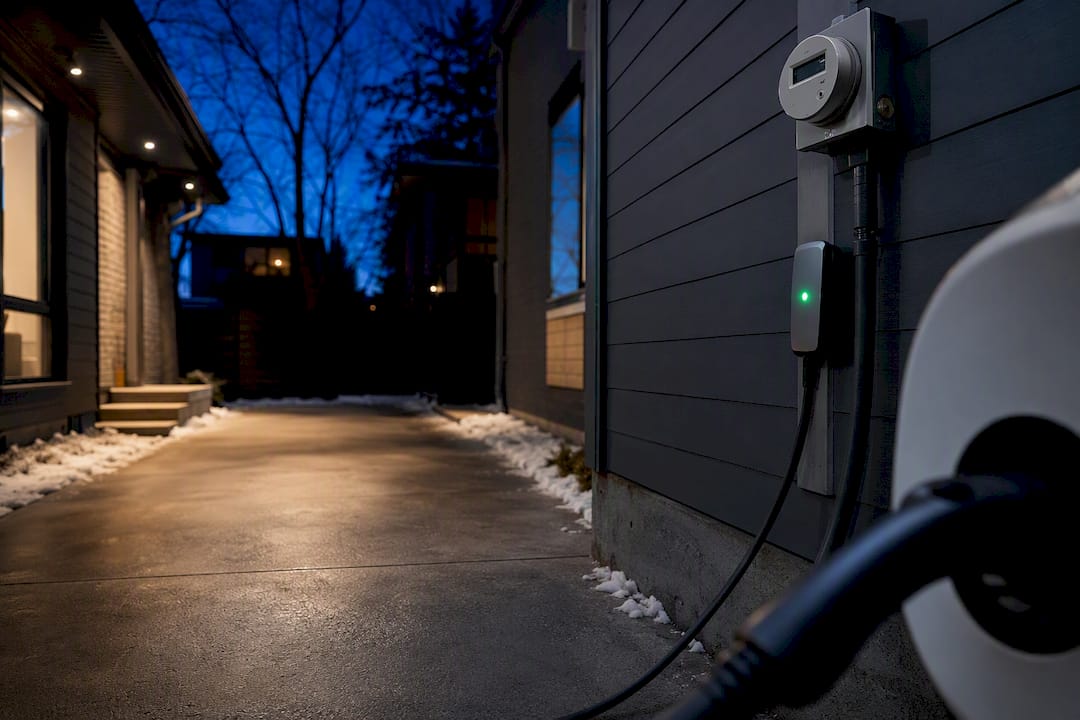
Charging overnight, during your utility’s off-peak or Ultra-Low Overnight window, is the cheapest option for most Canadian EV owners. That said, savings depend on your province, your whole-house electricity plan, and whether you’re charging at home or at a public station billed by time instead of energy used. The Ontario Energy Board and Natural Resources Canada back this up, with caveats worth understanding before you assume you’re saving anything.
TL;DR:
- Charging during the ULO overnight window can save money only if your household’s daytime energy use is low enough to prevent offsets from higher peak rates.
- Installing a dedicated EV submeter and scheduling your charger to start after 11 p.m. can maximize savings, but only if your electrical panel supports it.
- Public charging often bills by time rather than energy, which can lead to higher costs when charging speeds slow or after charging completes; favor per-kWh stations whenever possible.
- Switching to the ULO or TOU rate plan requires analyzing your household’s hourly usage and ensuring your electrical system can handle a Level 2 charger without costly upgrades.
- Most savings from off-peak rates depend on proper charger installation, load management, and avoiding heavy daytime energy use that can negate night-time savings.
Table of Contents
- EV charging basics: levels, times, and what changes them
- How time-of-use pricing works in Canada, and why the meter matters
- Cutting home charging costs: scheduling, submetering, and rebates
- Public charging billing: per-kWh, time fees, and how to avoid getting burned
- Choosing or switching your electricity price plan
- Why the same rate plan saves at home and costs more in public
- Government incentives tied to off-peak charging
- Renewable energy, time-of-use rates, and what it means for your bill
- A Toronto installer’s take on getting this right
- The gap between rate-plan advice and what actually happens in Canadian homes
- Sources
EV charging basics: levels, times, and what changes them
Before you can plan around time-of-use rates, you need a realistic sense of how long your car actually takes to charge. Charging speed depends on three things: the charger’s power output, your vehicle’s onboard charger, and how much energy your battery can accept at any given moment.
Here’s what the three common charging levels look like in practice:
- Level 1 (120V household outlet): Roughly 1.4 kW, adding about 5 to 8 kilometres of range per hour. Fine for a plug-in hybrid or light overnight top-up, painfully slow for a full battery.
- Level 2 (240V): The standard home setup, typically 7 to 19 kW depending on your panel and charger. Most EVs go from near-empty to full in 4 to 10 hours, which is why it’s the workhorse for overnight charging.
- DC fast charging (Level 3): Found at public stations, these deliver 50 kW to 350 kW and can push a battery from 10% to 80% in 20 to 45 minutes. Useful for road trips, expensive and unnecessary for daily driving.
Temperature and state of charge both matter more than most drivers expect.
How time-of-use pricing works in Canada, and why the meter matters
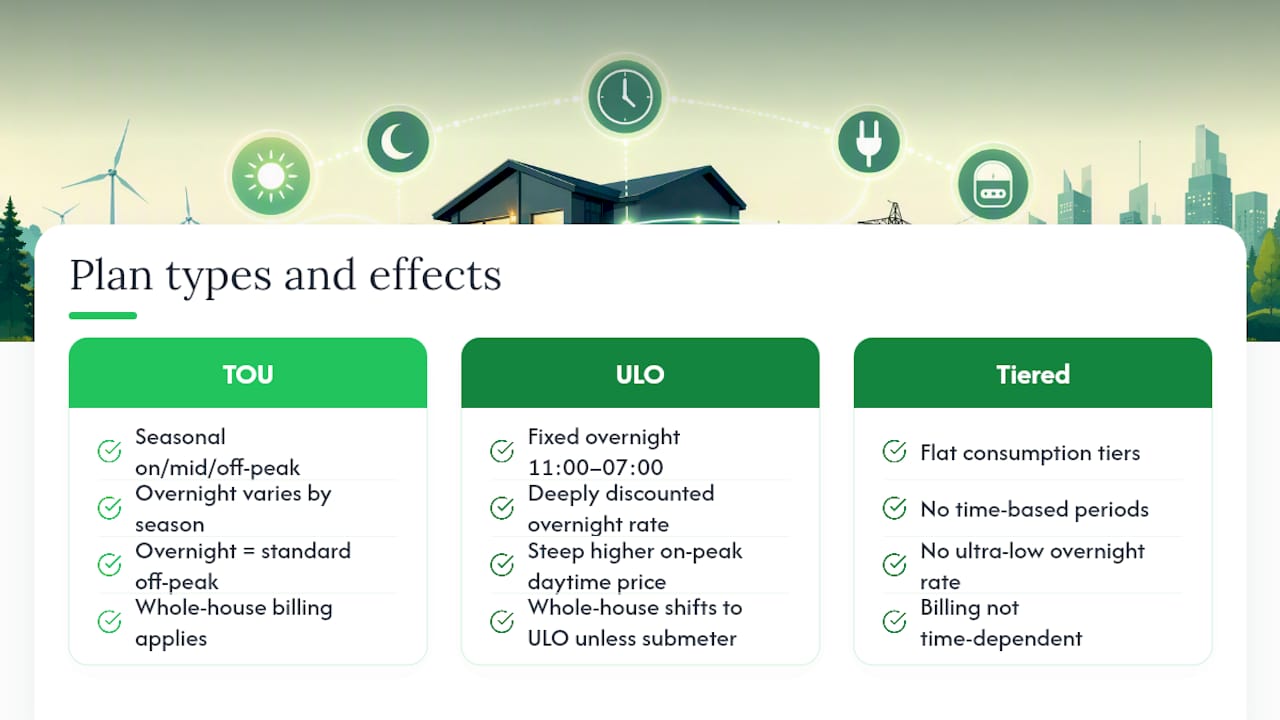
Time-of-use, or TOU, pricing charges different rates depending on the hour and season, based on the idea that electricity costs more to generate and deliver during peak demand. Ultra-Low Overnight, or ULO, pricing goes further, offering a deeply discounted rate during a fixed overnight window in exchange for higher on-peak pricing during the day.
In Ontario, the Ontario Energy Board sets three main plan types: TOU, ULO, and tiered pricing. Under ULO, the ultra-low price applies from 11 p.m. to 7 a.m. every day, while TOU periods shift by season, with on-peak, mid-peak, and off-peak hours arranged differently in winter versus summer.
Why this matters for your bill: Ontario’s ULO overnight rate is set well below the standard off-peak TOU rate, but the trade-off is a steep on-peak price during the day. If your household runs air conditioning or laundry loads in the afternoon, that higher daytime rate can erase your overnight EV savings entirely.
This is where whole-house billing becomes the deciding factor. Unless you install a dedicated EV submeter, your utility bills your entire home under one rate plan. That means switching to ULO to save on EV charging also shifts every other appliance in your house onto the same peak and off-peak structure. A home with heavy daytime electricity use can end up paying more overall even while the car itself charges cheaply at night.
Provincial rules vary outside Ontario too. Some utilities offer their own TOU or seasonal pricing structures, while others still bill on flat or tiered rates with no time-based discount at all. Always check your specific utility’s plan menu before assuming a Canada-wide standard applies.
Cutting home charging costs: scheduling, submetering, and rebates
Lowering your home charging bill starts with automation, not willpower. Most EVs let you set a charging schedule directly in the vehicle’s infotainment system or connected app, and most Level 2 chargers include their own scheduling function through a companion app or built-in timer.
- Set your charger or vehicle to start after your off-peak or ULO window begins. For Ontario ULO customers, that means scheduling charging to start at or after 11 p.m.
- Check whether submetering makes sense for your home. A dedicated EV submeter can isolate your charging costs from whole-house rates, and research on tariff design suggests submetering can generate meaningful annual savings depending on your grid and rate structure, though the benefit varies household to household.
- Look into available rebates before you buy equipment. Ontario has offered incentives tied to EV charger installation and new EV purchases; check current rebate programs before committing to a specific charger model.
- Confirm whether your electrical panel can handle a Level 2 charger. Many Toronto-area homes with 100-amp service need a panel upgrade before installation, which affects both cost and timeline.
Pro Tip: Run your dryer, dishwasher, and EV charger on a staggered schedule rather than all at once overnight. Off-peak pricing helps, but a panel that’s undersized for simultaneous heavy loads will trip before your rate plan ever saves you a dollar.
Call a licensed electrician early in the process, not after you’ve already bought a charger. Permit and inspection requirements catch a lot of DIY installations off guard, and a qualified installer can flag panel capacity issues before they turn into a delayed or non-compliant setup.
Public charging billing: per-kWh, time fees, and how to avoid getting burned
Public charging stations in Canada bill in one of three ways: per kilowatt-hour, per minute of connection time, or a flat session fee. The industry is shifting toward per-kWh billing, but the transition is incomplete, partly because Measurement Canada and ISED are still finalizing metering standards for EV charging equipment, and many stations still operate under temporary dispensations that allow time-based billing instead.
That distinction matters more than most drivers realize. If a station bills by the minute and your car’s charge acceptance slows down (because the battery is nearly full or it’s cold outside), you keep paying the same per-minute rate for a trickle of electricity. A car charging at 20 kW pays the same time-based fee as one charging at 150 kW on some networks, which punishes exactly the vehicles that need it least.
A few habits protect you from billing surprises:
- Compare the price shown in the network’s app against the rate posted on the charger screen before you plug in; they don’t always match.
- Favour per-kWh pricing whenever it’s offered, especially at DC fast chargers where charging speed varies widely between vehicles.
- Watch for idle fees, which kick in once your car finishes charging but stays plugged in, common at busy urban stations.
- Factor in membership versus guest pricing; some networks charge non-members a noticeably higher rate per session.
National average fast-charging prices sat around $0.42/kWh in the fourth quarter of 2025, but provincial averages vary widely, so checking your specific region’s typical pricing before a road trip beats assuming a national number applies to you.
Choosing or switching your electricity price plan
Before switching plans to chase EV savings, estimate your household’s actual hourly usage pattern, not just your car’s charging habits. A simple comparison between your current bill and a projected TOU or ULO bill, using a typical weekday and weekend as samples, tells you most of what you need to know. Several Ontario utilities offer free online calculators for exactly this kind of comparison, such as Alectra’s EV charging calculator.
- Pull your last few bills and note your total daytime versus overnight consumption.
- Contact your utility to ask which price plans are available in your area and request an estimate based on your usage.
- Submit the plan election form, keeping in mind that Ontario utilities require it at least 10 business days before your next billing cycle for the switch to take effect.
- Track your first one to two bills closely. If your total cost rises instead of falls, your daytime household load may be outweighing your overnight EV savings, and it may be worth switching back or adjusting your usage patterns.
Why the same rate plan saves at home and costs more in public
Time-of-use pricing rewards flexibility, and home charging gives you far more of it than public charging does. At home, you control when your car plugs in, so shifting a session to your cheapest overnight hours is as simple as a schedule setting. Public charging strips away that control almost entirely: you charge when you need range, not when the rate is lowest, and most public networks don’t offer time-of-use pricing at all.
This creates a lopsided cost picture for anyone who relies heavily on public infrastructure. A driver who charges primarily at home under Ontario’s ULO plan might pay a fraction of the per-kWh cost that a driver charging exclusively at DC fast stations pays, even though both are driving similar EVs similar distances. The gap widens further if that public charging happens during a network’s peak demand pricing, which some providers now apply during high-traffic hours.
The practical takeaway is to treat public charging as a backup, not a routine. Use it for road trips, emergencies, or when you’re away from home longer than your battery allows, and lean on scheduled home charging for your daily routine. Drivers without dedicated home charging, common in condos and some rental situations, don’t have this option and face a structurally higher cost of EV ownership as a result, which is part of why multi-unit residential charging infrastructure has become a policy focus across several provinces.
Government incentives tied to off-peak charging
Federal and provincial programs have started nudging EV charging behaviour toward off-peak hours, though most current incentives target the purchase and installation of charging equipment rather than paying drivers directly for overnight use. Ontario’s utilities set the ULO and TOU rate structures themselves through the Ontario Energy Board, which functions as the incentive: a lower price is the reward for shifting demand to overnight hours.
Where direct rebates exist, they typically apply to the hardware and installation side. Programs supporting Level 2 charger purchases, panel upgrades, and permit costs have appeared at various points across Ontario, sometimes paired with new EV purchase incentives. Plug’n Drive, a Toronto-based non-profit focused on EV adoption, publishes updated tracking of these programs as they shift, since eligibility and funding levels change from year to year.
For homeowners, the more durable incentive is structural: once you’re on a ULO or TOU plan and charging overnight becomes routine, the savings compound every month without needing a new government program to sustain them. That’s a more reliable planning basis than waiting on a rebate that could close or change its terms. Check current rebate availability before assuming a specific incentive still applies, since these programs are revised more often than most drivers expect.
Renewable energy, time-of-use rates, and what it means for your bill
Ontario’s overnight ULO pricing exists partly because the province’s grid, heavily reliant on nuclear and hydro baseload generation, has more supply than demand late at night. Charging your EV during that window doesn’t just save you money; it also draws power from a period when the grid has surplus low-carbon capacity rather than leaning on higher-emission peaking plants that sometimes run during the day.
Some provinces with growing wind and solar capacity are starting to see a different pattern emerge, where midday generation surpluses create their own low-price windows rather than only overnight ones. That shift hasn’t fully reached retail time-of-use structures across Canada yet, but it’s worth watching if you live somewhere with significant renewable generation on the grid, since your cheapest charging window might eventually shift away from the traditional overnight slot.
For now, the practical guidance holds steady in most provinces: overnight charging aligns with both the lowest price and the cleanest generation mix available on most Canadian grids. That alignment isn’t a coincidence. Utilities designed off-peak and ULO pricing specifically to encourage demand during hours when the grid has spare, lower-cost capacity, and EV charging happens to be one of the most flexible loads a household can shift into that window.
A Toronto installer’s take on getting this right
Time-of-use savings only materialize if your charger is installed correctly and your panel can support it. Our ESA-licensed electricians handle permits and inspections as part of every job, so homeowners aren’t left guessing about compliance after the fact. We also manage rebate applications on qualifying new EV purchases, and most installations wrap up within a few hours.
Pricing starts from an affordable rate, though panel upgrades add to that depending on your home’s existing electrical service. If you’re unsure whether your setup can support a Level 2 charger on an off-peak schedule, a site assessment answers that question before you commit to equipment. You can also run the numbers yourself first with our installation cost calculator.
The gap between rate-plan advice and what actually happens in Canadian homes
Most guidance on time-of-use EV charging treats the decision as a simple math problem: multiply kilowatt-hours by the off-peak rate, compare it to the on-peak rate, and call it a day. That framing misses the part that actually determines whether a household saves money, which is everything else the meter is measuring at the same time.
I’ve seen the ULO pitch oversold constantly, and the flaw is always the same: nobody accounts for the daytime rate spike until the first bill arrives. A family running central air through a Toronto summer, doing laundry after work, and cooking dinner between 4 p.m. and 9 p.m. is charging into Ontario’s most expensive pricing window on a ULO plan, whether or not their EV happens to be plugged in overnight. The car isn’t the problem. The rate plan applied to the whole house is.
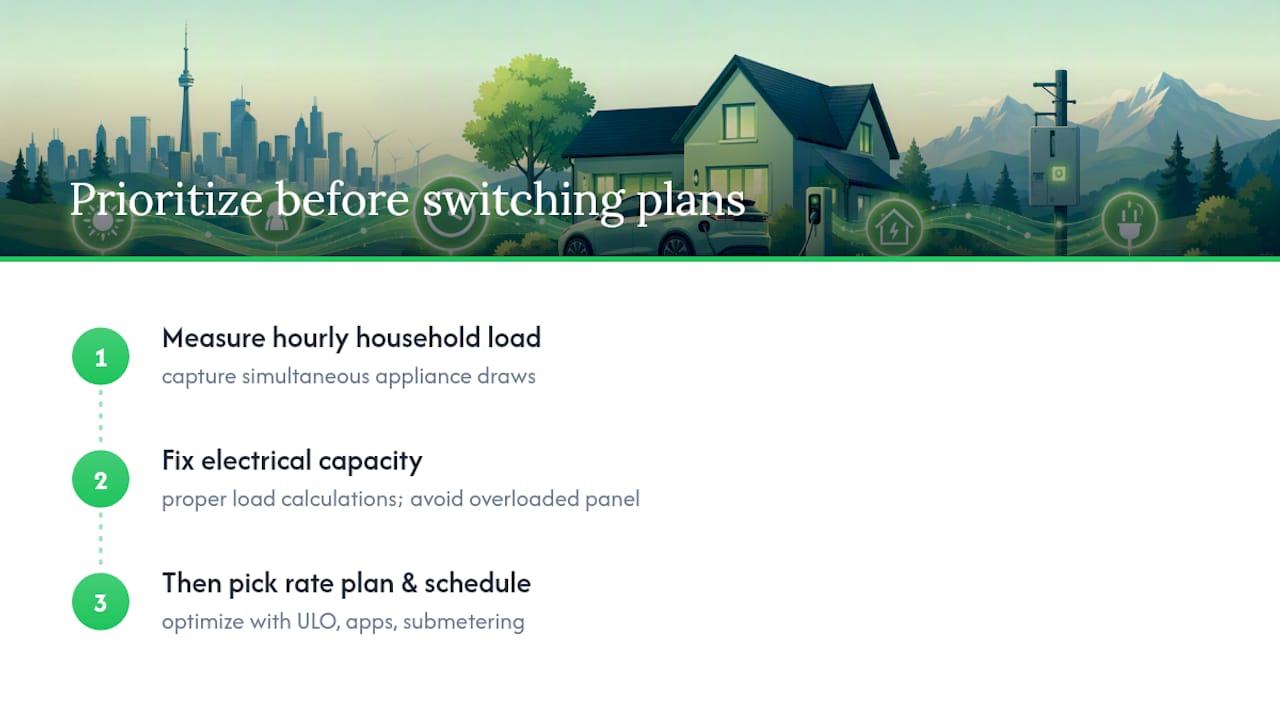
What gets underestimated even more is how much installation quality determines whether any of this scheduling advice is usable at all. A charger installed without proper load calculations, on a panel that’s already near capacity, forces homeowners into manual charging management that defeats the entire point of automated off-peak scheduling. You can’t reliably shift demand to cheap hours if your system trips a breaker every time the dryer runs at the same time as the charger.
The advice that actually holds up isn’t “switch to ULO.” It’s “know your household’s hourly load before you switch, and get your electrical capacity right before you worry about your rate plan.” Everything else, the scheduling apps, the submetering debates, the provincial rate comparisons, is optimization on top of a foundation that has to be solid first.
— Hafiz
Sources
- Electricity rates | Ontario Energy Board
- Electric vehicle charging - Natural Resources Canada
- EV Charging Rates in Canada — Free Interactive Map
Recommended
Get Your Free Installation Quote
Free assessment · ESA permit included · Same-week availability across the GTA