Stop Using Extension Cords for EVs: Canada’s safer fixes from $1,800
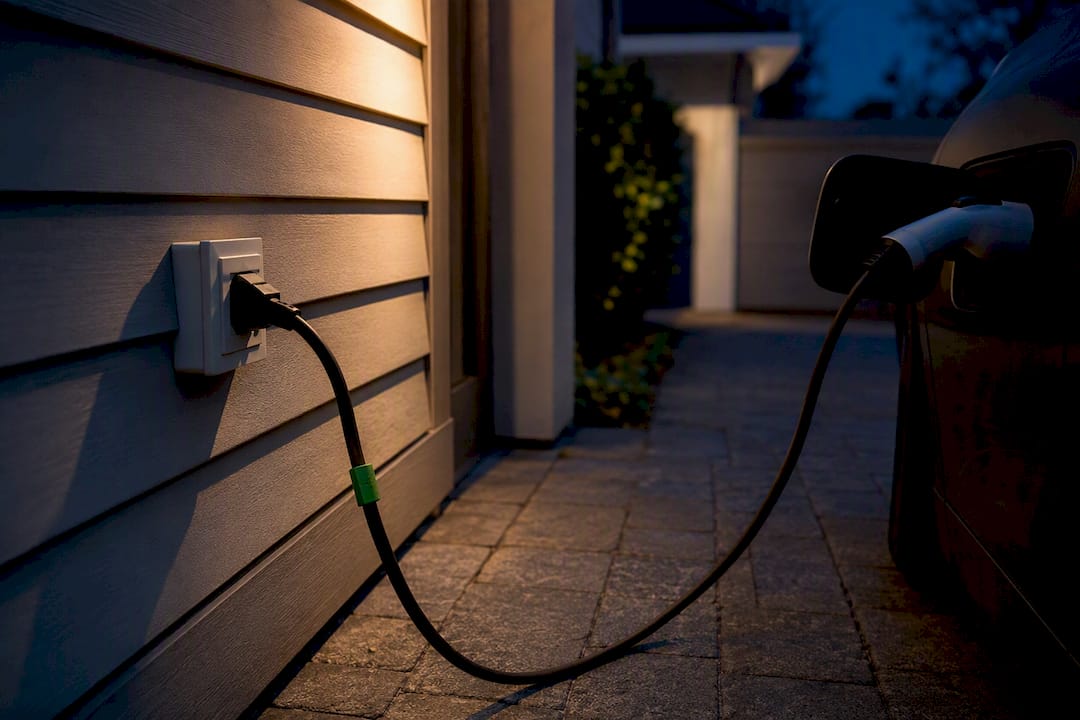
No, you should not use an extension cord to charge your EV. The sustained current draw creates real fire and shock risk that manufacturers explicitly warn against. If your factory cable does not reach the outlet, the safe fix is a dedicated outlet, a longer certified EVSE, or a professional Level 2 install, not a workaround from the hardware store.
TL;DR:
- Extension cords are unsafe for EV charging because sustained high current can cause overheating, fires, or electric shocks, especially over long periods.
- Level 2 charging draws too much current for any consumer-grade extension cord, making it a direct fire hazard during prolonged use.
- Emergency use of extension cords for Level 1 charging is only acceptable with strict specifications, including a minimum 10 AWG gauge, outdoor rating, and cords no longer than 25 feet.
- The safest solution involves installing a longer certified EVSE cable, a dedicated outlet, or a Level 2 circuit, all handled by licensed electricians for safety and warranty protection.
- Manufacturer and safety organization guidelines clearly advise against extension cords, emphasizing moving the outlet or upgrading the electrical system rather than relying on temporary workaround cords.
Table of Contents
- Why extension cords are dangerous for EV charging
- Emergency-only rules if you absolutely must use one
- Safer alternatives: move the connection, not the cord
- What to ask an electrician before you commit
- What automakers and safety experts actually say
- What I see on jobs that homeowners don’t expect
- How EV Install Pro gets you off the extension cord for good
- Sources
Why extension cords are dangerous for EV charging
EV charging is not like plugging in a toaster for two minutes. A Level 1 session can run several hours, and a Level 2 session pulls far more current for several hours at a stretch. That kind of continuous load is exactly the condition where a standard household extension cord starts to fail.
Every wire has resistance, and resistance turns electrical current into heat. A cord rated for a lamp or a power tool is built for short bursts, not for hours of steady amperage. Kelley Blue Book points out that automakers and safety experts advise against extension cords precisely because the sustained high current load can trigger overheating, fire, or electric shock.
Wire gauge matters more than most owners assume. Thinner cords (higher AWG numbers) have more resistance per foot, so they heat up faster under load. Length compounds the problem: the longer the run, the more voltage drop you get, and that drop forces the charger to work harder to deliver the same power. ChargersGO notes that a properly sized 10 AWG cord at moderate lengths keeps voltage drop small, while long, thin runs increase both drop and fault risk sharply.
There’s a second, less obvious danger: connection points. Every plug and socket you add between the wall and the vehicle is a spot where contact resistance can spike, arc, or loosen over time. NeoCharge explains that extension cords defeat the thermal protection built into the EVSE’s plug head, because that sensor only monitors the factory connection, not any extension you’ve added downstream. The charger thinks everything is fine while the real hot spot builds heat somewhere it can’t see.
Level 1 (120V) and Level 2 (240V) charging carry very different risk profiles:
- Level 1 draws continuous current that may be enough to overheat an undersized cord over many hours.
- Level 2 draws much higher current, a load that turns a marginal extension cord into a genuine fire hazard within a single session.
- Level 2 charging should never run through an extension cord, full stop; the current is simply too high for any consumer cord to handle safely over time.
A charge that finishes without incident is not proof the setup was safe. EVseekers warns that extension cords can degrade gradually, heating slightly with each session until insulation breaks down enough to cause a fire, sometimes long after the cord “worked fine” dozens of times before.
Emergency-only rules if you absolutely must use one
There’s one narrow exception to the no-extension-cord rule, and it comes with hard limits. If you’re stranded with a low battery, no outlet within reach of your factory cable, and no way to move the vehicle, a correctly specified cord for Level 1 charging only can serve as a short-term stopgap. Level 2 is never included in this exception; the current draw is too high for any consumer-grade cord.
Here’s the checklist to follow if you’re in that emergency situation:
- Confirm it’s Level 1 only. Never attempt this with a 240V Level 2 charger under any circumstances.
- Use 10 AWG minimum. Smart EV Home Charger identifies 10 AWG as the minimum gauge for handling roughly 12 amps of continuous Level 1 draw.
- Choose an outdoor-rated cord, marked STW or SOOW, with a grounded three-prong plug. Indoor-only cords lack the insulation and weatherproofing for this kind of sustained duty.
- Keep it as short as possible. Stay at 25 feet or under when you can; treat 50 feet as the absolute maximum length.
- Uncoil it completely. A coiled cord traps heat and can’t dissipate it, which turns a marginal setup into a dangerous one.
- Plug into a dedicated circuit with nothing else drawing power from it, and never daisy-chain multiple cords together.
- Check the cord by hand every 30 to 60 minutes. If it’s warm to the touch anywhere along its length, unplug immediately.
- Stop charging if you notice a burning smell, discoloured plastic, or a plug that feels loose.
- Treat this as a one-time fix, not a routine you repeat night after night.
Pro Tip: Keep the cord fully visible and walk its entire length before you leave it charging overnight. A hot spot hiding under a rug or against a wall is the scenario that turns a stopgap into an actual house fire.
Even a cord that checks every box on this list is still a compromise, not a solution. EVseekers makes the point clearly: insurance and warranty outcomes can be affected if damage is later traced to a non-compliant charging setup, even one that technically met emergency specs.
Safer alternatives: move the connection, not the cord
The real fix is never a better extension cord. It’s changing where the power comes from so you don’t need one in the first place. Three options, in order of how quickly you can act on them:
- A longer certified EVSE or mobile connector. Some manufacturers and third-party brands offer factory-certified charging cables in longer lengths than the stock unit. This keeps the manufacturer’s built-in thermal protection intact end-to-end, which a spliced-in extension cord never can. Check your EV charger cable length options before assuming you need a cord workaround at all.
- A dedicated 120V outlet closer to the vehicle. If Level 1 charging meets your daily driving needs, an electrician can install a grounded, dedicated outlet exactly where you park. This is a relatively quick, lower-cost job and it eliminates the reach problem permanently.
- A hardwired or plug-in Level 2 circuit. For most daily drivers, this is the destination worth building toward. It cuts charging time dramatically compared with Level 1, and once it’s installed, the extension-cord question never comes up again. Understanding 120V vs 240V charging helps you decide which one fits your driving pattern.
Licensed electricians matter here for a reason beyond code compliance. An ESA-licensed electrician confirms your panel has capacity, pulls the permit, and signs off on an inspection, all things that protect you if there’s ever a claim tied to your electrical work. Permit handling and rebate paperwork also affect your net cost. In Ontario, rebate programs tied to new EV purchases can be worth up to $5,000, and a good installer applies for that on your behalf instead of leaving it for you to navigate.
What to ask an electrician before you commit
Before you call anyone, have three details ready: the distance from your panel to where you park, your current panel’s amperage rating, and your vehicle’s charging specification. That trio determines almost everything about scope and cost.
Then ask these questions directly:
- Are you ESA-licensed, and will you pull the permit for this job? Never skip this step; unpermitted work can void insurance coverage.
- Will this require a dedicated circuit, and what breaker size does it need?
- What’s the all-in estimated cost, including panel work if my service can’t support it?
- What’s the installation timeline, and is same-week booking realistic?
- What warranty do you offer on the parts and the labour?
- Will you handle rebate paperwork, or is that on me?
Red flags include vague pricing, no mention of permits, or reluctance to confirm licensing. If your existing panel is maxed out, a dedicated circuit conversation should include whether you need a full panel upgrade or whether smart load management can avoid one. A quick rule of thumb: if Level 1 covers your daily mileage and budget is tight, a dedicated 120V outlet is enough. If you drive more, charge multiple vehicles, or want faster turnaround, go straight to Level 2.
What automakers and safety experts actually say
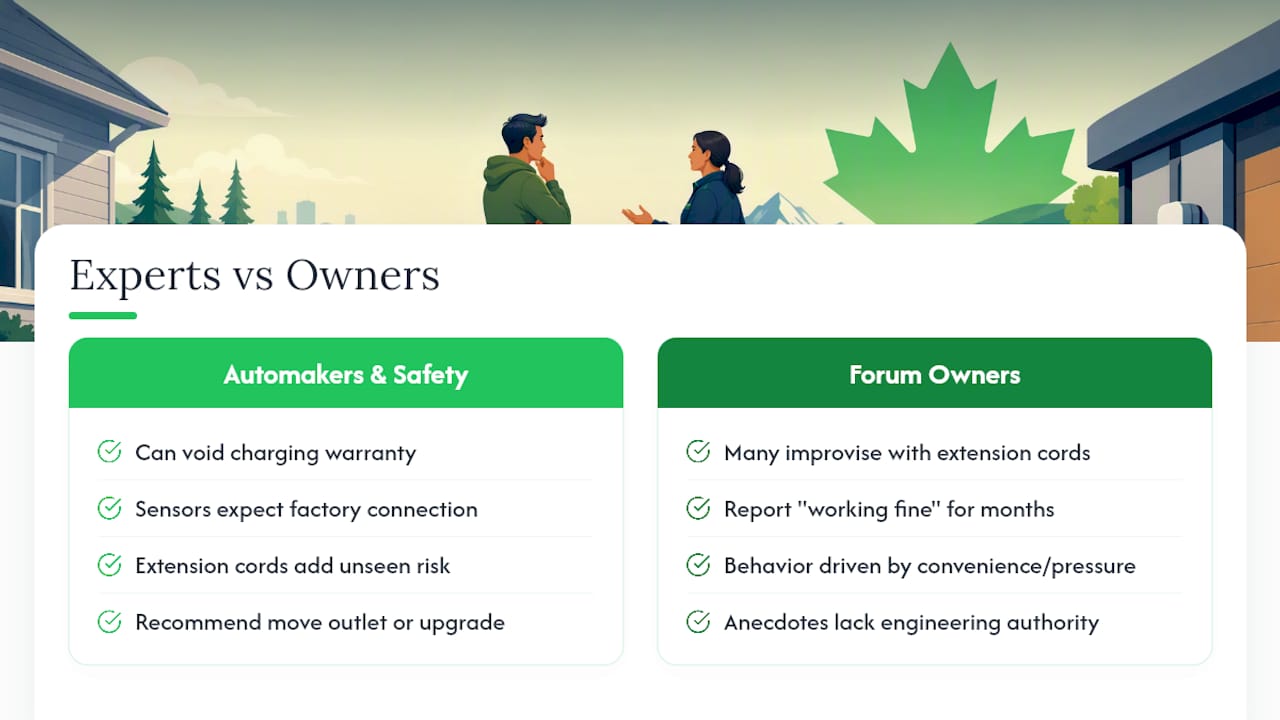
Vehicle manufacturers don’t hedge on this. Owner’s manuals from major automakers, Chevrolet among them, state plainly that extension cords are not approved for EV charging, and using one can void warranty coverage tied to the charging system. That’s not marketing caution; it reflects how the onboard safety sensors are designed to monitor a single, factory-terminated connection.
Safety organizations echo the same guidance. The core argument, repeated across manufacturer documentation and independent safety reviews, is that extension cords introduce variables the vehicle’s charging system was never built to detect. NeoCharge and other installer-facing safety guides consistently steer owners toward moving the outlet or upgrading the circuit instead of hunting for a heavier-gauge cord. Forum communities tell a different story about behaviour. Threads on platforms like r/electricvehicles show plenty of owners have improvised with extension cords when their factory cable came up short, and some report it “working fine” for months. Anecdotes like these describe what people do under pressure, not what’s actually safe, and they don’t carry the weight of a manufacturer’s engineering standard.
What I see on jobs that homeowners don’t expect
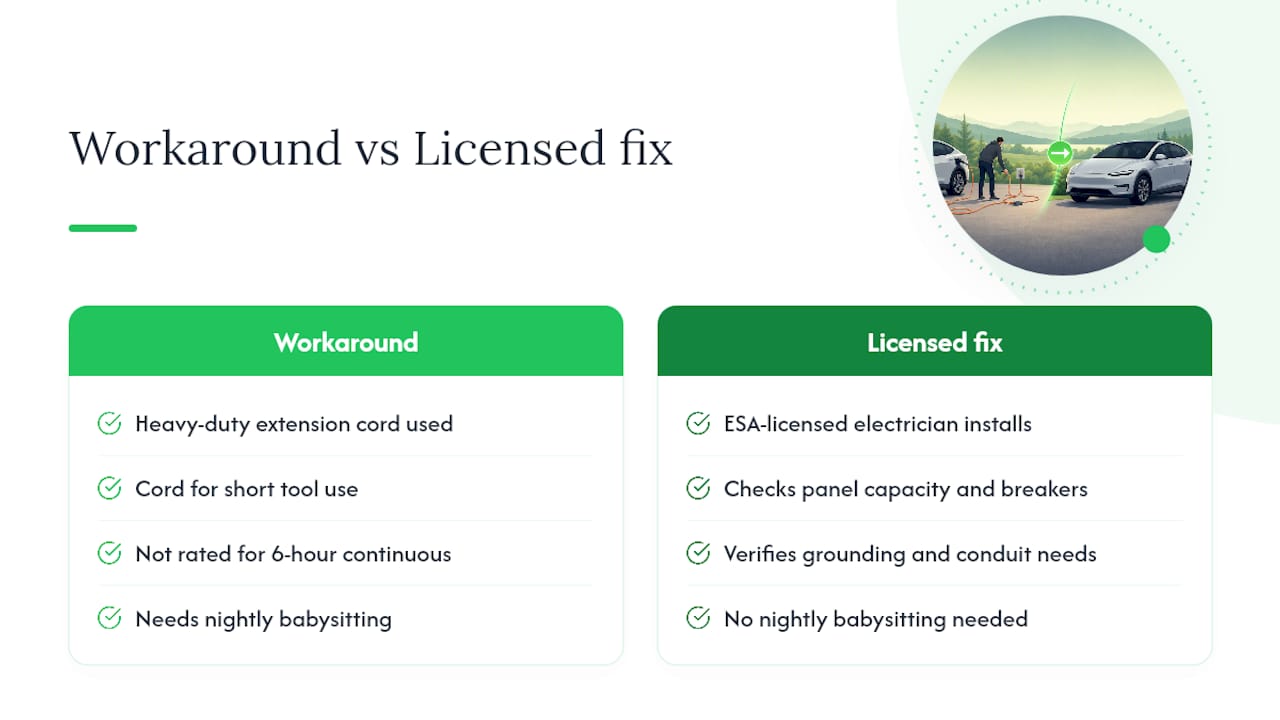
The shortcuts I see most often aren’t reckless, they’re just uninformed. Someone parks a little farther from the garage than their factory cable reaches, grabs whatever heavy-duty cord is in the garage, and assumes “heavy duty” means “rated for this.” It usually isn’t. The cord that’s fine for a table saw for twenty minutes is a different animal from something carrying continuous current for six hours overnight.
A licensed crew checks things a homeowner has no reason to know about: panel capacity, breaker sizing, grounding, and whether the run needs conduit protection. Permit and rebate handling should never be an extra line item; it’s part of doing the job correctly from the start. On most jobs, installation from an ESA-licensed electrician runs from $1,800 and wraps up in a few hours, with same-week booking realistic in most cases and rebate paperwork managed as part of the service. That’s the gap between a workaround and a permanent fix: one needs babysitting every night, the other you never think about again.
— Hafiz
How EV Install Pro gets you off the extension cord for good
EV Install Pro is the fastest route from “my cord doesn’t reach” to a charging setup you never have to think twice about, without the guesswork of sourcing cord specs or gambling on a panel that might not have capacity. Our ESA-licensed electricians handle the permit, the inspection, and the rebate paperwork at no extra charge, with transparent pricing starting from $1,800 and most installs wrapped up in a few hours.
Whether you need a dedicated 120V outlet closer to your parking spot or a full Level 2 circuit, we scope the job around your panel, your vehicle, and your budget, and we can often book the same week you call. If you’re a new EV owner, ask us about the rebate programs worth up to $5,000 that we apply for on your behalf. Get a clear number for your situation with our EV charger installation cost calculator and see what a permanent fix actually costs before you decide anything.
Sources
For vehicle-specific rules, always check your owner’s manual first. Background sources used here include Kelley Blue Book’s explainer on manufacturer warnings and Smart EV Home Charger’s breakdown of emergency cord specifications.
- Charging an EV? Don’t Use an Extension Cord — Kelley Blue Book
- Can You Charge an EV With an Extension Cord? (No) — EVseekers
- Can You Use an Extension Cord to Charge an EV? (Safety, Heat, and Better Alternatives) — NeoCharge
- Can You Use an Extension Cord for EV Charging? The Safe Way to Do It — Smart EV Home Charger
Recommended
Get Your Free Installation Quote
Free assessment · ESA permit included · Same-week availability across the GTA