One Permit, One Inspection: Fire Code Rules for EV Chargers in Canada
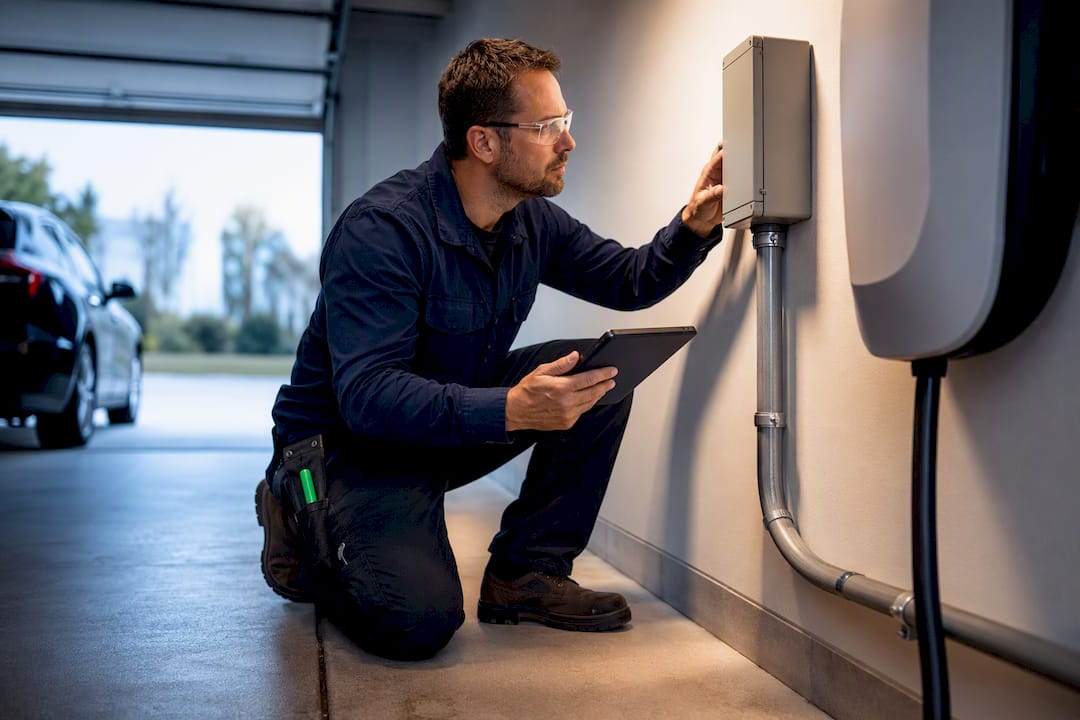
Yes, EV charger installations fall under Canadian electrical and fire codes, and every permanent charger needs a dedicated, code-compliant circuit plus a proper permit before it goes live. You need certified equipment, correct breaker sizing, and an inspection from your local electrical authority. The single best next step: hire a licensed electrical contractor who pulls the permit and arranges inspection before you plug anything in.
TL;DR:
- Every permanent EV charger in Canada requires a dedicated, properly sized circuit, CSA or CSA-equivalent certification, and a permit from a licensed electrical contractor.
- The CSA standards, including CSA C22.2 No. 280 and TS-802, set system-level safety requirements that must be met for all electrical equipment and infrastructure interactions.
- Proper breaker sizing follows the 125% rule based on the charger’s continuous current, with no shared circuits, to prevent heat buildup and fire hazards.
- In Ontario, permits must be obtained through the ESA, and the installation must be inspected and approved before being energized, with proper documentation kept for property and insurance records.
- Regular visual inspections by property managers are recommended after installation, especially in multi-unit or commercial settings, to identify potential fire risks like wear or damage.
Table of Contents
- Fire code ev charger rules: which Canadian standards apply
- Do you need a permit for an EV charger in Ontario?
- Breaker sizing and dedicated circuits: getting the numbers right
- Panel upgrade or smart load management: which one do you need?
- Fire risk in parking garages and multi-unit buildings
- What installers should hand you before you sign off
- A compliant installation from start to finish
- Clearance requirements you can’t skip around your charger
- Garage, outdoor, and condo installations: what changes by location
- Emergency shutoff: what fire code expects from your charger setup
- Materials and wiring practices that actually reduce fire risk
- The hazards that actually cause EV charger fires
- How often does your charger need to be inspected after installation?
- Why code-first installs protect you long after the inspector leaves
- Get a code-compliant EV charger install in the GTA
- Sources
Fire code ev charger rules: which Canadian standards apply
The Canadian Electrical Code (CEC) Part I sets the baseline for every EV charger installed in a home, condo, or commercial garage across the country. It governs wiring methods, overcurrent protection, and how circuits get sized for continuous loads like EV charging.
Layered on top of the CEC are specific CSA Group standards. CSA C22.2 No. 280 covers the construction and safety testing of EV supply equipment itself, the physical charger you mount on the wall. CSA TS-802:24 takes a systems-level view, addressing how chargers, energy management systems, and building electrical infrastructure interact safely, which matters more as buildings add multiple chargers. SPE-343 deals with the interconnection side, particularly relevant for larger installations tied to building management systems.
CSA Group describes this as a systems approach to EV charging and energy management, which is a shift from treating each charger as an isolated appliance.
Equipment needs a recognized certification mark, usually CSA or a body accredited to test to Canadian standards, before an inspector will approve it. International references like IEC standards inform how manufacturers design equipment, but they do not substitute for CEC and CSA compliance in Canada. An imported charger certified only to a European or American standard will not pass an ESA inspection here.
Do you need a permit for an EV charger in Ontario?
Yes. Every permanent EV charger installation in Ontario requires a permit through the Electrical Safety Authority (ESA), and the work must be carried out by or arranged through a Licensed Electrical Contractor (LEC). Skipping this step isn’t a minor paperwork shortcut. It leaves your installation unverified against the Ontario Electrical Safety Code, which becomes a real problem if you ever file an insurance claim.
The typical permit lifecycle looks like this:
- Your LEC submits the permit application to ESA before work begins.
- The contractor completes the installation according to CEC and CSA requirements.
- An ESA inspector reviews the finished work on-site or through a documented inspection process.
- You receive a Certificate of Acceptance confirming the installation passed inspection.
If you own or manage property outside Ontario, the exact permitting authority changes by province, but the pattern holds. Contact your provincial electrical safety regulator or local utility before any permanent installation begins, and confirm whether your municipality layers on additional building permit requirements for garage or parking structure electrical work.
Breaker sizing and dedicated circuits: getting the numbers right
Fire risk in EV charging comes down to heat, and heat comes down to circuits carrying more current than they were built for. That’s why the CEC treats EV charging as a continuous load, meaning current flows for three hours or longer without interruption. Continuous loads get sized at 125% of the equipment’s rated current, not 100%, to leave margin against sustained heating in the wire and breaker.
Here’s how that plays out for common Level 2 chargers:
- A charger rated at 32A continuous draw needs a breaker sized to at least 40A (32 × 1.25 = 40).
- A charger rated at 40A continuous draw needs a 50A breaker.
- A charger rated at 48A continuous draw needs a 60A breaker.
These 40A, 50A, and 60A breaker sizes show up constantly in residential Level 2 installations because they match the output ranges of the most common chargers sold in Canada, a pattern CSA Group’s own guidance on EV standards confirms.
Shared circuits, where an EV charger runs off the same breaker as another appliance, are not acceptable under code. An inspector checking your install will look at wire gauge relative to breaker size, whether conduit is used and properly secured, whether connections are torqued to spec, and whether the overcurrent protection matches the charger’s nameplate rating exactly.
Pro Tip: Check your charger’s nameplate before you assume breaker size. Two chargers that look identical can draw different continuous currents depending on the model year, and that changes your required breaker by a full size.
If you want the full mechanics of how the 125% rule gets applied on inspection day, our breaker sizing guide for home EV chargers walks through the math in more detail.
Panel upgrade or smart load management: which one do you need?
Not every property needs a $3,000 panel upgrade to add a compliant charger. The deciding factor is available capacity. If your existing panel has enough free amperage to support the new circuit without exceeding its rated capacity, a standard Level 2 install works fine. If the math doesn’t leave room, especially in older homes still running 100A service, you’re choosing between a service upgrade to 200A or an EV Energy Management System (EVEMS).
EVEMS software dynamically shares available capacity across multiple loads, throttling charger output in real time so the panel never gets pushed past its limit. That’s not a workaround for code, it’s a code-recognized method of load management that prevents the exact overload conditions that create fire risk in constrained electrical services.
Multi-unit buildings and older single-family homes are where EVEMS earns its keep most often, since installers there are usually trying to avoid the cost and disruption of ripping out and replacing service equipment. Inspectors will still verify that an EVEMS installation meets its own certification requirements and integrates correctly with existing overcurrent protection. Our panel upgrade guide for Ontario homeowners breaks down the signs that point toward a full upgrade versus smart load management as the better fit.
Fire risk in parking garages and multi-unit buildings
EV battery fires behave differently than gasoline fires. Thermal runaway in a lithium-ion battery pack burns longer, reignites unpredictably, and demands far more water for cooling than firefighters use on a conventional vehicle fire. The NFPA’s research on EV fire safety makes clear that enclosed parking structures amplify these challenges because heat and smoke have nowhere to vent quickly.
For property managers running charger clusters in underground or enclosed parking, that translates into concrete planning needs:
- Adequate spacing between charging stalls to limit fire spread between vehicles.
- Ventilation systems sized to handle smoke and heat from a potential battery fire, not just vehicle exhaust.
- Detection and alarm systems integrated with the building’s existing fire safety systems, not bolted on separately.
- Suppression systems where required by the local fire code for the specific occupancy and charger density.
- Clear removal routes so a damaged or overheating vehicle can be relocated away from other parked cars.
If you manage a property adding several chargers at once, commission a site-specific fire risk assessment and loop in your local fire service before installation, not after. Some jurisdictions require this coordination for charger clusters above a certain count. Others recommend it as best practice even when it isn’t strictly mandated.
What installers should hand you before you sign off
A compliant installation leaves a paper trail, and that trail is your protection if anything ever goes wrong. Here’s what to require:
- Confirmation that the installer is handling your ESA permit application directly, not leaving it to you.
- Proof the charger and any energy management equipment carry a recognized CSA certification mark.
- A written specification for the dedicated circuit, including breaker size and wire gauge before work starts.
- Documentation of mounting standards and wiring methods used, including conduit where applicable.
- A commissioning step where the installer tests the charger under load before calling the job done.
Keep the permit, the Certificate of Acceptance, the equipment manuals, and any maintenance schedule in one file. You’ll want it if you ever sell the property, file an insurance claim, or need to prove compliance to a condo board. Our guide to the ESA certificate of acceptance process explains exactly what that document should show.
Pro Tip: If an installer suggests running your charger off an extension cord or an existing outlet “just to test it,” that’s a hard stop. Extension cords aren’t rated for sustained EV charging current, and it’s one of the fastest ways to create a hidden fire hazard behind drywall.
Red flags worth walking away from: no written scope of work, no mention of a permit number, missing certification labels on the equipment itself, or a shared-circuit setup presented as normal.
A compliant installation from start to finish
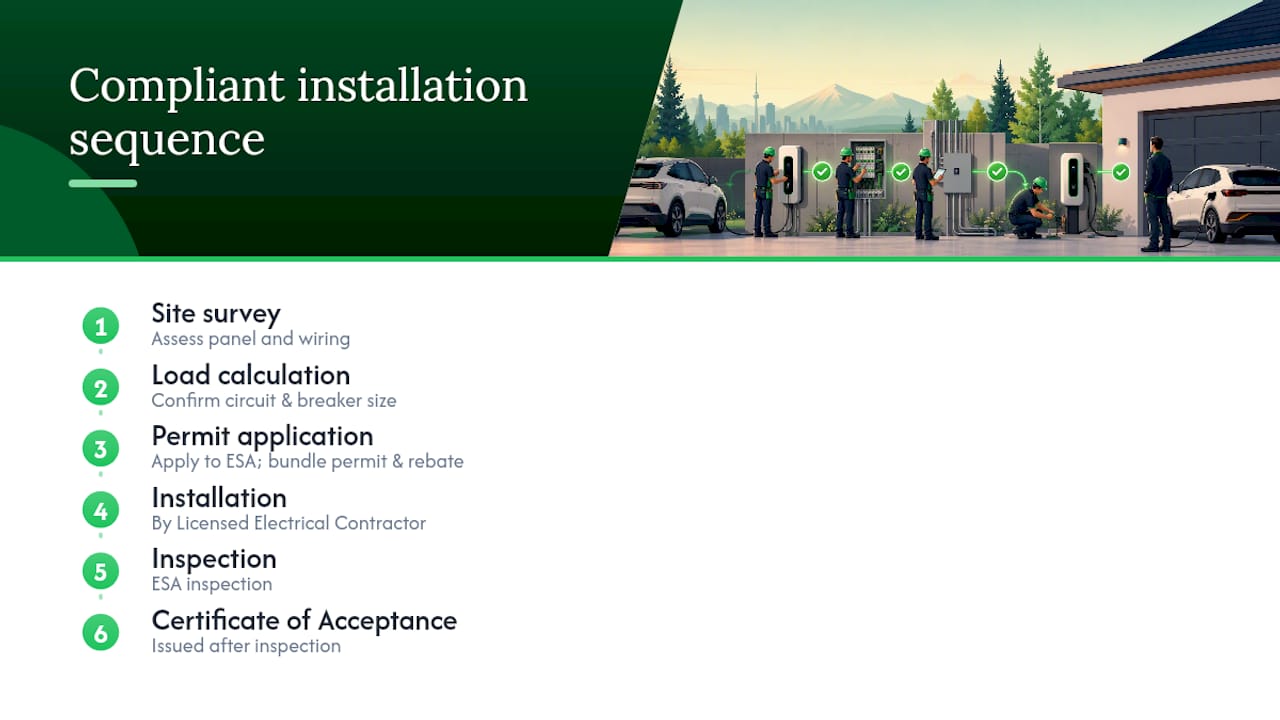
A properly run installation follows a clear sequence: a site survey to assess panel capacity and wiring routes, a load calculation to confirm the circuit and breaker size, permit application through ESA, installation by a Licensed Electrical Contractor, inspection, and issuance of the Certificate of Acceptance. Some installers, including our team at Evchargerinstallationtoronto, bundle permit handling and rebate applications into that same process so property owners aren’t juggling separate paperwork with separate deadlines. That bundling matters because a rebate application often has its own documentation requirements that overlap with what ESA already needs to see, and mismatched paperwork slows both down.
Clearance requirements you can’t skip around your charger
Fire codes and electrical codes both set minimum clearance distances around EV chargers, and these exist for two separate reasons: preventing ignition sources near the equipment, and giving anyone servicing or evacuating the area enough room to move safely. Chargers mounted too close to combustible materials, stored fuel, or cluttered garage shelving create exactly the kind of ignition pathway inspectors are trained to catch.
Practical clearance rules that show up consistently in Canadian residential and commercial installs include keeping the charger and its immediate wall space free of stored combustibles like paint cans, propane tanks, or cardboard. Mounting height needs to keep the connector and cable off the ground to avoid trip hazards and moisture exposure, both of which carry their own electrical risk. Chargers also need clear access space in front of them, not just beside them, so a technician or first responder can reach the unit and its disconnect without climbing over parked equipment or storage bins.
In multi-unit buildings, clearance requirements extend to spacing between adjacent charging stalls. Fire codes in shared parking structures increasingly treat charger density as a factor in overall risk assessment, meaning a wall of ten chargers installed shoulder to shoulder gets scrutinized differently than the same ten chargers spread across a larger footprint with ventilation between them.
None of this is arbitrary. Every clearance figure ties back to either preventing heat buildup near combustibles or ensuring a fire crew can physically access and isolate the equipment during an emergency. A licensed electrician doing the install should flag clearance issues during the site survey, well before the permit gets filed, so you’re not retrofitting a garage layout after the fact.
Garage, outdoor, and condo installations: what changes by location
Fire code requirements shift depending on where the charger physically sits, and property managers overseeing more than one property type need to track these differences carefully.
Attached garage installations are the most common residential scenario, and they carry the strictest scrutiny because a fire in an attached garage has a direct path into living space. Codes here focus heavily on the dedicated circuit requirement, proper conduit protection for wiring run through the garage, and keeping the charger clear of parked vehicle exhaust paths and stored combustibles.
Outdoor installations, common for driveways and open parking areas, introduce weatherproofing requirements on top of the standard electrical rules. The charger enclosure itself needs an appropriate ingress protection rating for outdoor exposure, and wiring run outside needs conduit rated for direct burial or outdoor use depending on the installation method. Outdoor chargers generally carry lower fire consequence than enclosed garage units simply because heat and smoke disperse rather than accumulating, but the equipment still needs to meet the same CSA certification standard.
Multi-unit residential buildings face the most layered requirements. Underground and enclosed parking garages combine limited ventilation with higher charger density, which is why fire departments and building code officials increasingly ask for a site-specific risk assessment before large-scale charger rollouts in condo garages. Condo boards adding chargers building-wide should expect this assessment to shape decisions on charger spacing, detection system upgrades, and whether existing suppression systems need modification. A single-unit owner adding one charger in an assigned condo spot faces a lighter version of the same review, usually handled through the board’s designated electrical contractor.
Emergency shutoff: what fire code expects from your charger setup
Fire code requires a way to cut power to an EV charger quickly during an emergency, without requiring anyone to access the main electrical panel under stress. This usually takes the form of a readily accessible disconnect switch mounted at or near the charging equipment, positioned so a first responder or property manager can kill power to that specific circuit in seconds.
The disconnect needs to be clearly labelled and free of obstruction. A shutoff buried behind storage boxes or hidden in a locked utility closet doesn’t meet the practical intent of the requirement, even if it technically exists somewhere on the property. Inspectors checking for compliance will look at both the presence of the disconnect and whether it’s genuinely reachable.
For multi-unit buildings, emergency shutoff planning extends beyond the individual charger. Building management needs a clear protocol for isolating an entire charger cluster or an affected electrical zone if a fire or suspected battery fault occurs, and that protocol should be shared with local fire services rather than kept as an internal document nobody outside the building knows about. Coordinating that information ahead of time is part of what a site fire risk assessment for larger installations typically covers.
If a vehicle shows signs of thermal runaway, whether from visible smoke, unusual heat, or charger fault codes, the priority is isolating that vehicle’s power connection and clearing the area, not attempting to troubleshoot the charger itself. Fire-safety protocols for damaged or suspected-thermal-runaway EVs generally call for quarantine procedures and direct coordination with fire services for safe removal, since these battery fires can reignite hours after they appear extinguished. Property managers should have this escalation path written down, not improvised in the moment.
Materials and wiring practices that actually reduce fire risk
The materials used in an EV charger installation matter as much as the design specs on paper. Conduit protects wiring from physical damage, moisture, and rodent intrusion, all of which degrade insulation over time and create the conditions for arcing faults. Code-compliant installations route wiring through rigid or flexible conduit rated for the installation environment, whether that’s a dry interior wall or an exposed outdoor run.
Wire insulation rating needs to match both the ampacity of the circuit and the ambient temperature conditions where it’s installed. A wire run through a hot attic space or alongside other heat-generating equipment needs insulation rated to handle that added thermal load without degrading faster than its expected service life. Undersized or improperly rated insulation is a slow-building fire risk that doesn’t show up on day one. It shows up years later as brittle, cracked insulation near a connection point.
Termination quality is where a lot of preventable fires start. Loose connections at the breaker, the charger, or any junction box create resistance, and resistance generates heat. A properly torqued connection, checked against the manufacturer’s specified torque value, is a five-minute step that prevents years of slow heat buildup at that joint. This is one of the areas an ESA inspector will check directly, often with a torque screwdriver at the panel.
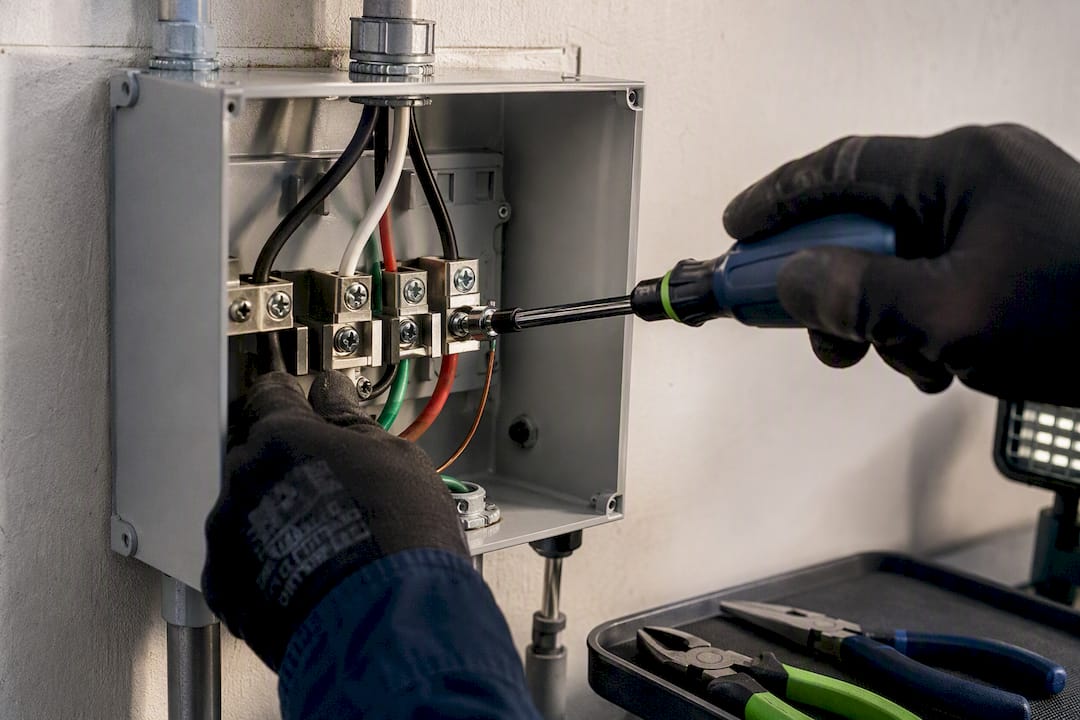
Mounting hardware matters too. A charger secured with the wrong fasteners for the wall material can loosen over time, straining the internal wiring connections every time the charging cable gets plugged in or removed. Proper installation and certified equipment remain the biggest determinants of EV charger safety overall. Improper connectors, poor wiring practices, and DIY shortcuts create far more risk than anything inherent to the vehicle or the charger itself.
The hazards that actually cause EV charger fires
Most EV charger fires trace back to a handful of preventable causes rather than some inherent flaw in EV technology. Overloaded or shared circuits top the list, since a charger drawing continuous current on a circuit already carrying another load pushes wiring past its safe operating temperature. This is exactly what the dedicated-circuit requirement and the 125% continuous-load rule exist to prevent.
Loose or corroded connections are the second major hazard, developing gradually at breaker terminals, charger connections, or junction boxes until resistance heating eventually ignites nearby insulation or combustible material. Regular visual inspection catches this before it becomes dangerous, which is one reason a maintenance plan matters as much as the initial install.
Improper or uncertified equipment introduces risk that a licensed installer’s process is specifically designed to screen out. A charger without a CSA certification mark hasn’t been tested against Canadian safety standards for things like overcurrent protection, thermal cutoffs, and ground fault detection, all of which are built into certified units.
Water intrusion in outdoor or garage installations can degrade wiring and connections over time, particularly in installations where conduit wasn’t properly sealed at entry points. DIY installations attempting to save on electrician costs are consistently the highest-risk category, since they skip the load calculation, permit, and inspection steps that catch these problems before the charger is ever energized. Mitigation across all of these hazards comes down to the same short list: certified equipment, a dedicated properly sized circuit, professional installation, and periodic inspection.
How often does your charger need to be inspected after installation?
The mandatory inspection happens once, at the point of installation, when ESA or your provincial equivalent reviews the work and issues the Certificate of Acceptance. That’s the legally required checkpoint, and it’s non-negotiable for any permanent installation.
Beyond that initial inspection, fire code doesn’t typically mandate a fixed recurring inspection schedule for a single residential charger the way it does for something like a commercial fire suppression system. That said, property managers overseeing multiple chargers, particularly in condo or commercial parking structures, should build periodic visual inspection into their regular building maintenance cycle. Checking for signs of connector wear, cable damage, loose mounting, or discoloration around electrical connections on an annual basis catches degradation long before it becomes a fire hazard.
Any time a charger is serviced, moved, or connected to a new energy management system, that work should trigger its own inspection and, in most cases, its own permit. Treating an EVEMS retrofit or a charger relocation as a minor tweak that doesn’t need sign-off is a common mistake that leaves a building’s compliance record incomplete. Insurance providers reviewing a claim after any electrical incident will ask for that documentation, and a gap in the paper trail becomes the property owner’s problem to explain, not the insurer’s.
Why code-first installs protect you long after the inspector leaves
The mistake I see most often isn’t bad equipment, it’s owners treating the permit and inspection as optional friction rather than the point of the process. A charger that works fine on day one tells you nothing about whether it was sized correctly for continuous load.
Property managers should insist on licensed installers and keep every permit and inspection document on file. That paperwork is what protects you when an insurer asks hard questions after any electrical incident, whether it involves the charger or not.
— Hafiz
Get a code-compliant EV charger install in the GTA
A licensed electrical contractor offering fully permitted, code-compliant charger installations can simplify the process in the Greater Toronto Area by handling ESA paperwork, rebate applications, and electrical work together. The process can include handling permit applications, installation, inspection booking, and rebate paperwork for eligible new EV purchases, offered with transparent pricing starting from $1,800.
If your panel is older or already tight on capacity, we’ll assess whether smart load management gets you a compliant install without a full service upgrade. And if you’re still deciding whether to apply for your own permit or hand it off, our ESA permit service covers that end-to-end at no extra charge on top of your installation. Start with a free estimate through our cost calculator to see what a compliant install looks like for your property, and book your site survey this week.
Sources
- Electric Vehicles & Charging Systems - ESA
- Standards for battery electric vehicle charging and energy management - CSA Group
- Electric Vehicle Safety Information - NFPA
Recommended
Get Your Free Installation Quote
Free assessment · ESA permit included · Same-week availability across the GTA