Charge a 60 kWh EV for $4.56: Ontario Home Rates and Install Costs
Charging at home overnight on the right rate plan is almost always the cheapest way to power an EV in Ontario. Public Level 2 and DC fast chargers cost several times more per kWh than a well-timed home charge. The rest comes down to picking the right electricity plan, sizing your installation correctly, and claiming the rebates you’re entitled to.
TL;DR:
- Charging at home overnight on the appropriate rate plan, especially ultra-low overnight rates, typically remains the cheapest option for Ontario EV owners.
- Most EV owners can save significantly by charging during off-peak or overnight hours instead of using public chargers, which can be up to ten times more expensive per kWh.
- Selecting the right plan, such as ULO if shifting most household consumption overnight, can reduce total costs far more than public charging choices.
- Installing a Level 2 home charger generally costs around $1,800 in Ontario, with costs varying based on panel capacity, distance, and permit requirements.
- Owners should utilize rebates, load management, and scheduling habits like charging after 11 p.m. to optimize savings on their EV charging costs.
Table of Contents
- What are Ontario’s EV charging rates for home electricity plans?
- How much does public EV charging cost in Ontario?
- How do you calculate your actual EV charging cost?
- What does home EV charger installation cost in Ontario?
- How do Ontario rebates and the OEB EVC rate affect your costs?
- What actually lowers your EV charging bill in Ontario?
- What I’ve seen work for GTA homeowners
- Get a same-week EV charger installation quote in the GTA
- Sources
What are Ontario’s EV charging rates for home electricity plans?
Your electricity plan determines your EV charging costs more than any other single decision. Ontario offers three residential pricing structures, and most EV owners find their home rate plan matters more than which public network they choose.
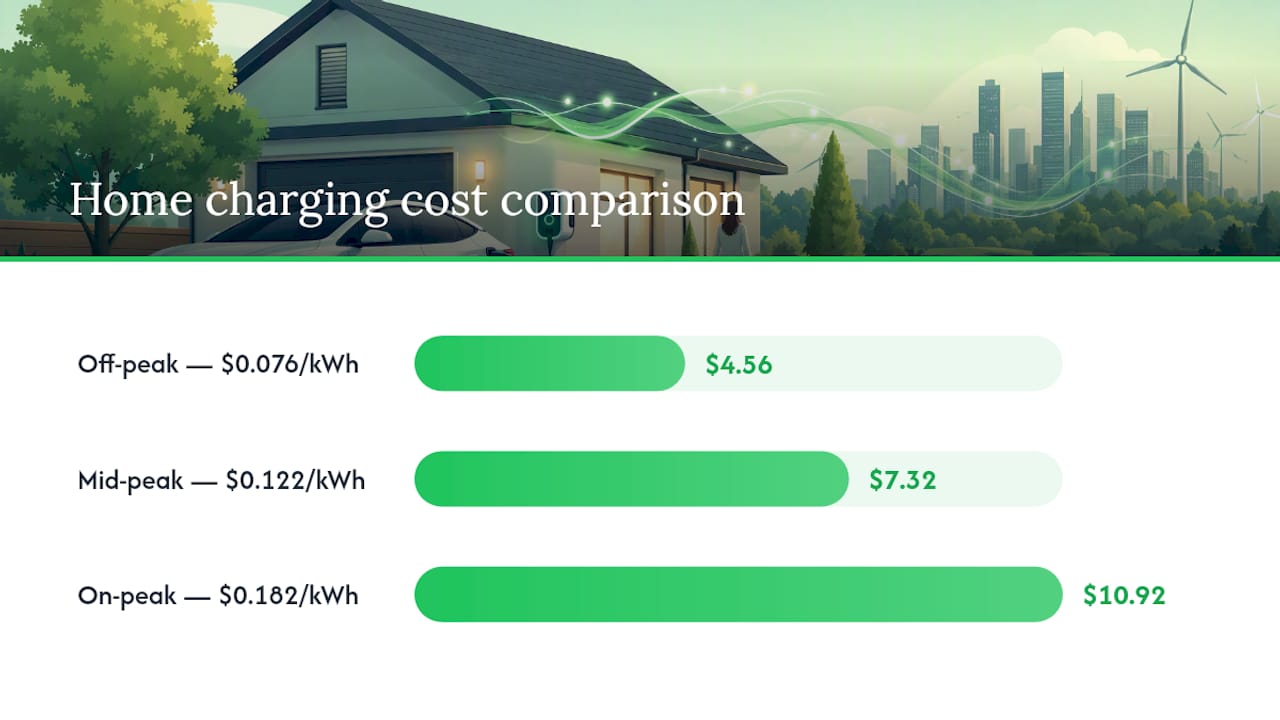
Time-of-Use (TOU) pricing splits the day into off-peak, mid-peak, and on-peak bands, with off-peak running around $0.076/kWh, mid-peak near $0.122/kWh, and on-peak reaching roughly $0.182/kWh. Charge a 60 kWh battery from empty to full during off-peak hours and you’re looking at roughly $4.56 for the electricity alone, versus nearly $11 at on-peak rates.
Ultra-Low Overnight (ULO) pricing pushes that gap even further. Overnight rates on ULO have been reported as low as $0.028 to $0.039/kWh, but daytime rates climb sharply to compensate. ULO only pays off if you can shift the bulk of your household load, laundry, dishwasher, EV, into the overnight window.
Tiered pricing works differently: a flat rate applies until your household crosses a monthly consumption threshold, after which every kWh costs more. An EV added to a tiered account often pushes the household into the higher tier well before the billing month ends.
- Off-peak TOU: best for households that charge most nights but still need daytime flexibility
- ULO: best for households that can genuinely shift most consumption overnight
- Tiered: worth avoiding for EV owners unless usage is already low
Ontario data point: most EV owners do more than 90% of their charging at home, so the plan you pick affects your total cost far more than public charger choices.
How much does public EV charging cost in Ontario?
Public charging exists for convenience, not for daily fuelling, and the price reflects that. Level 2 public stations in Canada average around $0.35 to $0.45 per kWh, while DC fast (Level 3) chargers often run $0.60 to $0.80 or more per kWh. That’s up to ten times what you’d pay charging overnight at home on ULO.
Billing models matter too. Some networks charge per kWh, others charge per minute, and a per-minute rate can quietly cost you more if your vehicle’s charging speed tapers as the battery fills.
- Many Level 2 chargers at malls, hotels, and municipal lots are free or low-cost as a customer perk
- DC fast chargers rarely offer free sessions, and idle fees can apply if you linger after charging finishes
- Membership programs sometimes shave a few cents off per-kWh pricing but rarely beat home overnight rates
- Natural Resources Canada’s charging registry and network apps show real-time pricing before you plug in
Treat public charging as a tool for road trips and top-ups, not a replacement for home charging.
How do you calculate your actual EV charging cost?
The math is simpler than most drivers expect, and it works for any EV once you know three numbers: usable battery size, the percentage you’re adding, and your rate per kWh.
- Find kWh added. Multiply usable battery capacity by the percentage of charge you’re adding. A 60 kWh battery going from 10% to 80% adds 42 kWh (60 x 0.70).
- Add charging losses. Home and public charging both lose roughly 10% to heat and conversion. Divide by 0.90, so 42 kWh needed becomes about 46.7 kWh drawn from the grid or charger.
- Multiply by your rate. Apply your actual per-kWh price, whether that’s ULO overnight, TOU off-peak, or a public network’s posted rate.
The cost-per-100-km figures assume roughly 6 kWh per 100 km, a reasonable midsize EV average. The spread between ULO and DC fast on the same 42 kWh top-up is substantial, which adds up fast if you’re charging several times a week.
What does home EV charger installation cost in Ontario?
Installed Level 2 home charger costs in Ontario commonly start around $1,800 for straightforward installs, where the electrical panel already has capacity and the run from panel to parking spot is short. Costs climb from there depending on a few predictable factors.
- Distance from the panel to the charger location (longer conduit runs mean more labour)
- Whether the home’s panel has spare capacity or needs a 200A upgrade
- Condo or multi-unit approval requirements, which add time but not always cost
- Permit and inspection fees, though a good installer folds these into one process
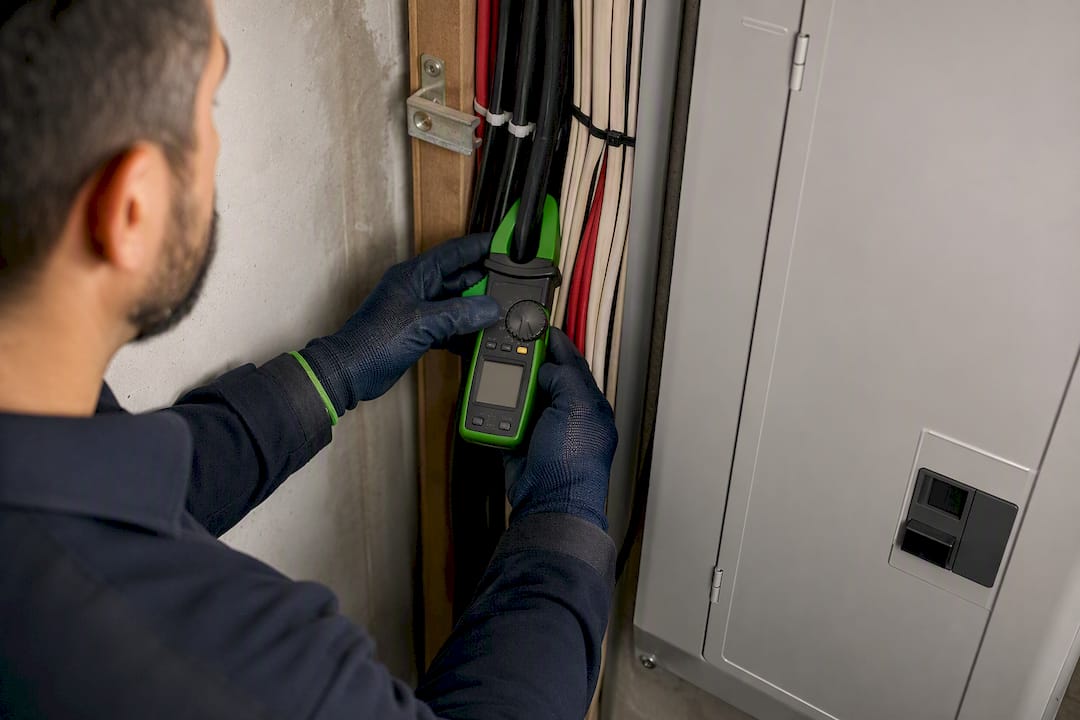
Older Ontario homes frequently need a panel upgrade for a straightforward Level 2 install. The alternative is a smart load management device like EVEMS or DCC-12, which manages simultaneous loads so you can skip the panel upgrade entirely in many cases.
Pro Tip: Ask your installer to check panel capacity before quoting. A five-minute load calculation can save you a $2,000+ panel upgrade if smart load management is a viable alternative.
How do Ontario rebates and the OEB EVC rate affect your costs?
Ontario runs two separate policy levers that affect EV charging costs, and homeowners often confuse them. Only one applies to your household.
- ChargeON reimburses eligible public charging infrastructure projects with post-construction rebates, typically covering a portion of eligible costs, helping to expand the province’s public network. This program targets businesses and property owners building public stations, not residential installs.
- NRCan maintains the country’s most reliable reference point for public charging price trends, useful if you want to track how public rates shift over time.
- The OEB’s EVC Rate applies a 0.17 parameter so eligible commercial DC fast charging stations pay just 17% of the Retail Transmission Service Rate that other commercial customers pay. Eligibility requires at least one DCFC unit plus specific load-factor and demand-band criteria.
- Homeowners and condo unit owners do not receive the EVC discount on residential electricity bills. It’s a commercial-operator mechanism designed to accelerate public DC fast charger rollout, and over time it should ease pressure on the price you pay at public stations.
What actually lowers your EV charging bill in Ontario?
Small scheduling habits save more money than any charger network switch. A few tactics consistently make the biggest difference for GTA drivers:
- Set your EV’s charging schedule to start after 11 p.m. if you’re on TOU off-peak, or align with ULO overnight hours if that’s your plan
- Use free or discounted Level 2 chargers at work or while running errands, and save DC fast charging for actual road trips
- Get a load calculation before assuming you need a panel upgrade. Smart load management often costs less
- Check ChargeON and any municipal rebate programs before starting installation work, not after
Pro Tip: Most utility apps let you set charge-start delays right from your vehicle’s own app, no smart plug required. If your EV supports scheduled charging, use it before spending money on anything else.
What I’ve seen work for GTA homeowners
Most homeowners I hear about get one thing right immediately: they switch to overnight charging within the first month and never look back. The savings are obvious once you see the first bill.
Where people run into trouble is skipping the licensed side of the job. A properly permitted installation with rebate paperwork handled up front avoids the delays and surprise costs that come from cutting corners on inspections.
— Hafiz
Get a same-week EV charger installation quote in the GTA
A practical alternative to piecing together your own electrician, permit applications, and rebate paperwork separately is to use a service that provides installations completed by licensed electricians, with transparent pricing, permit handling and inspections included, and rebate support for programs on new EV purchases.
Booking options can offer relatively quick scheduling and the process may include handling everything from straightforward Level 2 installs and panel upgrades to smart load management setups, along with rebate applications that DIY installs often miss.
If you want real numbers before committing to anything, run your address and vehicle through the free EV charger installation cost calculator to get a same-week estimate.
Sources
- Electric vehicle charging – Costs of EV charging | Natural Resources Canada
- Ontario
- EVC Rate - frequently asked questions | Ontario Energy Board (OEB)
- Thinkev
Recommended
Get Your Free Installation Quote
Free assessment · ESA permit included · Same-week availability across the GTA