Install a Condo EV Charger in 4–12 Weeks With Board Ready Documents
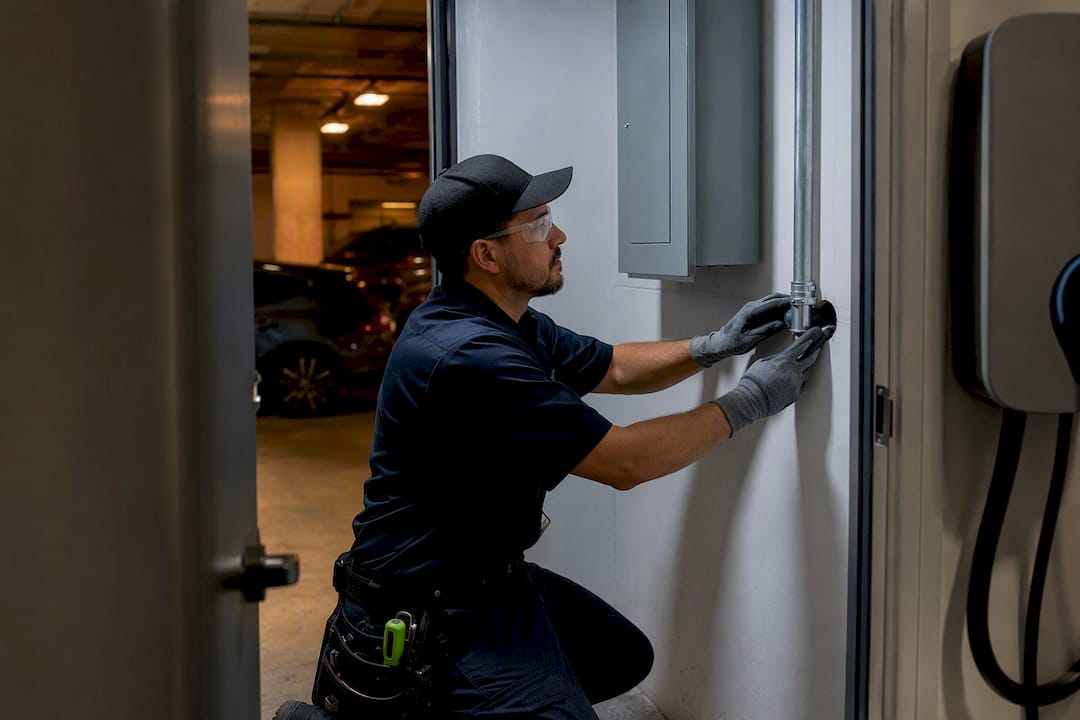
Yes, you can almost always get EV charging installed at your condo stall, but the timeline and cost depend entirely on your building’s meter access and spare electrical capacity. Your first move isn’t calling an electrician. It’s walking to your stall and checking whether there’s an outlet nearby and where the closest electrical panel or meter room sits.
TL;DR:
- Most condo buildings require a survey of electrical capacity, proximity to panels, and physical barriers before submitting a formal EV charger request.
- Approvals depend on province-specific processes, with Ontario and B.C. implementing clear timelines and reporting requirements that influence how quickly boards respond.
- The typical single-stall Level 2 charger costs between 2,000 and 5,000 CAD, but building-wide retrofits can reduce costs by up to 50 percent through shared wiring and trenching.
- Funding options like government rebates and utility incentives can cover a significant portion of installation costs when included upfront in proposals.
- Engaging licensed installers early and planning for future expansion can prevent costly panel upgrades and streamline approval processes.
Table of Contents
- How to survey your stall and building’s electrical system
- What condo boards and provincial law require for approval
- Charger and wiring options for condo garages
- What EV charging actually costs, and how to fund it
- Step-by-step: from stall survey to commissioned charger
- What to expect from a certified installer
- The gap between condo board advice and condo board reality
- Get your condo charger installed without managing the paperwork yourself
- Where to verify the rules before you submit anything
- Sources
- FAQ
How to survey your stall and building’s electrical system
Before you write a single word of a board proposal, gather the facts an electrician or engineer will actually need. Boards approve projects faster when the owner shows up with data instead of a request.
Start with these checks:
- Locate the nearest electrical panel or meter room and note how far it is from your stall in metres.
- Check whether your stall already has a 120V outlet or a 240V receptacle, such as a NEMA 14-50, which many Canadian garages install for block heaters.
- Confirm whether the panel serving your area has spare breaker capacity, or whether it’s already maxed out.
- Note any physical barriers between the panel and your stall, including concrete walls, structural slabs, or fire-rated partitions that raise conduit-run costs.
- Ask your property manager whether the building has ever had a load study done.
If your building has never assessed its total electrical capacity against how many EV chargers it could realistically support, that’s the point where a formal Electrical Planning Report earns its cost. It’s the same document B.C. now expects strata corporations to request, and it gives Ontario boards the technical backbone they need to approve or decline a request with confidence rather than guesswork.
What condo boards and provincial law require for approval
Boards can’t simply ignore an EV charging request anymore, and the rules differ by province in ways that change how you build your case.
In Ontario, the Condominium Authority of Ontario’s guidance sets out a structured process: owners submit a written request, and the board has defined timelines to respond, approve, or provide reasons for refusal rather than sitting on it indefinitely. In British Columbia, amendments to the Strata Property Act introduced Electrical Planning Report requirements and firm deadlines strata councils must meet when an owner requests EV infrastructure.
A few factors shape how smoothly your request moves through either process:
- Voting thresholds vary depending on whether the work is classified as a “significant change” or routine maintenance.
- Reserve fund health matters. Boards weigh whether a project draws down reserves meant for other repairs.
- “Material reduction” tests in some provinces protect other owners from losing amenity or access because of your installation.
- A complete application package (feasibility quote, funding sources identified, and a short owner interest survey) moves faster than a bare request letter.
Charger and wiring options for condo garages
Not every stall needs the same setup, and picking the wrong one either wastes money or under-delivers on charging speed. Here’s how the main options stack up:
- Level 1 (120V): Uses a standard outlet already common in some stalls. It adds roughly 5 to 8 kilometres of range per hour, which is fine for low-mileage drivers but too slow for daily commuters.
- Portable Level 2 with a NEMA 14-50 outlet: A practical middle ground if your stall already has a 240V receptacle for a block heater. Charging speed improves dramatically, and the unit can move with you if you sell the condo.
- Hardwired Level 2: The most common long-term solution. Costs more upfront but delivers consistent charging and can be wired direct-to-meter, which puts electricity charges on your own utility bill instead of a building-managed rate.
- Communal chargers with shared circuits: Buildings increasingly use EV energy management systems to let multiple stalls share one high-amp circuit, avoiding a costly service upgrade while still supporting several vehicles.
Networked chargers add app-based billing and remote diagnostics but come with subscription fees; non-networked units are cheaper and simpler but rely on the direct-to-meter approach for fair billing.
What EV charging actually costs, and how to fund it
A single-stall Level 2 install commonly runs $2,000 to $5,000 CAD, according to ThinkEV’s 2026 condo charging guide, with Level 1 setups sometimes landing under $1,000 when a usable outlet already exists. The spread comes down to wiring distance, whether panel capacity needs upgrading, and whether trenching through a concrete garage floor is involved.
The bigger lever is timing. Plug’n Drive’s research found that building-wide retrofits can cut the average per-stall cost by up to 50% compared with approving installs one owner at a time, because shared trenching, conduit, and panel work spread across many stalls instead of one.
Funding can close much of that gap:
- Natural Resources Canada’s Zero Emission Vehicle Infrastructure Program has funded multi-unit residential projects, and Charge-at-Home’s guidance notes it has historically covered a substantial portion of eligible infrastructure costs.
- BC Hydro and CleanBC Go Electric offer rebates aimed at multi-unit buildings in British Columbia.
- Ontario utilities periodically run incentive programs for EV-ready infrastructure, worth checking before you finalize a budget.
Presenting these funding sources up front in your proposal, before the board asks about cost, is one of the more effective ways to shift a hesitant board toward approval.
Step-by-step: from stall survey to commissioned charger
- Gather your stall and building facts. Use the checklist above so you’re not guessing when someone asks about panel distance or spare capacity.
- Form a committee and survey interest. Buildings that successfully add EV infrastructure almost always start by polling owners to gauge real demand before spending money on quotes.
- Request quotes, and an Electrical Planning Report if your building’s capacity is unclear. This is where an ESA-licensed electrician or professional engineer gets involved.
- Submit a formal application that names your funding sources and attaches the feasibility quote.
- Get permits, schedule the work, then inspect and commission the charger with your utility and your electrician.
Pro Tip: Ask your property manager and electrician early who else needs to sign off, since utility representatives sometimes require notice before a service upgrade, and skipping that step can add weeks to your timeline.
Expect four to twelve weeks from application to commissioning for a single stall, longer if a panel upgrade or trenching is involved. The most common blockers are underestimated panel capacity and boards that stall on cost before funding sources are on the table.
What to expect from a certified installer
A licensed installer should walk in already speaking the language your board needs to hear: permits, load calculations, and inspection sign-off.
Some installation companies work with ESA-licensed electricians who handle installations for both single-family homes and multi-unit condo buildings, with same-week booking sometimes available. Transparent pricing may start around mid-range amounts, and some teams manage permits, inspections, and rebate applications for qualifying new EV purchases at no extra charge, which can help reduce administrative work for owners dealing with board proposals.
A few things worth confirming with any installer you hire:
- ESA licensing status, since Ontario requires it for any electrical work tied to permits.
- Whether permit and inspection costs are included or billed separately.
- Whether rebate paperwork is handled for you or left to the owner.
- Turnaround time from signed quote to commissioned charger.
The gap between condo board advice and condo board reality
Most guidance on this topic treats board approval as a paperwork problem: fill out the form, cite the law, wait. That undersells how much boards actually respond to funding clarity and precedent. A board that has never approved an EV request treats the first application as a legal risk. A board that has already approved two treats the fifth as routine.
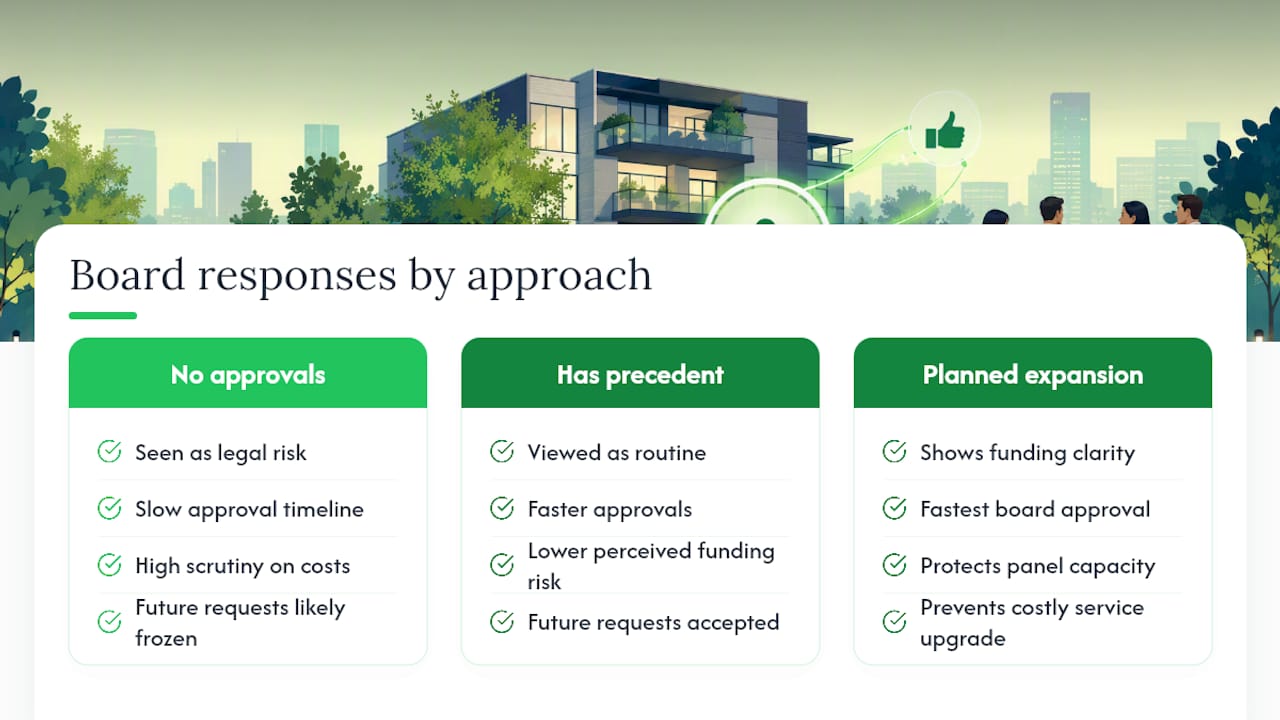
The advice that gets skipped most often is planning for expansion before installing a single charger. Plug’n Drive’s own analysis warns that uncoordinated, one-off installs eat spare panel capacity fast, and once it’s gone, boards freeze further requests until an expensive service upgrade gets approved. That’s the scenario every early applicant should be trying to prevent, not just for themselves, but for the fifteen owners who’ll want charging in three years.
If you take one thing from this, prioritize the building-wide feasibility conversation over your individual stall request. A board that sees a five-year plan approves faster than one reacting to a single ask.
— Hafiz
Get your condo charger installed without managing the paperwork yourself
Evchargerinstallationtoronto is the practical alternative to piecing this project together stall by stall. Instead of chasing quotes, permit applications, and rebate forms separately, you get one ESA-licensed team that handles the feasibility check, the wiring, the ESA permit, and the rebate paperwork worth up to $5,000 under one transparent quote starting from $1,800.
If you’re still at the stage of comparing wiring options for your building, our guide on condo and apartment EV charger installation in Toronto walks through board-approval-friendly designs in more detail. For a quick sense of what your specific stall might cost, run the numbers through our cost estimate calculator before you finalize your board proposal, and check our Ontario rebates page so your application already includes the funding sources that move boards toward yes.
Where to verify the rules before you submit anything
- NRCan’s ZEVIP program confirms federal funding rules and application windows for multi-unit buildings.
- Charge-at-Home’s toolkit covers EV-ready planning and EVEMS design.
- CAO’s guidance sets out Ontario owner rights and board timelines.
- BC Hydro and CleanBC publish current provincial rebate details for strata buildings.
If your project involves cutting or patching the garage floor for conduit runs, parking garage sealing specifications are worth reviewing so the repair doesn’t compromise the structure’s waterproofing.
Sources
- Plug’n Drive publications
- Charge at Home toolkit (Charge-at-Home)
- Condominium Authority of Ontario — Electric vehicle charging systems
- ThinkEV — EV charging condo/apartment guide (2026)
FAQ
How do I charge an EV if I live in a condo?
Most condo owners charge through a Level 2 charger installed at their assigned stall, wired either to a dedicated circuit or direct-to-meter, after getting board approval and a licensed electrician to complete the work.
Can I install an EV charger at a condominium without board approval?
No. Ontario and B.C. both require a formal application through your condo board or strata council, though provincial rules now set response timelines so boards can’t ignore the request indefinitely.
Do I have to pay for parking while my EV charges?
Parking fees are separate from charging costs. If your charger is wired direct-to-meter, electricity use appears on your own utility bill rather than through a building-managed rate.
Which condos in Toronto already have EV charging?
Coverage varies widely by building age and prior board decisions. CBC’s reporting on condo EV charging profiles buildings that wired every stall EV-ready during a garage retrofit, a model more Toronto buildings are adopting as demand grows.
Recommended
Get Your Free Installation Quote
Free assessment · ESA permit included · Same-week availability across the GTA